

Navigating Emotional Challenges in Recovery: A Proactive Coaching Guide

What if the overwhelming 'rawness' you feel right now isn't a sign of failure, but proof that you are finally waking up? When you stop using substances to numb out, the world suddenly feels incredibly loud and sharp. You might find yourself navigating emotional challenges in recovery that feel like they are coming out of nowhere, from sudden bursts of anger to a deep sense of social anxiety while standing in an Australian pub full of people. It's a vulnerable place to be, and it's completely normal to feel a bit lost without your old shield.
I know that feeling of being exposed because I've been there too. This guide isn't about clinical theories; it's about practical, lived-experience strategies that help you regain your sense of agency. You'll learn how to transform these intense emotions from obstacles into tools for growth. We'll look at how to stabilize your internal world and handle high-pressure social situations with confidence, moving you toward a life that feels vibrant and truly liberated. Your journey isn't just about stopping a habit; it is about starting a powerful new chapter where you are in control.
Key Takeaways
Understand why your feelings are so sharp right now and how to transition from early euphoria to a sustainable emotional reality.
Master the "Pause, Pivot, Proceed" technique to stop feeling overwhelmed and start taking proactive action in real-time.
Gain tactical strategies for navigating emotional challenges in recovery during high-pressure Australian social events like weekend BBQs or pub sessions.
Deconstruct the myth that intense feelings lead to relapse and learn how to sit with discomfort without it turning into an emergency.
Discover how a coaching framework focused on future-state action provides a direct shortcut to building trust and emotional stability.
Table of Contents
The Raw Reality: Why Emotions Feel Intense in Early Recovery
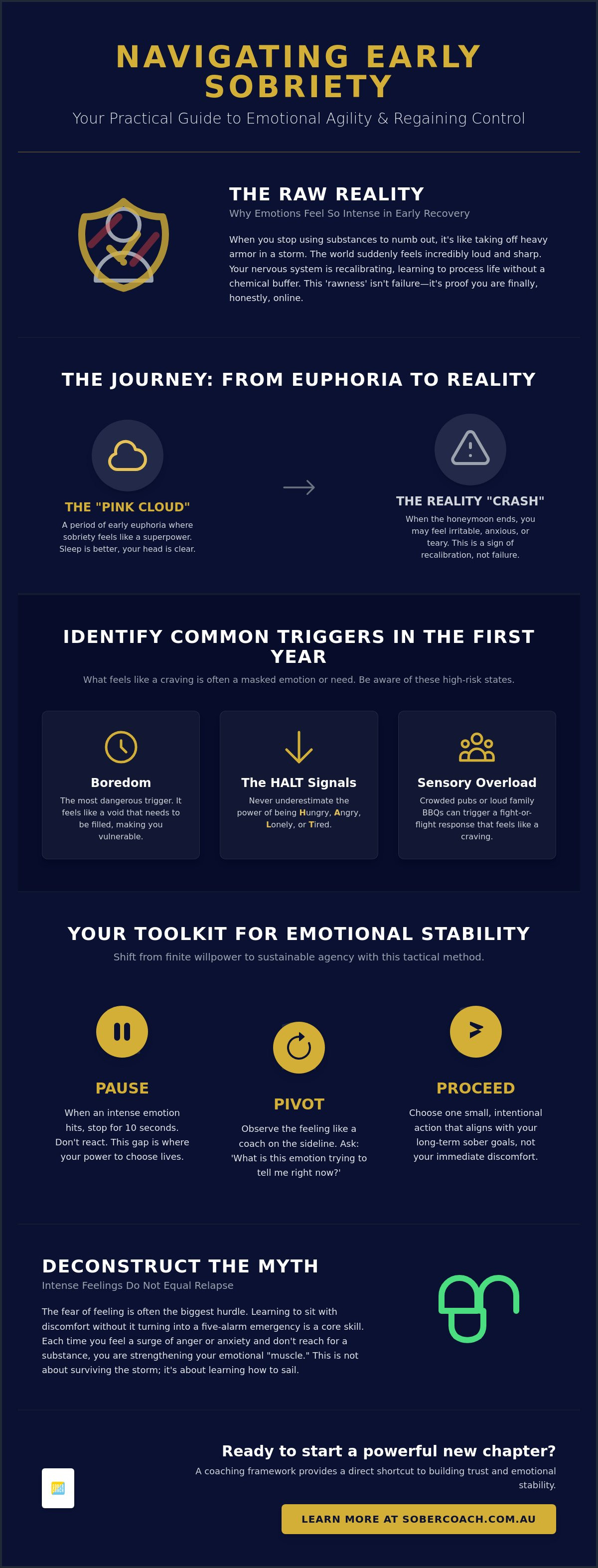
Removing the chemical buffer of alcohol or substances is like taking off a heavy suit of armor in the middle of a storm. Suddenly, everything is louder, sharper, and more demanding. This is the "Raw State." For years, you might have used a substance to dial down the volume of your life. Without it, your nervous system is essentially learning to hear for the first time again. Navigating emotional challenges in recovery isn't about fixing something that's broken; it's about learning to manage a system that is finally, honestly, online.
Many people start their journey on the "Pink Cloud," a period of early euphoria where sobriety feels like a superpower. You're sleeping better, your head is clear, and the world looks bright. But the cloud eventually dissipates. When the honeymoon phase ends, the "crash" into emotional reality can feel like a relapse in spirit. You might feel irritable, teary, or inexplicably anxious. This isn't a sign that you're failing. It's a sign that your brain is doing the hard work of recalibration. Traditional coping mechanisms often fall short here because they focus on just "getting through" the day. You need a proactive toolkit that treats these feelings as data, not as emergencies.
The Science of the Unmasked Mind
Long-term numbing effectively puts your amygdala, the brain's fear center, into a deep sleep. When you stop, it wakes up in a state of high alert. This often leads to emotional dysregulation, where your responses don't quite match the situation at hand. In 2026, we define emotional flooding as a natural neurobiological recalibration where the brain's alarm system fires without a filter. The key is learning the difference between feeling an emotion and becoming the emotion. You can feel anger without being an "angry person."
Common Emotional Triggers in the First Year
In the first twelve months, your brain will play tricks on you. What feels like a desperate craving for a drink is often just masked social anxiety or a need for connection. Identifying these "phantom" cravings is a core part of navigating emotional challenges in recovery. Watch out for these high-risk states:
Boredom: This is often the most dangerous trigger because it feels like a void that needs filling.
The HALT Signals: Never underestimate the power of being Hungry, Angry, Lonely, or Tired.
Sensory Overload: Crowded Australian pubs or loud family gatherings can trigger a fight-or-flight response that feels like a craving.
You aren't doing it wrong if you feel overwhelmed. You're finally feeling it right. This rawness is the price of admission for a life that is truly yours.
Emotional Agility: A Coaching Framework for Stability
Willpower is a finite resource that eventually runs dry. If you rely solely on grit to white-knuckle your way through a bad day, you're setting yourself up for exhaustion. Real stability comes from agency, the conscious ability to choose your response rather than reacting on autopilot. Navigating emotional challenges in recovery requires a shift from suppression to observation. Think of it as adopting a "Coach's Mindset." Instead of being the person drowning in the wave, you become the person on the shore watching the tide come in and out. You aren't judging the water; you're just measuring it.
This isn't just a mindset shift; it's backed by science. A recent systematic review and meta-analysis highlights that difficulties in emotion regulation are a primary driver of substance use disorders. By learning to sit with discomfort without treating it like a five-alarm fire, you build resilience through incremental exposure. Each time you feel a surge of anger and don't reach for a drink, you're strengthening your emotional "muscle." Navigating emotional challenges in recovery becomes less about surviving the storm and more about learning how to sail.
The 'Pause, Pivot, Proceed' Method
In the heat of a moment, you need a tactical tool that works. The 'Pause, Pivot, Proceed' method creates a circuit breaker in your brain. First, you Pause for 10 seconds. This gap is where your power lives. Next, you Pivot. Ask yourself: 'What is this emotion trying to tell me right now?' Finally, you Proceed by choosing one small action that aligns with your long-term sober goals. This simple process moves you from a state of panic to a state of agency.
Developing Your 'Emotional Vocabulary'
Vague feelings are harder to manage. Identifying that you feel "restless" rather than "anxious" changes the solution. Naming a feeling reduces its power. Use journaling as a tactical debrief rather than just a diary entry. If you're wondering what does a psychosocial recovery coach do, it's this. We provide the frameworks to decode your internal world. If you're ready to move faster, One-on-One Recovery Coaching can help you build your toolkit.
Navigating the 'Sober Social' Landscape in Australia
Australia has a unique relationship with alcohol that can make sobriety feel like a social rebellion. Whether it's a Sunday session at a Sydney pub or a backyard BBQ in Melbourne, the pressure to have a drink in your hand is palpable. In a culture where 64.9% of adults consumed alcohol in the year leading up to September 2025, being the one with the soda water can feel like standing under a spotlight. Navigating emotional challenges in recovery in this environment requires more than just willpower. It requires a tactical plan for when the "Tall Poppy" syndrome kicks in. Sometimes, your choice to stay sober makes others uncomfortable with their own habits. They might poke fun or push "just one" on you. It's important to remember that their reaction is about them, not your progress.
You don't owe anyone a medical history. When the inevitable "Why aren't you drinking?" question comes up, keep your response short and direct. "I'm not drinking tonight" or "I'm focusing on my health" are complete sentences. You aren't being a buzzkill; you are simply choosing a different path. Distinguishing between "drinking buddies" who only value you when there's a glass in your hand and true friends who support your growth is a vital part of protecting your new life.
The Australian 'Shout' and Social Anxiety
The "shout" is a cornerstone of Australian social life, but it's a significant hurdle for early recovery. The internal pressure to fit in and "buy your round" can be crushing. When you are navigating emotional challenges in recovery, having a pre-planned response to the 'shout' is a game changer. If the noise gets too loud or the temptation feels too heavy, use an Exit Strategy. Give yourself permission to leave after 20 minutes if you aren't feeling comfortable. There's no shame in protecting your peace. You can also explore sober activities in Sydney that don't revolve around a tap, helping you build a social life that actually supports your goals.
Rebuilding Trust and Relationships
Socializing with family brings a different set of hurdles. The "guilt-shame" cycle often resurfaces during holiday dinners or reunions. You might feel like you're constantly on trial, waiting for others to trust you again. It's frustrating, but you can't rush their healing. Stay emotionally steady by focusing on your current actions rather than past mistakes. Learning how to rebuild trust with family during recovery is a slow process built on consistent, sober behavior. Your agency is your best defense against the weight of the past. Focus on who you are becoming today, not who you were yesterday.
Overcoming the #1 Hurdle: The Fear of Feeling
The biggest myth in sobriety is that feeling bad is a sign that you're doing something wrong. Many people believe that intense emotions are a direct precursor to relapse, but the truth is the opposite. It's the fear of the feeling, and the subsequent urge to escape it, that creates the danger. Navigating emotional challenges in recovery means learning to sit with discomfort without treating it like an emergency. When you stop running, you realize that while feelings are powerful, they aren't fatal. They are simply waves of energy passing through you.
I often talk about the difference between "clean" and "dirty" pain. Clean pain is the natural sadness, anger, or fear that comes with being human. It's the grief of a lost relationship or the frustration of a difficult day. Dirty pain is the layer of shame or judgment you add on top of it. It's the voice that says, "I shouldn't feel this way" or "I'm weak for being sad." By stripping away the dirty pain, you make the clean pain much easier to process. Sometimes, the best way to move that energy is through your body. Go for a run, punch a bag, or just walk around the block. Movement gives that emotional energy somewhere to go so it doesn't stay trapped in your chest.
Reframing Discomfort as Growth
Feeling "off" or emotionally raw is often evidence that your brain is healing correctly. You're finally processing years of suppressed experiences. Emotional pain is a temporary state, not a permanent identity. When a wave hits, use the 15-Minute Rule. Commit to sitting with the feeling for just fifteen minutes without acting on it. Most emotional peaks are short-lived, and if you can outlast the surge, the intensity will naturally drop. You're proving to yourself that you are capable of handling high-stakes feelings without a chemical crutch.
Tools for the 'Emergency' Emotional State
If you feel yourself spiraling into panic or a "danger zone," you need immediate grounding. Use the 5-4-3-2-1 technique: name five things you see, four you can touch, three you hear, two you can smell, and one you can taste. This pulls your brain out of the emotional future and back into the physical present. While these tools are great for daily maintenance, some deep-seated patterns require more focus. Intensive Recovery Workshops are designed to help you build that deep resilience in a supportive environment. If you find the line between a normal struggle and a crisis is getting blurry, it's time to reach out. You don't have to figure this out alone. Explore our One-on-One Recovery Coaching to get direct, lived-experience support for your journey.
The Sober Coach Advantage: Beyond Clinical Support
Clinical support has its place, but there is a specific kind of trust that only comes from someone who has walked the path themselves. When you are navigating emotional challenges in recovery, you don't just need a diagnosis; you need a strategy. Lived experience acts as a shortcut. It strips away the clinical coldness and replaces it with a human-to-human connection that says, "I know exactly why you're feeling this way, and here is how we move through it." This shared history builds immediate credibility and reduces the anxiety often felt when seeking help for personal habits.
While therapy often focuses on deconstructing the past, coaching is unapologetically focused on your future-state. We don't just talk about why you feel anxious; we build the tactical tools you need to handle that anxiety when it hits at 3:00 PM on a Tuesday. This proactive approach is what helps you maintain agency. It's about moving from a state of being "managed" by your feelings to a state of thriving despite them. In the 'messy middle' of emotional growth, having an accountability partner who understands the nuances of habit change is the difference between spinning your wheels and making real progress. Navigating emotional challenges in recovery is a skill, and like any skill, it improves with the right guidance and consistent practice.
Personalized Support for Every Stage
One-on-One Recovery Coaching allows us to tailor emotional strategies specifically to your life triggers, whether they are professional or personal. If the environment itself is the hurdle, In-Home Recovery Support provides a way to manage triggers exactly where they happen. For those who need flexibility or community from across the country, our Rehab online options offer professional guidance and group coaching via Zoom without the need to travel. Every person’s journey is distinct, and your support should be too.
Your Next Steps to Emotional Liberation
Waiting for the "right time" to start is one of the most common emotional traps. It's a form of procrastination that keeps you stuck in the cycle of "raw" feelings without a plan. Your first session isn't about being perfect; it's about being honest. We move past the labels and the stigma to focus on what life looks like when you are finally liberated from the weight of old habits. You've spent enough time surviving. It's time to start thriving. Book a One-on-One Session with Sober Coach today to begin your proactive journey toward emotional stability and a vibrant, sober life.
Claim Your Emotional Agency
You've moved past the idea that sobriety is just about stopping a habit. It's actually about starting a life where you are finally in the driver's seat. By understanding that your raw feelings are a sign of healing and using tactical tools like the Pause, Pivot, Proceed method, you've already begun the work. Navigating emotional challenges in recovery doesn't have to be a solo mission or a clinical struggle. It is a proactive choice to build a toolkit that works in the real world, from the office to the local pub.
At Sober Coach, we provide non-judgmental, agency-focused coaching rooted in lived experience. We understand the specific pressures of the Australian social scene because we've lived through them too. Whether you need flexible online support or in-person sessions in Sydney, Melbourne, or Brisbane, we are here to help you move from surviving to thriving. You don't have to wait for the perfect moment to feel better. Take control of your emotional journey. Book a Sober Coach session today. Your most vibrant, liberated life is waiting for you to step into it.
Frequently Asked Questions
Is it normal to feel more depressed after I stop drinking?
Yes, feeling a dip in mood is a standard part of the brain’s recalibration process after years of chemical numbing. When you remove alcohol, your dopamine levels don't immediately return to baseline, which can lead to a period of flat or low mood. It’s a temporary phase of your journey, not a permanent state of being. We focus on building small, daily wins to jumpstart your natural reward system.
How do I handle sudden bursts of anger in early sobriety?
Sudden anger is often just your unmasked mind reacting to stress without its old shield. Instead of judging the rage, use it as data. Ask yourself if you are actually hungry, tired, or feeling exposed. We use tactical tools to create a gap between the feeling and the reaction. This ensures you don't blow up your life while you are navigating emotional challenges in recovery.
What is the difference between a recovery coach and a therapist for emotional support?
Therapists typically focus on diagnosing and healing past trauma through a clinical lens. Recovery coaching is different because it is future-oriented and action-based. We focus on the "how" rather than just the "why." By using lived experience, a coach provides a direct, peer-to-peer connection that helps you build a practical toolkit for your current, daily life.
Can NDIS funding be used for psychosocial recovery coaching in Sydney?
Yes, NDIS funding can often be used for psychosocial recovery coaching if your plan includes specific support for mental health or behavioral challenges. In Sydney and across Australia, these funds are designed to help you build capacity and independence in your daily life. You should check your current plan goals or speak with your Local Area Coordinator to see how coaching fits into your funding.
How do I deal with social anxiety at events where everyone is drinking?
Social anxiety is a natural response when you lose your old social lubricant. The best way to handle it is to have a solid exit strategy and a non-alcoholic drink already in your hand. You don't have to stay the whole night. Commit to twenty minutes and leave if the pressure feels too high. Protecting your peace is more important than being the last person at the BBQ.
What should I do if I feel like an emotional relapse is coming?
If you feel a spiral starting, the most important thing is to break the isolation immediately. Reach out to your coach or a trusted peer who understands the journey. Use grounding techniques like the 5-4-3-2-1 method to bring your focus back to the present moment. An emotional relapse is a signal that your current toolkit needs an upgrade, not a sign that you have failed.
How long do the intense 'raw' emotions usually last in recovery?
The most intense raw state usually begins to stabilize between three and six months as your nervous system recalibrates. However, everyone’s timeline is unique. While the initial flooding of feelings can be overwhelming, it eventually gives way to a more manageable baseline. Navigating emotional challenges in recovery becomes significantly easier as you practice your regulation tools and build new, healthier neural pathways.
Are online recovery workshops as effective as in-person sessions for emotional work?
Online workshops are highly effective because they allow you to access professional guidance from the safety and comfort of your own home. They provide a sense of community with others across Australia who are facing similar hurdles. While in-person sessions offer a different type of energy, the tactical tools and deep emotional work we do online are just as impactful for building long-term resilience.
Comments