

How to Have Fun Without Drinking: A Guide to Rediscovering Genuine Joy in 2026

What if your social life didn't need a chemical kickstart to feel meaningful? As of June 2026, half of all Australians have taken a conscious break from alcohol, proving that the search for a clearer way of living is now the mainstream choice. Learning how to have fun without drinking is no longer a niche pursuit for the "boring" few. It is a radical act of reclaiming your natural high and stepping into a more authentic version of yourself.
It is common to feel like everything looks a bit grey when you first step away from the bar. You might fear being the outsider or worry that social anxiety will swallow you whole without a glass in hand. We know that heavy feeling of losing your identity within your friend group or fearing you have become a buzzkill. This guide is your roadmap to rewiring your brain for high-definition joy, helping you build a vibrant life where alcohol is no longer the guest of honour.
We'll explore how to handle social pressure with ease, find hobbies that spark real excitement, and finally feel normal without a drink in your hand.
Key Takeaways
Understand the science of your brain's dopamine reset and why early sobriety feels dull before the high-definition joy returns.
Master the practical toolkit for socialising, including why you should never wing it when learning how to have fun without drinking.
Shift from passive leisure to active Australian adventures that provide a genuine, natural adrenaline rush without the hangover.
Overcome social anxiety by dismantling the Spotlight Effect and gaining the confidence to be yourself in any crowd.
Discover how professional coaching bridges the gap between simply quitting and designing a vibrant, intentional life you actually love.
Table of Contents
The 'Sobriety is Boring' Myth: Understanding Your Brain’s Dopamine Reset
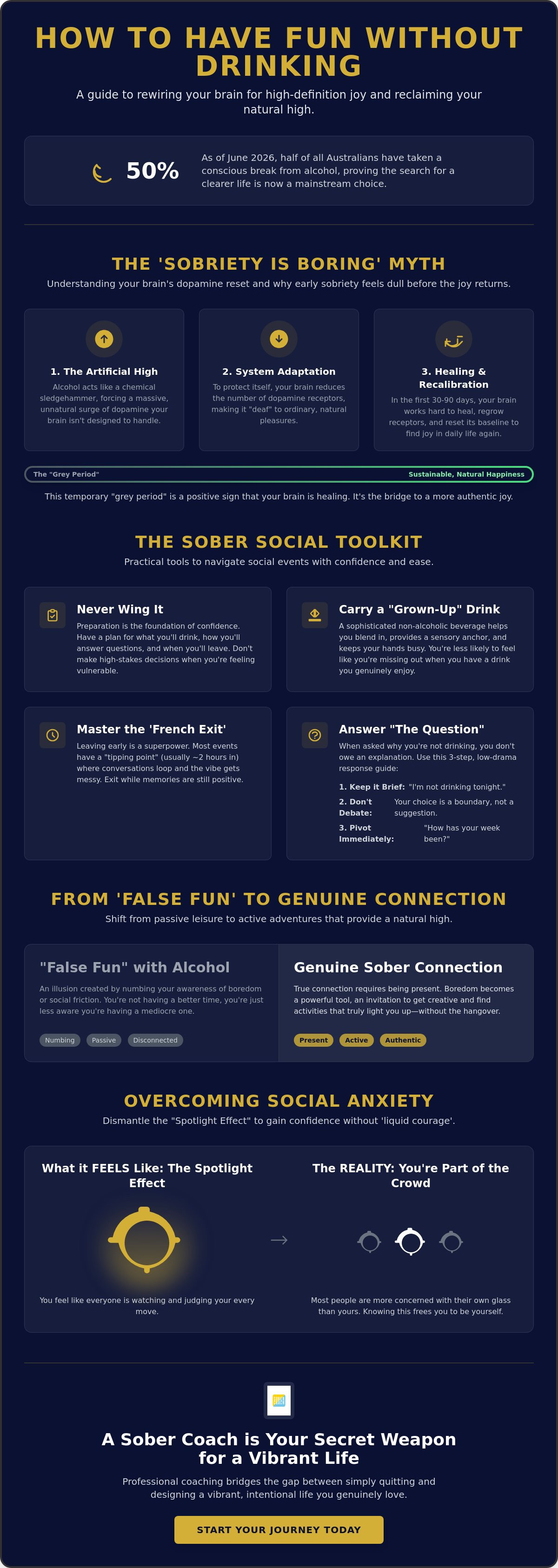
If you've recently stepped away from alcohol, you might feel like someone has turned the world's saturation slider all the way down. This grey, flat feeling is known as anhedonia. It is a common experience where things that used to be exciting now feel dull or pointless. You aren't losing your personality, and you haven't forgotten how to be happy. Your brain is simply in the middle of a major chemical recalibration.
The biological culprit here is dopamine. Alcohol acts like a chemical sledgehammer on your reward system, forcing a massive surge of dopamine that your brain simply wasn't designed to handle on a regular basis. To protect itself, your brain reduces the number of available dopamine receptors. When you stop drinking, you're left with a nervous system that is temporarily "deaf" to ordinary pleasures. Many people struggle with how to have fun without drinking because their internal reward system has been temporarily recalibrated to only respond to extreme, artificial spikes.
The good news is that your brain is incredibly plastic. It has a remarkable ability to heal and grow new pathways. Embracing Sobriety isn't about entering a permanent state of deprivation; it's about allowing those dopamine receptors to grow back. Discovering how to have fun without drinking is actually a process of biological healing, not just a test of willpower. Sober joy is the physiological return to a baseline state where your brain can once again find genuine pleasure in the natural rhythms of daily life.
The Dopamine Baseline: Why You Feel Flat Initially
Expect a "grey period" during the first 30 to 90 days. During this time, your brain is working hard to reset its dopamine baseline. If life feels boring right now, take it as a positive sign. It means the "noise" of artificial stimulation is finally quieting down so your system can start hearing the "music" of real life again. This phase is temporary, and it's a necessary bridge to a more sustainable, natural happiness.
Identifying 'False Fun' vs. Genuine Connection
Alcohol creates an illusion of fun by numbing your awareness of boredom or social friction. You aren't actually having a better time; you're just less aware that you're having a mediocre one. True connection requires being present, which alcohol actively prevents. When you stop numbing yourself, boredom becomes a powerful tool. It is an invitation to get creative, try something new, and find activities that actually light you up rather than just helping you "get through" the night.
How to Have Fun Without Drinking: The Sober Social Toolkit
Walking into a party sober for the first time can feel like you have forgotten the lyrics to a song everyone else is singing. Don't wing it. Preparation is the foundation of confidence. Having a plan for how to have fun without drinking means you aren't making high-stakes decisions when you're already feeling vulnerable. You need a strategy that protects your peace while allowing you to stay connected to your community.
One of the best tools is the "grown-up" non-alcoholic drink. With the rise of sophisticated non-alcoholic beverages in late 2025, you don't have to settle for a lukewarm glass of orange juice. Holding a glass helps you blend in and provides a sensory anchor. It allows you to socialize without alcohol while keeping your hands busy and your mind sharp. When you have a drink you actually enjoy, you're less likely to feel like you're missing out.
When someone asks the inevitable "Why aren't you drinking?" question, remember that you don't owe anyone a medical history. Use this simple three-step guide to keep things low-drama:
Keep it brief: Use a firm, neutral statement like "I'm not drinking tonight" or "I've realized I feel much better without it."
Don't invite debate: Your choice is a boundary, not a suggestion. You don't need to justify your health decisions.
Pivot immediately: Ask them a question about their week or the music. Most people are more concerned with their own glass than yours.
The Art of the 'French Exit' and Time Management
Leaving early is a superpower, not a failure. There is a specific tipping point, usually about two hours into an event, where the conversation begins to loop and the volume rises. This is when the "fun" becomes messy. Recognizing this moment allows you to exit while the memories are still positive. To reinforce this choice, schedule a "post-party" reward for yourself, like a favorite dessert or a late-night movie. If you find these transitions difficult to navigate alone, connecting with a recovery mentor can provide the personalized support you need to stay on track.
Navigating Australian Pub Culture as a Non-Drinker
Australian mateship is often built around a "round" of beers, and with 64.9% of adults still drinking as of late 2025, the pressure can feel immense. However, a June 2026 report found that 50% of Australians have consciously taken a break from alcohol in the past year. You aren't as alone as you think. Suggest neutral ground like a coastal walk or a bowling alley. If the pub is unavoidable, focus on being the person who organizes the pool game or the trivia. You can be the life of the party without being the drunk one by focusing on the "doing" rather than the "drinking."
Redefining Leisure: Australian Activities That Don’t Need a Drink
For many, "fun" has become synonymous with sitting at a bar. This is passive leisure. You're consuming, not creating. To truly master how to have fun without drinking, you need to switch to active leisure. This means engaging your body and mind in a way that generates its own excitement. In Australia, we are spoiled for choice. Whether it's catching a sunrise surf at dawn or tackling a challenging bushwalk in the Blue Mountains, these activities offer a physical high that alcohol can't touch. You're trading a fuzzy, temporary buzz for a clear, lasting sense of accomplishment.
Flow state is the ultimate sober alternative to intoxication. It's that psychological sweet spot where you're so deeply immersed in a task that the rest of the world fades away. Unlike the blurry, disconnected "high" of alcohol, flow state makes you feel more alive and more capable. It's a natural release of dopamine and endorphins triggered by challenge and mastery. When you find an activity that puts you in flow, you aren't just passing time. You're thriving. You are fully present in your own life, which is a far more powerful experience than any chemical escape.
Sydney & Beyond: Sober Things to Do in Your Backyard
Sydney's culture is shifting rapidly. The morning is the new evening. Coastal walks from Bondi to Coogee are packed with people reclaiming their weekends before the rest of the world has even woken up. We're also seeing a massive rise in alcohol-free bars and sober-curious pop-ups across the country. If you're looking for expert tips on going out without drinking, start by looking for events that focus on the experience rather than the menu. Weekend trips are now about the destination, the hike, or the gallery, rather than how well the mini-bar is stocked.
Building a 'Sober Tribe' and Finding New Communities
You don't have to do this in a vacuum. Finding a "sober tribe" is one of the most effective ways to sustain your new lifestyle. This isn't about sitting in a circle talking about what you've lost. It's about joining hobby-based groups where alcohol simply isn't the point. Whether it's a local run club, a pottery class, or a gaming group, these communities provide the peer support needed to rewrite your social calendar. Connecting with Online Recovery Communities can help you find like-minded Australians who are also discovering how to have fun without drinking. It's about building a life where you don't need an escape because you're actually enjoying the reality you've created.
Overcoming Social Anxiety Without 'Liquid Courage'
"I'm just too shy to talk to people sober." This is the most common barrier people face when learning how to have fun without drinking. We have been conditioned to believe that confidence comes in a glass, but that "liquid courage" is actually just a chemical mask. It doesn't give you confidence; it simply numbs your ability to care that you're being awkward. Real social ease is a skill you can build, and it starts with dismantling the Spotlight Effect. This is the psychological phenomenon where we overestimate how much others are noticing our flaws. In reality, most people at a party are far too worried about their own social standing to track what is in your hand.
When social anxiety spikes, you need practical tools to stay grounded. If you feel the familiar tightening in your chest, try the 5-4-3-2-1 technique. Acknowledge five things you see, four you can touch, three you hear, two you smell, and one you can taste. This pulls your brain out of a future-focused panic and back into the present moment. Authentic sobriety is not about becoming a different person; it is about finally meeting the person you were always meant to be without the chemical filter.
Cognitive Reframing: You Are Not 'Losing' Anything
Change your internal narrative from "I can't drink" to "I don't have to drink." The first feels like a punishment, while the second feels like a promotion. When you feel a pang of FOMO, visualise the "Day After." While others are waking up with a dry mouth and a sense of shame, you will wake up with a clear head and a full memory of the night. You can also adopt the "Observer Role." There is a quiet power in watching the room's energy shift as the night goes on, enjoying the chaos without being swept up in the mess of it.
Why You’re Actually More Interesting When You're Sober
The "funny drunk" is largely a myth. Alcohol makes people repetitive and less capable of reading social cues. When you're sober, your wit is sharper and your stories are more coherent. You build genuine rapport because you are actually listening, not just waiting for your turn to speak. There is a deep, unshakeable confidence that comes from knowing you are in total control of your words and actions. If you're ready to move beyond the fear and start designing a life that feels good from the inside out, one-on-one recovery coaching can help you navigate these social hurdles with ease.
Why a Sober Coach is Your Secret Weapon for a Vibrant Life
Quitting alcohol is only the first step of the journey. The real challenge lies in designing a life you don't want to escape from. This is where many people get stuck. They know they want to change, but they don't know how to have fun without drinking in a culture that seems obsessed with the bottle. One-on-One Recovery Coaching serves as a premium tool for this exact transformation. It moves you beyond the baseline of "not drinking" and into the high-performance territory of intentional living. You aren't just surviving; you're mastering a new way of being.
Professional coaching bridges the critical gap between clinical recovery and real-world enjoyment. It provides the high-level accountability needed to stay the course when the initial novelty wears off and social pressure ramps up. You aren't just following a generic plan or a set of restrictive labels. You're working with a mentor to build a bespoke lifestyle that prioritises genuine joy over temporary sedation. This is a proactive, goal-oriented approach that distinguishes itself from traditional medical frameworks by focusing on your potential rather than your past mistakes.
From Survival to Mastery: The Coaching Framework
We focus on setting goals that actually excite you. If your new hobbies feel like chores, you'll eventually drift back to what's easy. Mastery means identifying the specific triggers in your Australian lifestyle, whether it's the Friday afternoon office drinks or the Sunday session at the local surf club. We look at your habits with a direct, no-nonsense lens to see what's serving you and what's holding you back. For those who need a more immersive approach, In-Home Recovery Support offers a way to integrate these changes seamlessly into your daily environment. It's about building resilience exactly where you live, work, and play.
Taking the Next Step with Sober Coach Australia
Our Intensive Recovery Workshops are designed to provide deep emotional toolkits for navigating the complexities of a sober life. You'll work with mentors who possess lived experience. They "get" the Aussie social scene because they've walked the path themselves. They understand the nuances of mateship and the subtle pressures of our drinking culture. This shared history builds immediate trust and credibility, stripping away the anonymity of typical services to offer a human-to-human connection that feels brave and transparent.
Learning how to have fun without drinking is a powerful beginning, not an end point. It is a path to self-discovery that allows you to reclaim your agency and find strength in your own choices. Ready to rediscover your joy? Book a session with a Sober Coach today and start building the vibrant, liberated life you deserve.
Reclaiming Your Natural High
Sobriety is not a life of missing out; it's a life of finally showing up. You've learned that the initial grey period is just your brain healing and that true leisure is found in active participation, not just passive consumption. Understanding how to have fun without drinking is about more than just surviving a Saturday night. It's about rewiring your nervous system for a version of joy that doesn't require a chemical kickstart or a morning of regret.
You don't have to navigate the complexities of the Australian social scene alone. We offer professional recovery coaching tailored to Australians, delivered by lived-experience mentors who understand the unique social pressures we face. With flexible online and in-person support options, you can move from simply quitting to truly thriving. Start your journey to a vibrant, sober life with a professional Sober Coach. Your future is waiting, and it is far more colourful than you ever imagined.
Frequently Asked Questions
Is it possible to have a social life without drinking in Australia?
Yes, it's absolutely possible to maintain a vibrant social life. While Australia has a reputation for heavy drinking, the shift toward wellness is real. You can still hit the beach, attend footy matches, and go to gigs. The difference is that you'll actually remember the highlights. You'll find your social circle might shift toward people who value connection over consumption, which leads to much more fulfilling relationships.
How do I deal with friends who keep pressuring me to drink?
Start by being direct and unapologetic about your choice. If a friend pressures you, it's often more about their own relationship with alcohol than yours. Use a firm "No thanks, I'm sticking to this" and change the subject. If the pressure is relentless, it might be time to evaluate if that environment serves your new goals. You deserve a tribe that supports your growth, not one that holds you back.
What are the best non-alcoholic drinks to order at a pub?
Look for alcohol-free spirits, kombucha on tap, or ginger beer with fresh mint. Most modern Australian pubs have moved beyond just offering sugary soft drinks. Ordering a soda, lime, and bitters is a classic choice that feels social but keeps you clear-headed. Having a drink you actually enjoy makes it much easier to stay involved in the conversation without feeling like you're missing out on the ritual.
Will the 'boredom' of early sobriety ever go away?
The boredom is a temporary phase while your brain resets its reward system. It usually begins to fade after the first few months as your dopamine receptors become more sensitive to natural pleasures. You'll eventually find that a sunset or a great meal provides a more satisfying hit than a glass of wine ever did. Learning how to have fun without drinking is a skill that gets easier with every sober experience.
How can I tell people I'm not drinking without it being awkward?
Confidence is the key to avoiding awkwardness. Treat your decision as a casual, positive fact rather than a heavy secret. You might say, "I'm on a health kick" or "I'm loving the extra energy I have without it." When you don't act like it's a big deal, others won't either. Most people are too focused on their own night to spend much time questioning your glass.
What are some fun sober date ideas in Sydney?
Sydney is perfect for dates that don't involve a pub. Consider a sunrise hike at West Head, a round of putt-putt at Holey Moley, or a visit to the night markets. Taking a pottery class or visiting an escape room provides a shared challenge that builds much more rapport than a standard dinner and drinks. These active dates help you see your partner's true personality in a high-definition, sober light.
Can a Sober Coach help me if I'm not an 'alcoholic' but just want to stop?
Absolutely, coaching is a proactive tool for anyone wanting to reclaim their agency. We reject restrictive labels and focus on where you want to go, not where you've been. Many of our clients don't identify with traditional recovery models but simply want to learn how to have fun without drinking. A coach provides the professional guidance and lived experience to help you bridge that gap and design a life you love.
What should I do if I feel a panic attack coming on at a party?
Step away from the noise and find a quiet spot to ground yourself. Remind yourself that you're safe and that the feeling will pass. If the environment feels too overwhelming, use your exit strategy and head home. There is no shame in prioritising your peace. Having a pre-planned plan is a vital part of your sober toolkit, ensuring you never feel trapped in a high-pressure social situation.
Comments