

Managing Social Anxiety Without Alcohol: A Practical Guide to Genuine Confidence
- angie391
- 1 day ago
- 13 min read

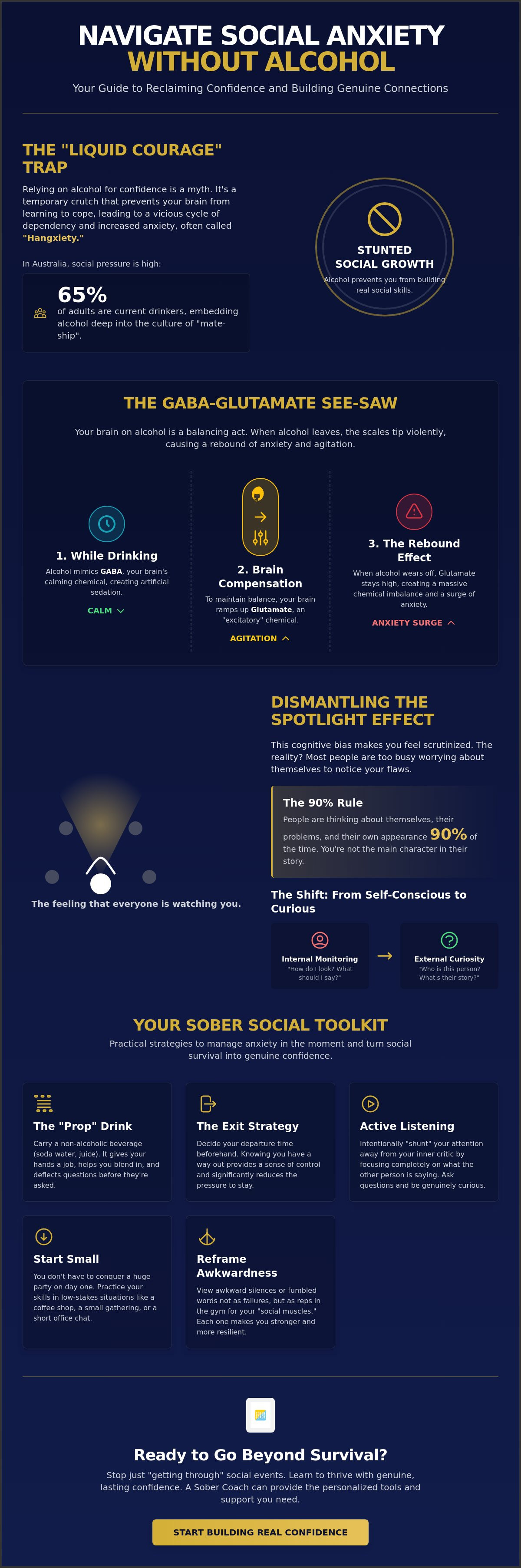
That "liquid courage" you're relying on isn't actually building your confidence; it's just putting your personal growth on a permanent pause. You know the feeling of standing in a crowded pub or a backyard BBQ, heart racing and palms sweating, reaching for a cold one just to feel "normal." It's exhausting to handle the pressure of Australian drinking culture when your internal monologue is screaming that you're boring or awkward. Managing social anxiety without alcohol feels like a tall order when nearly 65% of Australian adults are drinking, and the "mate-ship" culture often revolves around the next round.
We understand that the fear of being the "quiet one" is real, but you don't have to choose between isolation and a hangover. You can learn to walk into any room with a sense of calm and clarity that doesn't evaporate once the buzz wears off. This guide will show you how to replace temporary crutches with sustainable psychological tools. We'll explore practical ways to handle physical panic, engage in meaningful conversations, and finally wake up without the crushing weight of post-event rumination or social regret. It's time to discover a version of yourself that's naturally vibrant and truly liberated.
Key Takeaways
Master the art of managing social anxiety without alcohol by understanding why your brain overcompensates for "liquid courage" with even more panic later.
Learn to dismantle the "Spotlight Effect" so you can stop feeling like every flaw is being scrutinized by the room.
Build a practical toolkit for Australian events, including the psychological safety of an exit strategy and the simple power of a non-alcoholic "prop" drink.
Discover how to navigate office drinks and weekend BBQs with a clear head, turning social survival into genuine, vibrant confidence.
Table of Contents
The Liquid Courage Myth: Why Alcohol Makes Social Anxiety Worse
The idea that alcohol is a social lubricant is one of the most pervasive lies in our culture. We've been told for decades that a glass of wine or a cold beer is the only way to "take the edge off" and fit in. In reality, alcohol is a thief. It steals your ability to develop genuine confidence and leaves you more vulnerable to panic than when you started. By choosing the path of managing social anxiety without alcohol, you aren't just quitting a substance; you're reclaiming your power to actually exist in a room without a mask.
When you use alcohol to mask the symptoms of Social Anxiety Disorder, you enter a cycle of social avoidance. Your brain never learns that the party isn't actually a threat. Because you "survived" the event while drinking, your brain gives the credit to the booze, not to you. This prevents habituation, the natural process where your nervous system calms down after repeated exposure to a stressor. You're stuck in the "hangxiety" loop. This is where the shame of the morning after, characterized by checking your sent texts and ruminating on your behavior, fuels the anxiety of the next event. It's a self-perpetuating trap that keeps you dependent on a chemical crutch.
The GABA-Glutamate See-saw
Alcohol is a sedative that mimics GABA, the primary chemical your brain uses to slow things down. When you drink, your brain senses this artificial surge of calm and tries to maintain balance by amping up your "excitatory" chemicals, specifically glutamate. It's like a see-saw. When the alcohol leaves your system, the GABA side drops, but the glutamate side stays high. This creates a biological debt you pay back with interest at 3 AM. The rebound effect is the physiological backlash where the brain's attempt to counter alcohol's sedation results in a surge of chemical agitation and heightened anxiety.
Stunted Social Growth
If you started using liquid courage to navigate parties at eighteen, your social development likely stalled right there. You haven't had to learn how to handle a lull in conversation or how to introduce yourself to a stranger with a clear head. We often talk about "emotional age" in recovery; socialising sober feels like being a teenager again at first because you're finally learning the skills you bypassed years ago. Reframing the "awkwardness" as a necessary growth phase is vital. It's not a permanent character flaw. You're simply building the social muscles that have been atrophied for years, and that process takes time and practice.
The Mechanics of Sober Socialising: Understanding the Spotlight Effect
We've all been there. You walk into a room and suddenly feel like every eye is on you. You're convinced people are noticing your slightly sweaty palms or the way you stumbled over a greeting. This is the Spotlight Effect. It's a cognitive bias that makes us believe we're the center of everyone's attention. When you're managing social anxiety without alcohol, this sensation can feel overwhelming at first. Alcohol usually "fixes" this by dulling your senses, creating a foggy barrier that makes you feel invisible. But that's an illusion. It doesn't make you blend in; it just makes you stop caring that you don't.
Genuine confidence requires a different approach. It's about leveraging neuroplasticity. Your brain is incredibly adaptable. By repeatedly showing up without a drink, you're teaching your nervous system that social situations aren't life-threatening. This isn't about clinical therapy; it's about real-world practice. You can find excellent resources on how to manage social anxiety without alcohol that highlight the importance of shifting your perspective from your own internal panic to the world around you. Moving from internal monitoring (how do I look?) to external curiosity (who is this person?) changes the entire chemistry of the interaction.
Dismantling the Internal Critic
Your internal monologue is often your own worst enemy. To shut it down, try "shunting." This means intentionally moving your attention away from your thoughts and onto the person you're talking to. Active listening acts as a shield against self-consciousness. When you're truly focused on someone else's story, there's no room for your critic to chime in. Remember the 90% rule: people are thinking about themselves, their own problems, and their own appearance 90% of the time. They aren't looking for your flaws; they're worrying about their own.
The Science of Exposure
You don't have to stay at a party for five hours to make progress. Micro-exposures allow you to build social muscle without hitting a wall of burnout. Instead of "white-knuckling" your way through an event, try "curiously observing" it like a fly on the wall. Watch how others interact. Notice the pauses. You'll see that everyone is a bit awkward sometimes. Every 15 minutes of sober socialising re-trains the amygdala, the brain's fear center, to recognize that you are safe. If the idea of doing this alone feels daunting, connecting with a Sober Coach can help you design a plan that feels manageable rather than terrifying.
Your Sober Toolkit: 5 Strategies to Manage Anxiety in the Moment
Managing social anxiety without alcohol requires more than just willpower; it requires a tactical plan for the heat of the moment. When the music is loud and the room is full, "just breathing" often feels like trying to put out a forest fire with a water pistol. You need tools that work in real time. These strategies aren't about pretending you're not anxious. They're about staying present enough to realise that the anxiety isn't actually dangerous.
The first tool is the Exit Strategy. This is your psychological safety net. Tell yourself that you only have to stay for 20 minutes. If you're still miserable after that, you're allowed to leave. When you know you can walk out the door at any second without explanation, the pressure to perform disappears. Most people find that once the "trap" is removed, they actually want to stay. You can also use Pre-event Priming to set your internal state. Blast your favourite high-energy music or do a quick five-minute workout before you head out. This shifts your physiology from a "freeze" state to an active, engaged one before you even step through the door.
Once you're there, use the Five-Question Rule to stop overthinking your openers. Stick to simple, open-ended questions like "How do you know the host?" or "What's been the highlight of your week?" This keeps the focus on the other person and gives you time to settle in. Finally, practice Post-event Debriefing. Instead of letting the "cringe-reel" play in your head the next morning, intentionally list three things that went well. This interrupts the habit of social rumination and builds a new narrative of success.
The Power of the Non-Alcoholic Beverage
The "Prop Trick" is a game-changer. Research suggests that having a beverage in hand reduces social fidgeting by approximately 50%. It satisfies the motor-habit of drinking and gives you something to do with your hands during a lull. If someone asks, "Why aren't you drinking?" have a direct script ready. A simple "I'm not drinking tonight, I've got a big day tomorrow" or "I'm on a health kick" is usually enough. You don't owe anyone a medical history. Practicing these scripts in a safe environment like Online Rehab and Group Coaching can make them feel like second nature when you're under the pump.
Sensory Grounding Techniques
If you feel a "social freeze" coming on, use sensory grounding to come back to your body. Try the 5-4-3-2-1 method: name five things you can see, four you can touch, three you can hear, two you can smell, and one you can taste. If the room feels too small, head to the bathroom for a two-minute reset with Box Breathing. Inhale for four, hold for four, exhale for four, and hold for four. It's a biological "ctrl-alt-delete" for your nervous system. Pair this with the Feet on the Floor technique, where you push your heels into the ground to remind yourself that you're physically stable and safe right where you are.
Field Guide: Navigating the Australian Social Scene
Australia's social fabric is often soaked in beer, making the task of managing social anxiety without alcohol feel like swimming against a very strong tide. From the "shout" at the pub to the esky at the weekend BBQ, the pressure to participate is woven into our version of mateship. But you can navigate these scenes with your dignity and your sobriety intact. It starts with rejecting the idea that you have to be the last one standing to be part of the group. You don't owe anyone a hangover just to prove you're "one of the mates."
Friday afternoon drinks at the office are a classic hurdle. Instead of avoiding them entirely, try the 30-minute appearance. Show up early, grab a non-alcoholic drink, and have three meaningful conversations. Once the second round of heavy drinks starts, slip away. You've ticked the social box, and most people won't even notice you've left as their own inhibitions start to drop. At a backyard BBQ, the BYO culture is your greatest asset. Bring a six-pack of high-end non-alcoholic ginger beer or premium sparkling water. Having your own stash ensures you always have a "prop" in hand, which shuts down most questions before they even start. If a "drink pusher" gets persistent, stay firm with a simple, "I'm good for now, thanks." You don't need to be judgmental; just be immovable.
The "Shout" Culture Survival Guide
The Australian "shout" can be tricky when you're managing social anxiety without alcohol. You don't have to opt out of the circle to stay sober. When it's your turn, simply buy a round of whatever everyone else is having and get yourself a soda or a non-alcoholic beer. It maintains social parity and keeps you in the loop without compromising your goals. Arriving 15 minutes early is another pro move. It allows you to settle into the environment and find a comfortable spot before the room gets loud and the rotation gains momentum.
Sober in Sydney, Melbourne, and Beyond
We're seeing a massive shift in cities like Sydney and Melbourne, where the "Sober Curious" movement is exploding. Mateship is being reframed around shared activities rather than shared intoxication. Think sunrise surfs, hiking the Blue Mountains, or hitting up the incredible specialty coffee scene. If you're looking for new ways to connect, check out these Sober Activities in Sydney to find your tribe. If you're struggling to navigate these specific cultural pressures, our One-on-One Recovery Coaching provides the personalized strategy you need to stay firm. You aren't losing your social life; you're finally showing up for it.
Beyond Survival: Building Genuine Confidence with a Sober Coach
Simply stopping the habit of drinking is the baseline. It's the foundation, but it's not the house. Managing social anxiety without alcohol isn't about just surviving a wedding or a work event while clutching a soda water; it's about reaching a state where you actually enjoy yourself. There's a massive difference between being "sober," which is the act of abstinence, and being "recovered," which is the state of thriving. One feels like deprivation. The other feels like liberation.
Professional coaching bridges the gap that clinical rehab often misses. While medical models focus on the "problem," coaching focuses on the "solution" in your real, messy, daily life. It's about social mastery. This process requires accountability that goes beyond a weekly check-in. It's about having a mentor who understands the specific cultural weight of the Australian social scene and can guide you through the transition from chemical reliance to genuine self-efficacy. You don't have to navigate this transition alone, and you shouldn't have to.
One-on-One Coaching for Social Mastery
Personalized sessions allow you to dig into your specific triggers. Maybe it's the silence in a conversation or the fear of being seen as "boring" by your old mates. We work together to build a bespoke "Social Re-entry" plan. This isn't a generic list of tips; it's a strategy designed for your specific life, career, and social circle. By engaging in One-on-One Recovery Coaching, you get the direct feedback and encouragement needed to face these fears head-on. You'll learn to walk into a room and feel like you belong there, without needing a drink to prove it.
Intensive Workshops and Group Support
There is immense power in practicing your social skills in a controlled, supportive group environment. It's a safe space to be awkward and to realize that everyone else is feeling the same way. Shared lived experience is the fastest way to dissolve the social shame that fuels anxiety. You aren't a patient in a clinic. You're a person in training for a better life. When you see others successfully managing social anxiety without alcohol, it normalizes the path and makes your own goals feel attainable. It’s about building a vibrant, liberated life that you don’t need to escape from.
Ready to stop white-knuckling your way through life? It's time to move past survival mode and into a version of yourself that feels brave, transparent, and fully present. Book a consultation with Sober Coach today to start your journey toward liberated socialising.
Step Into Your Genuine Confidence
Reclaiming your social life starts with the realization that you are enough, exactly as you are. By dismantling the myth of liquid courage and understanding the spotlight effect, you've already taken the first steps toward real freedom. You now have a toolkit of sensory grounding techniques and tactical strategies to navigate the unique pressures of the Australian social scene. Managing social anxiety without alcohol is a courageous path that leads to deeper connections and a life lived with total clarity. It's about thriving. You've got this.
You don't have to walk this road alone. Our mentors bring lived experience and a non-clinical, empowering approach to help you bridge the gap between where you are and where you want to be. We offer Australia-wide online and in-home support to ensure you have the guidance you need, right where you are. This isn't just about quitting a substance; it's about starting a powerful new chapter. Your vibrant, liberated life is waiting for you to show up. It's time to be brave.
Ready to build genuine social confidence? Explore our One-on-One Coaching programs.
Frequently Asked Questions
Is it normal to feel more anxious after I stop drinking?
Yes, it is completely normal to experience a temporary spike in anxiety. Your brain is adjusting to the absence of a sedative it has relied on for years to dampen social stress. This is a physiological response where your nervous system remains in a high-alert state while your chemistry rebalances. It doesn't mean you're failing; it means your brain is finally learning to process social signals without a chemical filter.
How do I tell my friends I’m not drinking without it being awkward?
Direct honesty is usually the least awkward path. You don't need a complex excuse or a medical history. A simple "I'm not drinking tonight, I'm focusing on my health" or "I have a big morning tomorrow" is usually enough to end the conversation. Most friends will move on to the next topic within seconds. If they push, it's often a reflection of their own relationship with alcohol rather than yours.
Will I ever be able to have fun at a party again without alcohol?
Yes, you will, but the fun will feel different and more grounded. Initially, events might feel a bit flat as your brain adjusts its reward system and learns to produce dopamine naturally. Over time, you'll find that genuine laughter and real connection are far more satisfying than the blurry, chemical-induced "fun" of the past. You'll actually remember the conversations and wake up without social regret.
Can a Sober Coach help with social anxiety if I am not an "alcoholic"?
Absolutely. We reject restrictive labels and focus instead on personal agency and lifestyle exploration. Our coaching is for anyone who feels that managing social anxiety without alcohol is the key to unlocking their potential. Whether you drink every day or just use it as a social crutch on weekends, we provide the tactical tools to build a vibrant, liberated life on your own terms.
What is the best non-alcoholic drink to order at a bar to blend in?
A soda, lime, and bitters is the gold standard for blending in at any Australian pub or bar. It looks exactly like a standard mixed drink, which prevents unwanted questions from "drink pushers." High-quality non-alcoholic beers and spicy ginger beers are also excellent options. These satisfy the motor-habit of holding a bottle while keeping your head clear for meaningful conversation.
What should I do if I have a panic attack at a social event while sober?
Immediately use your pre-planned Exit Strategy or a sensory grounding technique. Head to a quiet spot, like the bathroom, and practice "Box Breathing" for two minutes. Remind yourself that a panic attack is a physical surge of adrenaline, not a social catastrophe. If you need to leave the event entirely, do it. Your mental well-being always takes priority over staying for the sake of appearances.
Does Sober Coach offer support for people in Melbourne or Brisbane?
Yes, we provide comprehensive support across all of Australia. While our One-on-One Recovery Coaching and group sessions are available via Zoom for anyone in Melbourne, Brisbane, or regional areas, we also offer In-Home Recovery Support in specific locations. Our goal is to make professional, lived-experience mentorship accessible to every Australian who is ready to transform their social life.
How long does it take for the brain to stop feeling social anxiety after quitting?
There is no fixed timeline, but neuroplasticity begins the moment you start practicing new social habits. You might feel the "raw" edge of anxiety for a few weeks as your brain rebalances its chemistry. However, every sober social interaction serves as a "micro-exposure" that retrains your amygdala to feel safe. Most people report a significant shift in genuine social confidence after three to six months of consistent practice.
Comments