

Coping with Anxiety Without Alcohol: A Guide to Breaking the Cycle in 2026
- angie391
- Aug 4
- 13 min read

You wake up at 3 AM with your heart hammering against your ribs, a dry mouth, and a heavy cloud of "hangxiety" that you just can't shake. It was supposed to be just one drink to take the edge off a stressful Tuesday, but now the edge feels sharper than ever. If you find yourself dreading the 5 PM witching hour or feeling like Sydney pub culture is a minefield you can't cross sober, you aren't alone. In 2026, nearly 17 percent of Australians are navigating anxiety disorders, and many are realizing that the "liquid courage" we’ve relied on is actually a chemical trap. Coping with anxiety without alcohol isn't about deprivation; it's about reclaiming your agency.
We understand that the cycle of using a depressant to treat stress is exhausting and counterproductive. In this guide, you’ll discover exactly why alcohol makes your heart race the next morning and learn practical, coach-led strategies to manage stress with a clear mind. We will explore how to build a sustainable emotional toolkit that works better than any happy hour special. From mindfulness techniques proven to rival conventional treatments to navigating social scenes with confidence, it's time to trade the temporary fix for a vibrant, liberated life.
Table of Contents
The Alcohol-Anxiety Loop: Why 'Liquid Courage' is a Lie
We’ve all been there. The day was a grind, your inbox is overflowing, and your chest feels tight with a familiar, low-grade dread. You reach for a glass of wine or a cold beer because it feels like a warm hug for your nervous system. For about forty-five minutes, it works. Alcohol is a central nervous system depressant that slows everything down, offering a fleeting sense of peace. But this "liquid courage" is a high-interest loan that your brain has to pay back with interest. While it provides short-term numbing, it creates long-term chemical instability that actually makes you more vulnerable to stress over time.
Hangxiety is the physiological rebound of glutamate after alcohol leaves the system. This isn't just a "bad hangover" or a bit of morning-after regret. It is a full-scale chemical revolt. By understanding the long-term health effects of alcohol, we can see that regular drinking sensitizes the nervous system. Instead of becoming more resilient, you become more reactive. The very tool you use to quiet the noise eventually becomes the loudest sound in the room.
The 3 AM Wake-Up Call: Cortisol and Glutamate
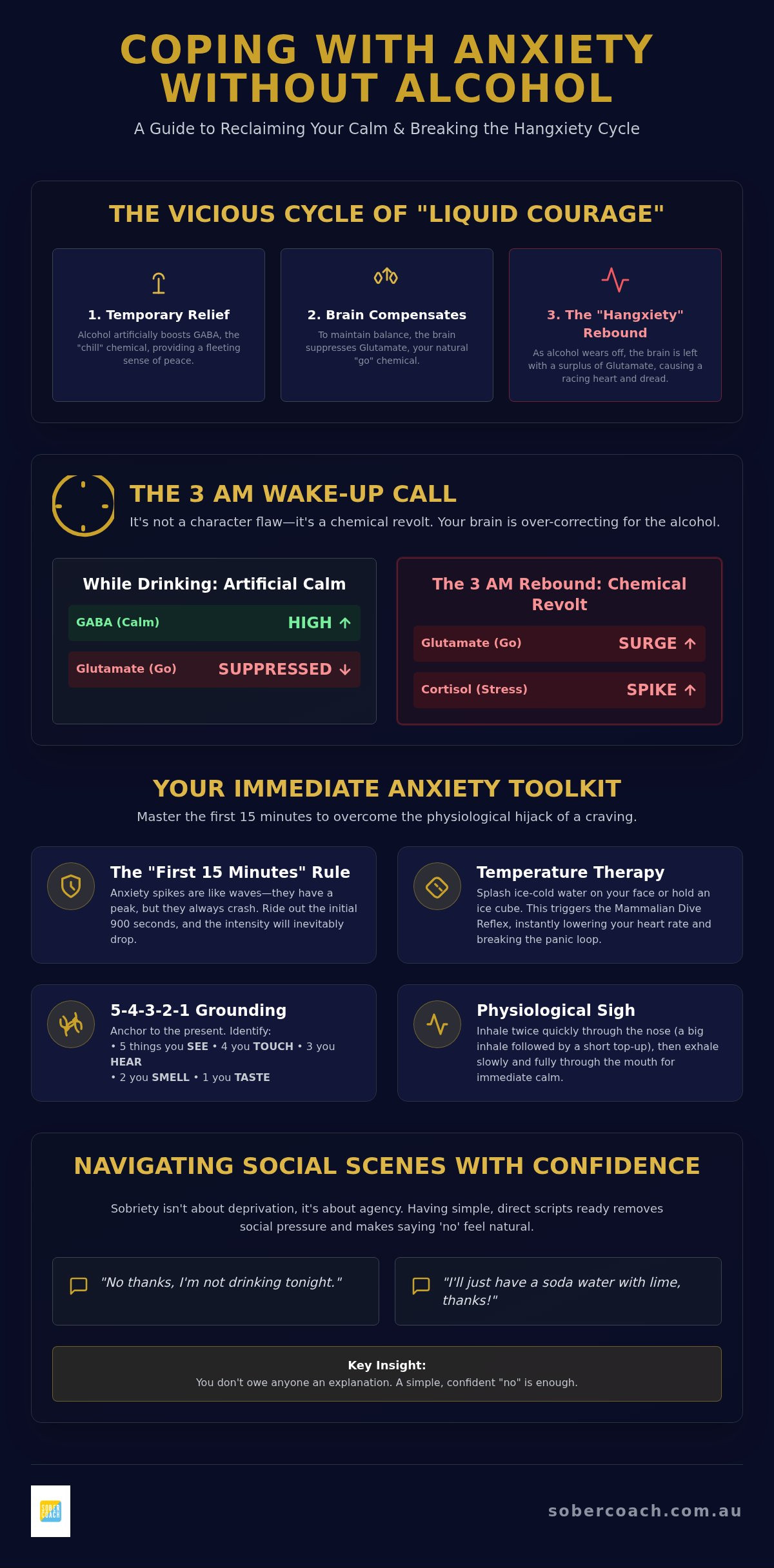
Your brain is a master of balance. When you flood your system with alcohol, you artificially boost GABA, the chemical responsible for making you feel "chill." To compensate for this sudden dip, your brain suppresses glutamate, your natural "go" chemical. It's a survival mechanism. However, once the alcohol wears off in the middle of the night, your brain is left with a massive surplus of glutamate and a spike in cortisol. This is why you wake up at 3 AM with a racing heart and a mind spinning with intrusive thoughts. You aren't actually in danger; your brain is just over-correcting for the chemical suppression from a few hours earlier. This cycle is why "one drink to calm down" inevitably creates a physical need for two drinks tomorrow just to feel "normal" again.
Breaking the Stigma: Anxiety is a Physiological Response
It is time to stop viewing your anxiety as a character flaw or a sign of weakness. It is biology. When you focus on coping with anxiety without alcohol, you are choosing to work with your body rather than against it. Many of us have a "witching hour," often around 5 PM, where the day’s cumulative stress peaks and the urge to numb out is strongest. Recognizing this as a predictable physiological event allows you to prepare for it with better tools.
Alcohol-Induced Anxiety: Feelings of panic, dread, and physical tremors that occur specifically during the "rebound" phase after drinking.
Clinical Anxiety: A baseline condition that exists independently of substance use but is significantly worsened by the chemical spikes and crashes of alcohol.
The Sensitization Trap: The more often you use alcohol to mask stress, the less your brain remembers how to regulate itself naturally.
Coping with anxiety without alcohol is about reclaiming your agency. It’s about moving away from the shame of "not being able to handle a drink" and toward the empowering realization that your nervous system is simply asking for a more sustainable form of support. You aren't broken; you're just caught in a loop that was designed to keep you stuck.
Immediate Tools for Coping with Anxiety Without Alcohol
When that 5 PM wave of tension hits, your brain often screams for the quickest exit. It is a physiological hijack. The secret to coping with anxiety without alcohol lies in mastering the first 15 minutes. Cravings and anxiety spikes are like waves; they have a distinct peak, but they always crash. If you can ride out those initial 900 seconds, the intensity will inevitably drop. One of the fastest ways to force your nervous system to reset is through temperature therapy. Splashing ice-cold water on your face or holding an ice cube triggers the mammalian dive reflex. This instantly lowers your heart rate and forces your brain to shift from "panic mode" to "survival mode," breaking the anxiety loop in seconds.
Somatic Grounding for High-Stress Moments
Sometimes you need to anchor yourself to the present when your mind is racing toward a catastrophe. The 5-4-3-2-1 technique is a classic because it works. Identify five things you see, four you can touch, three you hear, two you smell, and one you can taste. In a busy Australian office or a loud social setting, this pulls you out of your head and back into your body. While box breathing is great for focus, the "physiological sigh" is often more effective during an active spike. Take two quick inhales through the nose followed by a long, slow exhale through the mouth. This is scientifically proven to dump carbon dioxide and lower arousal faster than almost any other breathing pattern. If you still feel that buzz of excess adrenaline, movement is your best medicine. A 10-minute brisk walk around the block physically burns off the "fight or flight" energy that alcohol only masks.
Rewiring the Ritual
We often crave the ritual as much as the substance. The weight of the glass, the sound of the pour, and the first sip are powerful psychological cues. Don't deprive yourself of the ceremony. Use your best high-quality glassware for a sophisticated non-alcoholic substitute. In 2026, the Australian market is flooded with premium botanical spirits and craft non-alcoholic beers that offer the complex flavors of a cocktail without the chemical rebound. This satisfies the "habit brain" while you focus on Overcoming Social Anxiety Without Alcohol. Creating a "Sober Sanctuary" at home, a dedicated space with dim lighting, a weighted blanket, or a specific scent, helps signal to your brain that the workday is over and safety has arrived.
Building these habits takes practice, and having a guide can make the transition much smoother. You might find that One-on-One Recovery Coaching provides the accountability you need to turn these tools into a permanent lifestyle.
Navigating the Australian Social Landscape Sober
Australia’s social scene is famously soaked in booze, making the local pub feel like the only place to truly connect. But you don't have to be the "boring" one just because your glass is filled with soda and lime. Coping with anxiety without alcohol in a culture that celebrates the "Sunday session" is a bold act of self-preservation. It is about shifting your focus from what you're missing to what you're gaining: real connection, better sleep, and a morning without the crushing weight of regret. The Anxiety & Depression Association of America offers several Tips to Manage Anxiety and Stress, including the vital advice to limit alcohol because it can actually trigger panic attacks rather than prevent them.
Standing your ground in a pub requires a no-nonsense approach to your own boundaries. You don't need a complex excuse to decline a drink. "I'm not drinking tonight" is a full sentence. If you prefer something less direct, "I’ve got an early start" or "I’m on a health kick" usually shuts down the conversation quickly. The key is to keep your response brief and move the topic along. Most people are more concerned with their own drink than yours.
The 'First Hour' Strategy
Arriving early is one of the most effective ways to manage social jitters. It allows you to settle into the environment before the noise and crowd peak. Get a non-alcoholic drink in your hand immediately. People rarely ask what’s in your glass if it looks like a standard drink. Set a firm exit time before you even arrive. Knowing you only have to stay for ninety minutes can make the experience feel manageable rather than endless. Identify your "safe people" in the room—those friends who support your choices and won't pressure you into a round of shots. When they're around, the pressure of the pub culture hurdle feels significantly lighter.
Sober Activities in Sydney and Beyond
Building a new social identity means finding joy outside of dimly lit bars. Sydney offers an incredible outdoor lifestyle that is often wasted on those sleeping off a hangover. Trading a late night for a 6 AM surf at Bondi or a hike through the Royal National Park changes your perspective on what a "good time" looks like. You can find plenty of Sober activities in Sydney that revolve around movement, sunlight, and genuine engagement. As you lean into these healthier habits, your "social battery" will naturally adjust. You’ll start to realize that leaving a party early isn't a failure; it’s a strategic move to protect your peace and ensure you wake up feeling calm and clear.
Building a Long-Term 'Anxiety Toolkit' with Recovery Coaching
While clinical therapy is essential for unpacking deep-seated trauma, many Australians find a gap between understanding their past and navigating the pressure of a Friday afternoon in a Sydney office. This is where proactive recovery coaching steps in. It functions as the bridge between realizing you have a problem and actually changing your daily habits. Coping with anxiety without alcohol requires more than just willpower; it requires a structured, practical system that you can deploy when life gets loud. Coaching doesn't just ask "why" you feel this way; it focuses on "how" you are going to move through it without a drink in your hand.
Building this toolkit is a deliberate process. We move through specific stages to ensure your new lifestyle is sustainable and resilient. It starts with identifying your unique high-risk situations. For some, it is the quiet house after the kids go to bed; for others, it is the high-stakes corporate lunch. Once we know the triggers, we develop a personalized crisis plan for anxiety spikes. This plan is a literal "if-then" menu of actions that bypasses the decision-making fatigue that often leads to a relapse. We then implement accountability through 1-on-1 sessions and, where needed, integrate these new routines through In-Home Recovery Support to ensure the change sticks in your actual living environment.
Why Peer-Led Support Bridges the Gap
There is a profound power in working with someone who has "been there." Lived experience strips away the clinical coldness often found in traditional settings. It creates a space where you don't have to explain the specific shame of a "hangxiety" spiral because your mentor has already walked that path. This approach focuses on real-life application. We discuss how to handle the BBQ culture, the work stress, and the messy middle of early sobriety where emotions feel raw and unfiltered. It is professional support with a human-to-human connection that feels brave and transparent.
The Sober Coach Methodology
Our approach is built on the idea that sobriety is a power move, not a life sentence of deprivation. It is about liberation. We customize your tools to fit the specific professional pressures and lifestyle demands of living in 2026. Whether you are navigating the intense social expectations of NSW or the coastal lifestyle of QLD, your toolkit needs to be as dynamic as your life. By choosing One-on-One Recovery Coaching, you are investing in a tailored strategy that prioritizes your agency and personal growth. You can start building your calmer, clearer life today by reaching out to a Sober Coach for professional, lived-experience support.
Taking the First Step Toward a Calmer Life
You have likely spent years trying to white-knuckle your way through the stress, convinced that you should be able to "fix" this on your own. Admitting that the old way isn't working isn't a sign of weakness; it is the bravest thing you'll do this year. Coping with anxiety without alcohol is a journey that doesn't have to be walked in isolation. We provide a space where the stigma is stripped away, replaced by practical tools and a shared history of transformation. Whether you are in a high-rise in Sydney or a quiet town in rural Queensland, professional support is within reach. You deserve a life where your pulse doesn't skyrocket every time the clock strikes five.
Our Flexible Recovery Programs
Accessibility is the cornerstone of effective support. Our Rehab online and Group coaching online via zoom offer a way to connect with professional mentors and peers without the logistical nightmare of travel or the fear of being recognized in a local clinic. These sessions create a community of people who actually get it, providing a safe harbor to share wins and navigate setbacks. For those who need a more immersive experience, our Intensive Recovery Workshops provide a deep dive into the mechanics of emotional regulation and habit change. If you are in Sydney, Melbourne, or Brisbane, you can access these programs today, ensuring that your location never dictates the quality of your recovery journey.
Many people hesitate because they fear the "messy middle" where emotions feel raw and unfiltered. They worry that without their primary coping mechanism, they'll be left defenseless against the storms of life. But sobriety isn't about giving something up. It's about getting your life back. It is about waking up with a clear head, a steady hand, and a heart that doesn't race for no reason. It's about finally being present for the people who matter most, including yourself. When you remove the chemical interference of alcohol, you finally give your brain the chance to heal and find its own natural equilibrium.
Your Path to Liberation Starts Here
Taking action is the only way to break the loop. Booking a discovery session is a low-pressure way to see if our coaching methodology aligns with your personal goals. We’ll discuss your specific triggers, your lifestyle challenges, and how we can help you build that resilient, long-term toolkit we’ve explored in this guide. This is your opportunity to move from a state of survival to a state of thriving. Your anxiety isn't the enemy; it is the compass pointing toward the parts of your life that need more support and better tools. Start your journey with Sober Coach today and discover how vibrant and liberated your life can truly be.
Your New Chapter Starts with a Clear Mind
Breaking the cycle of using a depressant to mask stress is the first step toward a life that actually feels good to live. You now understand that the 3 AM heart race is a chemical rebound rather than a character flaw. By using the grounding tools we’ve discussed to ride out the first 15 minutes of a craving, you're already shifting from survival to agency. Coping with anxiety without alcohol is about more than just "not drinking"; it is about building a life you no longer feel the need to escape from.
We provide professional recovery support rooted in a lived experience perspective. Whether you need flexible online rehab or personalized in-home support across Australia, we offer an empowering, non-judgmental space to redefine your habits. You don't have to navigate the pressures of Australian social culture or the weight of your internal landscape alone. It’s time to trade the "hangxiety" for a vibrant, liberated future. Book a One-on-One Recovery Coaching Session today to start building your personalized toolkit. You are capable of profound transformation, and the path to a calmer life is wide open.
Frequently Asked Questions
Can alcohol cause long-term anxiety even when I'm not drinking?
Yes, alcohol causes long-term chemical changes that sensitize your nervous system even when you are sober. Regular consumption alters how your brain processes stress by suppressing natural calming chemicals. Over time, this makes you more reactive to everyday triggers. This persistent state of high alert is a common hurdle for those focusing on coping with anxiety without alcohol. It takes time for your brain to recalibrate its baseline without the interference of a depressant.
What is the fastest way to calm anxiety without a drink?
Temperature therapy is the fastest way to physically interrupt an anxiety spike. Splashing ice-cold water on your face or holding an ice cube triggers the mammalian dive reflex, which instantly lowers your heart rate. Alternatively, the physiological sigh, which is two quick inhales followed by a long exhale, dumps carbon dioxide and signals safety to your brain. These somatic tools provide the immediate relief people often mistakenly seek in a glass of wine.
How do I deal with social anxiety at a wedding or party if I'm sober?
The best strategy is to arrive early, secure a non-alcoholic drink in your hand immediately, and set a firm exit time. Having a glass already filled prevents people from offering you alcohol and reduces the pressure of the "pub culture" hurdle. If your social battery drains, give yourself permission to leave. Weddings are about connection; you’ll find that genuine conversations are much easier to navigate when you aren't masking your jitters with booze.
Is it normal for anxiety to get worse right after I stop drinking?
Yes, it is very common for anxiety to peak in the first few days or weeks after you stop drinking. Your brain is dealing with a massive "rebound" effect as it tries to balance its own chemistry without the suppression of alcohol. This temporary spike is a physiological event, not a permanent state. Understanding this helps you stay the course, knowing that your nervous system is simply learning how to regulate itself naturally again.
What is the difference between a Sober Coach and a therapist?
A Sober Coach focuses on the "how" of daily life and habit change rather than just the "why" of your past. While therapists address clinical trauma and mental health history, we provide proactive, lived-experience support for navigating real-world triggers. We act as a bridge between realizing there is a problem and implementing a practical toolkit. Our approach is professional yet deeply personal, focusing on liberation and personal agency in your current environment.
Do I need to go to detox before starting recovery coaching?
We do not provide medical detox services. If you are physically dependent on alcohol, it is essential to consult a doctor or medical professional first to ensure your safety. Once you are medically stable, recovery coaching is an excellent next step to build the emotional and practical skills needed for long-term sobriety. We focus on the lifestyle and mindset shifts that follow the initial physical transition and help you maintain your progress.
How long does it take for the brain to stop feeling anxious after quitting alcohol?
While everyone is different, many people report a significant reduction in baseline anxiety within three to six months of total abstinence. Your brain needs this time to repair its GABA and glutamate receptors. During this period, coping with anxiety without alcohol becomes progressively easier as your natural resilience returns. You’ll notice that the 3 AM wake-up calls vanish and your ability to handle daily stress improves without the chemical spikes of drinking.
Are your recovery coaching sessions available online for people outside Sydney?
Yes, our programs are accessible to anyone across Australia. We offer Rehab online and group coaching online via zoom to support individuals in rural areas or other major cities like Melbourne and Brisbane. These digital sessions provide the same professional, lived-experience support as our in-person work. Whether you are seeking One-on-One Recovery Coaching or intensive workshops, you can access our tools and community from the comfort of your own home.
Comments