

Dual Diagnosis Support in Australia: 2026 Guide

The Australian healthcare system often treats your mental health and your habits like two different people living in the same body. You've likely felt the exhaustion of being "bounced" from a clinic to a rehab service, only to be told you're too complex for both. It's a frustrating loop that leaves you feeling more like a file number than a human being. Finding effective dual diagnosis support australia shouldn't feel like a bureaucratic marathon. You deserve a space where your anxiety and your substance use are understood as a single, connected experience, not a set of competing labels.
We agree that the traditional, clinical approach often misses the mark because it ignores your lived reality. This 2026 guide promises to show you how to reclaim your agency and navigate these complexities with practical, non-clinical strategies. We'll look at how to manage triggers in real-time and build a support system that actually understands what you're going through. From updated NDIS recovery coach rates to finding long-term sobriety without restrictive rules, we're mapping out a path to a vibrant, liberated life. It's time to stop managing symptoms and start living again.
Table of Contents
What is Dual Diagnosis? Understanding the Australian Landscape
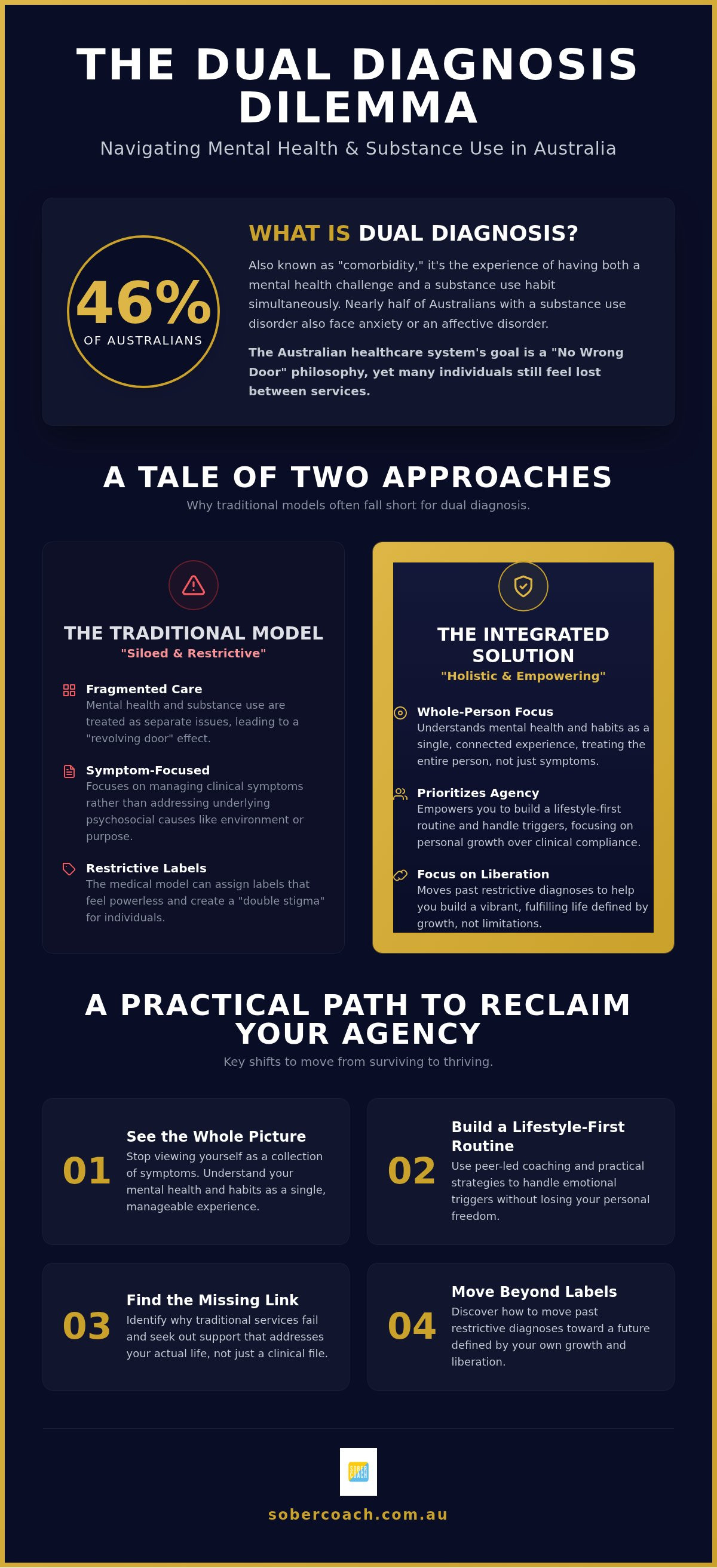
"Dual diagnosis" isn't a life sentence or a permanent character flaw. It's just a way of saying you're dealing with a mental health challenge and a substance use habit at the same time. In many Australian clinics, you'll hear the term "comorbidity," but What is Dual Diagnosis? at its core is a human experience of complexity. It's simply a description of where you are right now. You might feel like you've been given a label that defines your future, but we see it as a starting point for a more integrated, liberated life. Your diagnosis is a chapter in your story, not the whole book.
You are far from alone in this struggle. In 2026, the Australian landscape is shifting to recognize that these issues aren't separate. The National Study of Mental Health and Wellbeing shows that nearly half of people with a substance use disorder also face an anxiety or affective disorder. Because of this, the Australian healthcare system aims for a "No Wrong Door" philosophy. This means that whether you walk into a mental health clinic or a drug and alcohol service, they should be able to help you find the right dual diagnosis support australia. While the system is still catching up to the ideal, the shift toward integrated care is real and growing.
The "Chicken or the Egg" Dilemma
It's often hard to tell where the mental health struggle ends and the habit begins. Maybe you started using a substance to quiet the noise of trauma or to numb the sharp edges of social anxiety. Or, perhaps your substance use has reached a point where it's triggering panic attacks or deep depressive episodes. Comorbidity is the clinical term for the 46% of Australians who experience a mental health disorder alongside a substance use issue. This intersection is where the real work happens. We don't need to solve the "which came first" puzzle to start moving toward growth. We just need to address the whole picture at once.
Common Signs of Co-occurring Disorders
Identifying the signs of a dual diagnosis often starts with a feeling that something is missing in your current treatment. You might find that traditional, single-track rehab feels too clinical or ignores your emotional triggers. Common signs include:
Difficulty maintaining daily routines or professional responsibilities because your energy is split between two internal battles.
A sense of social withdrawal fueled by "double stigma," which is the fear of being judged for both your mental health and your substance use.
Feeling that your progress stalls because one issue keeps pulling the other back into the shadows.
If you feel like traditional treatment isn't working, it's often because the system is trying to treat two halves of you rather than the whole person. Finding the right dual diagnosis support australia means looking for integrated care that honors your personal agency. It's about looking at your lifestyle as a whole and exploring non-binary behavioral patterns rather than just checking boxes in a clinical file.
Why Traditional Treatment Often Fails Dual Diagnosis Clients
Traditional services in Australia often operate like separate islands. If you've ever been told by a mental health professional to get your drinking under control before they can help with your depression, you've experienced siloed care. Conversely, many drug and alcohol services aren't equipped to handle complex trauma or anxiety disorders. This disconnect creates a revolving door effect. You treat the symptom in one facility, only for the underlying cause to trigger a relapse the moment you leave. Clinical intervention is vital for crisis management, but it's rarely enough for a vibrant, long-term transformation. Real change happens when we address the psychosocial pieces of the puzzle: your environment, your relationships, and your sense of purpose.
The #1 objection to non-clinical support is the fear that it isn't "serious" enough. In reality, clinical doesn't always mean effective for the long haul. A hospital can keep you safe for a week, but it can't teach you how to navigate a stressful Tuesday afternoon without reaching for a substance. We need to look beyond the medical file to see the human being. Effective dual diagnosis support australia must prioritize your personal agency over clinical compliance. When treatment focuses only on the "problem," it misses the opportunity to build the "solution" which is a life you actually enjoy living.
The Stigma of the Medical Model
The medical model often relies on restrictive labels that can make you feel powerless. While a diagnosis can offer clarity, it shouldn't become your identity. Being treated implies you're a passive recipient of care. We prefer the idea of being empowered to take charge of your own habits. By moving away from heavy, medicalized language and using modern lifestyle descriptors, we strip away the shame. You aren't just a dual diagnosis patient; you're a person exploring new ways to navigate emotional strength. Choosing a non-clinical recovery mentor allows you to focus on liberation rather than just the absence of a disorder.
The Gap Between Detox and Daily Life
The first 90 days after a clinical intervention are often the most precarious. Traditional rehab settings are controlled environments that don't look anything like your actual life. You might learn the theory of coping, but applying it while standing in the middle of a stressful workday is a different story. Many treatment plans fail because they ignore the practical, real-world tools needed for daily survival. If your current support plan doesn't mention how to handle specific social triggers or manage real-time anxiety, that's a major red flag. Integrated support must bridge the gap between the clinic and the kitchen table. It's about building a lifestyle that supports your mental health every single day.
Integrated Support Options in Australia: Clinical vs. Coaching
The Australian landscape for dual diagnosis support australia has evolved significantly in 2026. We've moved past the idea that a hospital bed is the only place to find healing. While clinical settings excel at stabilization, they often lack the personal touch required for long-term lifestyle change. This is where the shift toward peer-led recovery models becomes a game-changer. Lived experience isn't just a bonus; it's the foundation of trust. When you speak to someone who has navigated the same internal storms, the clinical wall comes down. You aren't just another case file to be managed. You're a person who is ready to reclaim their agency.
The NDIS has recognized this need for specialized, non-clinical support. As of July 1, 2026, the rate for a Psychosocial Recovery Coach is $110.44 per hour. This role is designed to bridge the gap between medical treatment and real-world living. The "National Disability Insurance Scheme Amendment (Securing the NDIS for Future Generations) Bill 2026" passed in August, reinforcing the focus on functional capacity and long-term outcomes. Whether you're in Sydney or a regional town, these integrated options mean you don't have to choose between mental health care and addiction support. You can have both in a way that respects your personal journey.
When to Choose Clinical Intervention
Clinical intervention is a necessary starting point for many, especially when physical safety is at risk. If you require a medical detox, you must seek a clinical facility, as this is a medical procedure we don't provide. Acute crisis management is the strength of the Australian public health system. If you're in a state of immediate danger or require medication stabilization, a hospital setting is the right choice. Non-medical support has its limits. It's built for the marathon of recovery, not the sprint of a medical emergency. Knowing when to utilize these clinical tools is a sign of strength, not a failure of your personal agency.
The Power of Recovery Coaching
Recovery coaching takes over where the clinic leaves off. It's a no-nonsense, mentor-led approach that focuses on vibrant liberation rather than just clinical maintenance. Through one-on-one recovery coaching or intensive recovery workshops, you get a level of accountability that a traditional therapist often can't provide. We aren't here to just "manage" your symptoms. We're here to help you build a life that you don't want to escape from. This support integrates with your existing NDIS plan or private health arrangements, providing the missing link in your recovery journey. Whether it's through online rehab or in-home recovery support, the goal is always the same: giving you the tools to lead your own life.
Practical Strategies for Managing Dual Diagnosis Daily
Managing a dual diagnosis requires more than just attending a weekly session. It's about the small, quiet choices you make every day. You need a "lifestyle-first" routine that acts as a buffer against emotional triggers. In cities like Sydney, Melbourne, or Brisbane, the social pressure to use substances as a "crutch" for social anxiety can be intense. Navigating these environments without your old habits takes more than just grit; it takes a calibrated toolkit. By focusing on your personal agency, you can learn to move through these spaces with a sense of vibrant liberation rather than deprivation. This isn't about avoiding life; it's about engaging with it on your own terms. Finding effective dual diagnosis support australia shouldn't depend on whether you live in a capital city or a remote town.
Building Your Recovery Toolkit
Your toolkit needs to be practical and immediate. When anxiety spikes, you don't need a clinical lecture; you need a way to ground yourself. In-Home Recovery Support is a powerful way to identify the environmental triggers hiding in your own living room. Whether it's a specific chair associated with old habits or a time of day that feels heavy, seeing these patterns in your own space changes the game. Habit replacement is the intentional process of swapping a destructive behavioral loop for a constructive action that provides the same emotional release or regulation. This might mean replacing a drink with a specific breathing technique or a physical movement that shifts your nervous system. These tools give you the power to manage your mental health and your habits in real-time, right where you live.
Accessible Support Anywhere in Australia
One of the biggest hurdles for dual diagnosis support australia is the tyranny of distance. If you're in a rural area or simply have a schedule that doesn't allow for travel, traditional rehab isn't an option. We've broken that barrier with Zoom-based group coaching and Rehab Online. These platforms offer a high level of support while maintaining your absolute privacy. You get to connect with a community that understands your lived experience without ever leaving your home. It's a way to bridge the gap between where you are and where you want to be. For those ready for a deep-dive, our Intensive Recovery Workshops provide the space for rapid personal growth that a standard hour-long session simply can't reach. These workshops allow you to strip away the noise and focus entirely on your transformation for a concentrated period.
If you're ready to stop managing symptoms and start building a life you love, explore our One-on-One Recovery Coaching to start your transformation today. We're here to help you navigate the complexities of your journey with a no-nonsense, empathic approach that actually works in the real world.
Reclaiming Your Agency: The Sober Coach Approach
Traditional recovery models often start by asking you to admit you are powerless over your habits. We take the opposite view. Real transformation begins when you reclaim your agency and realize you have the power to design a life that doesn't require an escape. This shift from "powerless" to "empowered" is the heart of our approach to dual diagnosis support australia. We focus on your strengths rather than just your symptoms. Our intensive recovery workshops are designed to accelerate this process, moving you past the "revolving door" of clinical care and into a high-functioning life. Most clinical services leave a massive gap between the safety of a hospital and the reality of your kitchen table. We bridge that gap by focusing on the "now" and the "what's next." The end of a substance habit isn't the finish line; it's the powerful beginning of your real life.
A Mentor with Lived Experience
Shame thrives in the silence of clinical settings. When you work with a mentor who has walked the same path, that shame starts to dissolve. A clinical therapist offers valuable tools, but a courageous mentor offers a shared history that builds immediate trust. This human-to-human connection is what makes our one-on-one sessions so effective for complex needs. You aren't being "treated" by an anonymous professional; you're being guided by someone who knows exactly how heavy the weight of a dual diagnosis can feel. This shared history strips away the medicalized anonymity of typical services. If you're ready to start this transition, you can book a session today to see how peer-led support changes the dynamic of your recovery.
Your Next Steps Toward Liberation
Sustainable change happens when recovery is integrated into your actual environment, not just a sterile office. Our in-home recovery support helps you identify and navigate the triggers that exist in your daily life. We also offer group coaching online via zoom, which connects you with a community of like-minded Australians who are also choosing growth over deprivation. This isn't about clinical maintenance; it's about building a lifestyle that supports your emotional strength and personal development. By using modern descriptors for your journey and focusing on non-binary behavioral patterns, we strip away the stigma and focus on your future. This integrated, lifestyle-first approach is the future of dual diagnosis support australia. Ready to move beyond the labels? Explore our recovery coaching programs today and discover what a liberated life looks like.
Step Into Your Vibrant Beginning
You've spent enough time feeling "bounced" between services that don't talk to each other. Recovery isn't about clinical maintenance or checking boxes in a medical file; it's about building a life you actually want to live. By shifting your focus from "powerless" to "empowered," you can start managing your mental health and habits as one single, connected journey. Finding the right dual diagnosis support australia means choosing a path that respects your personal agency and your unique lived experience.
Whether you need the privacy of rehab online or the hands-on guidance of in-home recovery support, our Australian-based recovery specialists are here to bridge the gap. We offer a non-judgmental space led by mentors with lived experience who understand the nuances of emotional recovery. Don't let a label define your destiny. Your journey toward a liberated life starts with a single, courageous decision to prioritize your growth. Begin your journey to vibrant liberation with a professional Sober Coach. You have the strength to rewrite your story.
Frequently Asked Questions
What exactly is dual diagnosis support in Australia?
Dual diagnosis support australia involves managing co-occurring mental health challenges and substance use habits as a single, connected experience. Instead of being bounced between separate clinics, you receive integrated care that addresses how your anxiety or trauma fuels your behavior. In 2026, the Australian healthcare system is moving toward a "No Wrong Door" approach. However, private coaching offers a more personal, non-clinical bridge for those who want to maintain their personal agency while they heal.
Can I use NDIS funding for dual diagnosis recovery coaching?
Yes, you can access this support through your NDIS plan if you have a psychosocial disability. As of July 1, 2026, the NDIS pricing schedule sets the rate for a Psychosocial Recovery Coach at $110.44 per hour. The National Disability Insurance Scheme Amendment Bill 2026 passed in August, reinforcing that funding should be used for functional capacity and long-term recovery goals. It's a powerful way to fund your path toward a vibrant, liberated life.
How is a recovery coach different from a psychologist for dual diagnosis?
A psychologist focuses on clinical diagnosis and treatment, often supported by Medicare rebates which reached $149.05 for clinical psychologists in July 2026. A recovery coach provides non-clinical, peer-led mentorship based on lived experience. While a psychologist treats the disorder, a coach helps you navigate the daily complexities of your lifestyle. We focus on accountability and practical tools for habit replacement, acting as the missing link in the Australian mental health system.
Do I need to go to a clinical rehab for dual diagnosis?
You don't always need a hospital-based rehab unless you require a medical detox, which is a clinical procedure. For many, staying in their own environment with in-home recovery support or online rehab is more effective for long-term change. This allows you to identify real-world triggers in your own living room rather than a sterile clinic. It's about building a sustainable routine that works in your actual life, not just in a controlled setting.
Can I get dual diagnosis support online if I live in a remote area?
Absolutely. Remote dual diagnosis support australia has become a standard option for the half a million Australians who currently fall through support gaps. Through Zoom-based group coaching and rehab online, you can access high-level mentorship regardless of your postcode. This breaks the barrier of distance and provides a private, flexible way to work on your transformation without the need for travel or the cost of traditional, live-in clinical facilities.
What happens if I relapse while in a dual diagnosis program?
We view a slip as a moment for deeper reflection rather than a reason for shame. Relapse is often a sign that a specific emotional trigger hasn't been fully addressed in your lifestyle-first routine. Instead of clinical punishment, we use these moments to refine your toolkit and strengthen your habit replacement strategies. The goal is to learn from the experience and reclaim your agency immediately, ensuring your journey continues toward long-term sobriety and strength.
Is dual diagnosis support only for people with severe mental illness?
Not at all. While 6.5% of Australians have a reported psychosocial disability, dual diagnosis support is for anyone whose mental health and substance use are affecting their quality of life. Whether you're dealing with social anxiety or complex trauma, if your habits are a way of self-medicating, this integrated approach is for you. It's about exploring non-binary behavioral patterns and finding liberation, regardless of how severe your initial diagnosis might feel.
How long does dual diagnosis recovery typically take?
There is no fixed timeline, but the first 90 days are often the most critical for establishing new behavioral patterns. Recovery is a powerful beginning rather than a clinical endpoint. Some people find that intensive recovery workshops accelerate their progress, while others prefer the steady accountability of long-term one-on-one coaching. We focus on helping you build a life you don't want to escape from, which is a goal-oriented process tailored to your specific needs.
Comments