

Managing Sobriety at Work: Strategies for Success

What if your decision to quit drinking wasn't a career handicap, but actually the competitive edge that puts you three steps ahead of everyone else? Most professionals feel a deep sense of dread when Friday afternoon drinks roll around or when a high-stakes deadline makes that old "crutch" look tempting. You might worry that skipping the pub means skipping the promotion, or feel a constant, low-level anxiety about being "found out" by your peers. Managing sobriety at work in a culture that often revolves around "boozy" networking can feel like walking a tightrope without a net.
It's a valid fear, but it's also one we can dismantle together. You deserve a professional life where clarity replaces brain fog and where your performance is fueled by genuine resilience rather than temporary fixes. This guide offers a no-nonsense roadmap for the Australian workplace, showing you how to master the art of maintaining your recovery while thriving in your career. We will explore how to handle social pressure with confidence, manage stress without the bottle, and create a sustainable balance that keeps your recovery and your paycheck secure.
Table of Contents
The Professional Pivot: Why Sobriety is a Career Superpower
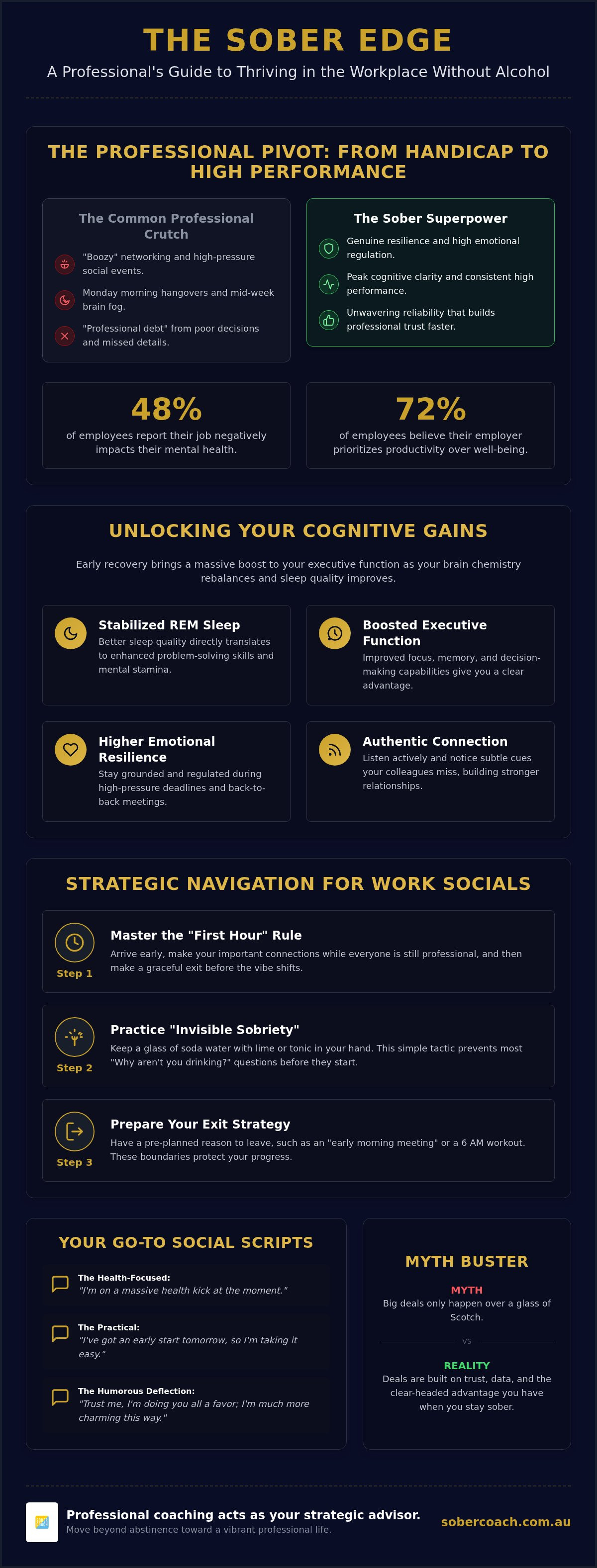
The "Clarity Dividend" is real. While your colleagues are nursing a Monday morning hangover or masking deadline stress with a mid-week bottle, you are operating with a level of focus that feels like a cheat code. Redefining your relationship with alcohol isn't about what you are losing. It's about what you are gaining: a strategic professional advantage. Managing sobriety at work allows you to be the most reliable person in the room. In 2026, where 48% of employees report their job negatively impacts their mental health, your choice to prioritize wellness is a radical act of performance. You aren't just surviving the grind; you are optimizing for it.
Consistency is your new currency. In high-stakes environments, being the person who is always present, always sharp, and always emotionally regulated is rare. This reliability builds trust faster than any "bonding" session at a pub ever could. Employers are starting to notice this shift. Recent data shows 72% of employees believe their employer prioritizes productivity over well-being. By taking control of your recovery, you are reclaiming your agency in a system that often demands more than it gives back. You become the anchor in a turbulent office culture.
The Myth of the "Liquor Lunch"
We have been sold a lie that big deals only happen over a glass of Scotch. The reality is that alcohol-fuelled networking often creates "professional debt." This is the fallout from poor decisions, misread social cues, or missed nuances during a high-pressure negotiation. High-performance leaders are increasingly ditching the booze to maintain their edge. They realize that a clear head is far more valuable than a shared hangover. Deals are built on trust and data. They aren't built on who can drink the most at 2 PM. When you stay sober, you catch the details everyone else misses.
Cognitive Gains in Early Recovery
Early recovery brings a massive boost to your executive function. Once you move past the initial phase, your REM sleep stabilizes. This is where the magic happens for your brain. Better sleep means better problem-solving skills and higher emotional resilience during back-to-back meetings. While some people explore frameworks like Moderation Management to re-evaluate their habits, many find that total clarity is what truly fuels their career trajectory. You might face some "brain fog" at first, but it's temporary. The Sober Edge is the rare combination of high-level emotional intelligence and the physical stamina required to outlast the competition.
Strategic Navigation: Handling Work Socials and Networking
Managing sobriety at work doesn't mean you have to become a social hermit. In the Australian corporate landscape, Friday afternoon drinks are often treated as a mandatory extension of the job description. But here is the secret: you don't have to drink to be "part of the team." The "First Hour" Rule is your best friend. Show up early, grab a soda water with lime, and make your rounds while everyone is still professional. By the time the second round of shots appears and the conversation starts looping, you've already made your impact. You can slip away unnoticed, leaving behind a reputation for being social and sharp.
Invisible sobriety is a powerful tactic for those who aren't ready to broadcast their journey. Keeping a glass in your hand, even if it's just tonic water, prevents the "Why aren't you drinking?" interrogation before it starts. If the vibe shifts from professional networking to a late-night party, have your exit plan ready. A pre-booked "early morning meeting" or a scheduled workout at 6 AM provides the perfect cover. These commitments aren't just excuses; they are the boundaries that protect your progress.
Social Scripts for the Australian Workplace
Aussie work culture can be notoriously pushy. When a colleague asks why you aren't having a beer, you don't need to give a clinical history of your recovery. Use a script that fits the room. "I’m on a massive health kick" or "I’ve got an early start tomorrow" usually shuts down the questioning. If they persist, a bit of dry humor goes a long way. "Trust me, I'm doing you a favor; I'm much more charming when I'm not three sheets to the wind." Directness, delivered with a smile, is usually enough to move the conversation along. If you find these social hurdles particularly daunting, exploring one-on-one recovery coaching can provide you with personalized scripts for these specific high-pressure moments.
Networking Without the Hangover
Authentic connection happens in the gaps between the noise. When you are sober, you are actually listening. You notice the subtle cues your manager gives about upcoming projects or the frustrations a client mentions in passing. This is your "Job to be Done" during social events. You are moving from being a "drinking buddy" to a "professional ally." While others might wake up with "hangxiety" fueled by a vague memory of saying something inappropriate, you wake up with actionable insights. This clarity allows you to follow up on Monday morning with precision, reinforcing your value as a high-performance team member who is always on the ball.
The Disclosure Dilemma: To Tell or Not to Tell?
Deciding whether to disclose your journey is a deeply personal fork in the road. In the Australian context, managing sobriety at work involves weighing the benefits of transparency against the reality of your office culture. Not every workplace is psychosocially safe yet. Before you speak, observe the landscape. Does your company prioritize genuine wellness, or is it still stuck in a "work hard, play hard" loop? Under the Fair Work Act, you have a right to privacy regarding your health information. You aren't legally required to share your history unless it directly impacts your ability to perform the inherent requirements of your role safely.
If you do choose to speak, consider the difference between HR and your direct manager. HR is there to mitigate risk and document policy; your manager is the one who actually sees your daily output. Telling a supportive manager can build trust and rapport. Telling HR is often a more formal step to secure specific protections. When you stop drinking, the rumour mill might spin. You don't owe anyone an explanation for the lime and soda in your glass. Control the narrative by being the most consistent version of yourself. Your performance will eventually speak louder than any office gossip.
When Disclosure is Strategic
Vulnerability can be a powerful tool for authentic leadership. By sharing your story on your own terms, you transform from "the person who doesn't drink" into a leader who values personal growth and resilience. This transparency allows you to set firm boundaries with supervisors regarding your recovery time or after-hours expectations. You can secure workplace accommodations, such as flexible hours for group coaching or workshops, without needing to lean on heavy clinical labels. It's about framing your needs as part of a high-performance lifestyle rather than a deficit that needs fixing.
The "Need to Know" Basis
Privacy is an act of empowerment, not a sign of shame. There is a vital distinction between secrecy, which hides behind fear, and privacy, which protects your energy. If you prefer to keep your recovery personal, you are well within your rights. When nosy colleagues ask why you’ve changed your habits, you can keep it professional and brief. "I’m focused on a new health block" or "I’ve realized I feel much better without it" are complete sentences. You don't need to justify your liberation to anyone who hasn't earned your trust. Managing sobriety at work is your business first and foremost.
Building a High-Performance Recovery Routine
High performance is not just about what you do at your desk; it is about how you manage your internal state between the emails. Managing sobriety at work requires a tactical approach to your daily schedule. Think of your recovery as a professional operating system that needs regular updates and maintenance. The "Morning Muster" is your first line of defense. Before you even touch your phone or open your inbox, spend five minutes grounding yourself. This isn't about "wellness" in a vague sense. It is about setting a cognitive baseline so you don't spend the rest of the day in a reactive, high-cortisol state.
Your lunchtime is another critical window for a reset. Instead of eating at your desk while scrolling through news, use fifteen minutes for a micro-meditation or physical movement. This clears the mental cache and lowers the stress levels that often peak in the early afternoon. Perhaps most importantly, you need a "Shut-Down Ritual." Your brain needs a clear signal that the workday has ended. Without the old 5 PM drink to mark the transition, you might find yourself stuck in work-mode all night. Change your clothes, take a quick walk, or listen to a specific podcast. These are the new anchors that tell your nervous system it's time to downshift.
To truly excel, treat your recovery like any other high-level skill. You wouldn't try to master a new market without a mentor, so why manage this transition alone? You can integrate one-on-one recovery coaching directly into your professional development plan as a strategic investment in your performance and longevity.
Stress Management Without the Bottle
Identifying your specific "Work Triggers" is essential for long-term success. It might be a demanding client, a looming deadline, or the anxiety of a performance review. When these triggers hit, your brain will naturally look for the quickest dopamine hit available. You have to replace the 5 PM drink with high-value activities that actually nourish you. This is where In-Home Recovery Support becomes invaluable. Having a professional help you establish these new routines in your own environment ensures that your home remains a sanctuary rather than a place where old habits wait in the shadows.
Accountability in the Digital Age
Staying connected doesn't require a physical meeting room. Zoom-based group coaching allows you to tap into a community of peers who understand the unique pressures of corporate life. You can also leverage digital tools for sobriety tracking to maintain a visual record of your progress. However, technology is only part of the equation. It is vital to cultivate a "sober network" that exists entirely outside of your professional circle. This provides a safe space where you are a human being first, not just an employee or a manager. This external support system acts as a pressure valve, ensuring that work stress doesn't compromise your personal freedom.
Professional Coaching: Your Competitive Edge in the Workplace
Managing sobriety at work is about more than just avoiding a drink; it's about optimizing your entire professional existence. While previous sections of this guide have focused on social scripts and daily routines, professional coaching is the strategic engine that drives those habits home. A Sober Coach acts as a strategic advisor for your life and career. We move you beyond the restrictive idea of "abstinence" and into the realm of vibrant professional living. This isn't about deprivation. It's about liberation from the habits that used to slow you down, allowing you to operate at a level your competition can't match.
There is a vital distinction between a clinical therapist and a peer-led recovery coach. A therapist often looks backward to diagnose and treat clinical issues. A coach looks forward. We focus on the "now" and the "next," providing the practical tools that HR departments or traditional EAPs often lack. Because our support is peer-led, it comes with a shared history. You're talking to someone who understands the pressure of a boardroom and the specific weight of corporate expectations. Investing in this support is the highest ROI you can find for your career. The dividend is a clear head, total reliability, and the kind of emotional intelligence that defines modern leadership.
One-on-One Support for Leaders
The corporate cultures in Sydney and Melbourne are notorious for their intensity. Managing sobriety at work in these hubs requires a tailored approach that respects your time and your status. Our One-on-One Recovery Coaching sessions are designed for professionals who need high-level accountability without the clinical fluff. We work with you to build a bespoke Workplace Recovery Plan. This strategic document outlines how you will handle high-stakes transitions, such as starting a new role or navigating a major promotion, while staying grounded in your recovery. You don't have to guess how to be a sober leader; you can build a roadmap for it.
Taking the Next Step
The first 90 days of professional recovery coaching are transformative. During this period, you'll move from reactive stress management to proactive career building. You'll learn to spot triggers before they impact your performance and develop a resilience that feels like a superpower. If you're tired of the "work hard, play hard" myth and you're ready to see what you're truly capable of, the next step is simple. Ready to own your career? Book your one-on-one session today.
Own Your Clarity and Your Career
You've seen that sobriety isn't a career handicap. It's the ultimate competitive edge in a world full of burnout and brain fog. By mastering the social scripts of the Australian workplace and building a high-performance routine, you aren't just staying dry; you're leveling up. Managing sobriety at work is a journey of reclaiming your agency and your performance. It's time to move past the fear of being "found out" and step into the role of the sharpest, most consistent leader in the room.
You don't have to navigate this transition alone. Our coaches bring lived experience from the corporate grind to every session, offering a non-clinical, empowering approach that focuses on your future growth. We provide flexible Zoom sessions for busy professionals across Australia, ensuring your recovery fits into your high-stakes schedule. This is about building a life you don't need to escape from.
Book a One-on-One Recovery Coaching Session today and start building a professional life that truly reflects your potential. You've already done the hard work of choosing change; now let's make it sustainable and vibrant together.
Frequently Asked Questions
Do I have to tell my boss I am in recovery?
No, you aren't legally required to disclose your recovery history in Australia unless it directly affects your ability to perform the essential duties of your role. Privacy is protected under the Fair Work Act. Deciding to share is a personal choice based on your relationship with your manager and the safety of your workplace culture. Focus on your performance as the primary indicator of your professional value. Your choice to stay private is an act of empowerment.
How do I handle "Friday drinks" if everyone expects me to be there?
Use the "First Hour" rule by showing up early, making your presence felt, and leaving before the atmosphere shifts. Have a non-alcoholic drink in hand immediately to avoid being offered one. If you're asked why you aren't drinking, keep it light and professional. You might mention a health goal or an early Saturday commitment. Managing sobriety at work is easier when you have a clear entry and exit strategy for social events.
What should I say if a client asks why I’m not drinking at dinner?
Keep your response brief and move the conversation back to business or a shared interest. You don't owe anyone a detailed medical history. A simple "I’m not drinking tonight" or "I've got a busy morning tomorrow" is usually enough. If they persist, use a bit of dry humor to deflect. Most clients respect professional discipline. They're there for your expertise, not your ability to match them drink for drink during a dinner.
Can I lose my job in Australia for having a past alcohol problem?
You cannot be legally terminated solely for having a history of substance use disorder. Under the Fair Work Act and various state anti-discrimination laws, employees are protected from unfair dismissal based on past health issues. However, employers can take action if your current performance or conduct is negatively impacted. Managing sobriety at work ensures your performance remains high, which is your best protection against any workplace stigma. Reliability is your most valuable asset.
How can I manage work-related stress without using alcohol?
Replace the 5 PM drink with high-value dopamine hits like physical movement, micro-meditation, or a hobby that requires focus. Identifying your specific work triggers is the first step. When stress peaks, use a "Shut-Down Ritual" to signal to your brain that the workday is over. This might involve a walk or a specific podcast. Building these new anchors helps your nervous system regulate without needing a chemical crutch. You're training your brain to decompress naturally.
What are the benefits of a recovery coach for my career?
A recovery coach acts as a strategic advisor who focuses on your future performance rather than just your past habits. Unlike clinical therapists, coaches provide practical, peer-led support tailored to the corporate grind. They help you build accountability in high-stakes environments and manage transitions like promotions. This investment offers a high ROI by replacing "hangxiety" with the cognitive clarity and emotional intelligence required for modern leadership. It's about moving from abstinence to a vibrant professional life.
Is workplace recovery support covered by the NDIS?
Recovery coaching is generally not covered by the NDIS as it is considered a non-clinical, personal development service. Most professionals fund coaching privately as an investment in their career longevity and performance. While it is a non-medical service, many find the peer-led approach more effective for navigating corporate life than traditional clinical models. Check with your accountant to see if professional development coaching is tax-deductible for your specific role. It's an investment in your high-performance future.
What if I have a slip-up while at a work event?
A slip-up is a data point, not a professional death sentence. If it happens, remove yourself from the situation immediately and contact your support network. Don't let shame spiral into a full relapse. Focus on getting back to your routine the next morning. If your performance wasn't publicly affected, you may not need to disclose it. Use the experience to identify a gap in your strategy and adjust your plan for future events. Resilience is built on recovery.
Comments