

Accountability in Recovery: Building a Support System That Actually Works
- angie391
- Aug 12
- 12 min read

What if accountability wasn't a cage designed to catch you failing, but a safety net designed to help you fly? For many Australians, accountability in recovery feels like a heavy weight. You might feel like you're constantly being watched by the "alcohol police" at home, or living in fear that one small slip will undo everything. It's exhausting to feel like your sobriety is a performance for others rather than a gift to yourself. We've been there, and we know that the traditional model of being "checked up on" often breeds more shame than success.
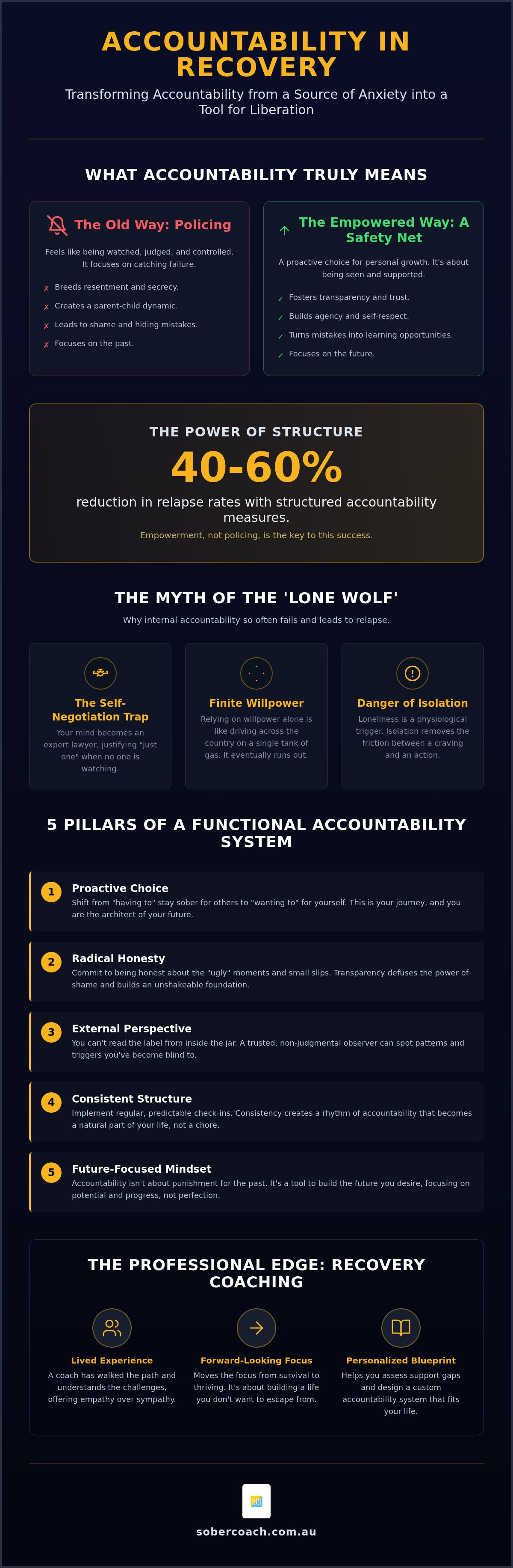
Research indicates that structured accountability measures can lead to a 40-60% reduction in relapse rates, yet the system only works if it empowers you. This article will show you how to transform accountability from a source of anxiety into a powerful tool for lasting sobriety and personal liberation. We'll explore how to build a structured, non-judgmental network and provide practical tools to handle triggers in real-time. It's time to swap the fear of relapse for a sense of genuine pride in every choice you make.
Table of Contents
Beyond Policing: What Accountability Truly Means in Recovery
Most people hear the word accountability and immediately think of a finger wagging in their face. They picture a spouse sniffing their breath or a parent checking their bank statements like a detective. This isn't accountability; it's policing. In the context of long term sobriety, policing is a recipe for disaster. It creates a parent-child dynamic that breeds resentment, secrecy, and eventually, a blowout. Real accountability in recovery is a proactive choice you make for your own growth, not a reactive response to someone else's suspicion.
When you shift from "having to" stay sober for others to "wanting to" stay sober for yourself, the entire energy of your journey changes. Transparency becomes a tool for your liberation. It's about having the guts to be seen, flaws and all, by people who want you to succeed. This proactive approach is a core component of Recovery coaching, where the focus stays on your potential rather than your past mistakes. It moves the needle from survival to thriving.
Accountability vs. Shame: Knowing the Difference
Shame is a heavy, stagnant emotion. It tells you that you are fundamentally "bad" because of your struggles. This mindset drives you into isolation, and isolation is where addiction thrives. Accountability is the opposite. It doesn't care about your worth as a person; it cares about your actions and your trajectory. Accountability is the bridge between a goal and its achievement. By owning your mistakes, you stop being a victim of your past and start being the architect of your future. You'll find that once you stop hiding, the mistakes you were so terrified of actually lose their power over you.
The Role of Radical Honesty
Radical honesty is the fuel that keeps a support system running. We often start with "little white lies" about where we were or how we're feeling because we don't want to worry people. These tiny deceptions are the early warning signs of a relapse. They create small cracks in your foundation that external stressors will eventually exploit. When you commit to being honest about the "ugly" moments, you build a foundation that can't be shaken. There is a profound, physical sense of relief that comes from having nothing left to hide. You no longer have to keep track of different versions of the truth. You can just be yourself, and that is where true accountability in recovery begins to feel like freedom rather than a chore.
The Myth of the 'Lone Wolf': Why Internal Accountability Often Fails
The idea that you can white-knuckle your way through sobriety alone is one of the most dangerous lies in the recovery space. We love the image of the 'Lone Wolf' because it feels heroic. It feels like we're finally taking control. But internal accountability in recovery is notoriously unreliable because the person holding the contract is the same person trying to break it. This is the self-negotiation trap. When no one is looking, your mind becomes an expert lawyer, justifying "just one" because you had a hard day or because you've been "so good" lately.
Willpower isn't a personality trait. It's a finite biological resource that depletes throughout the day. Relying on it alone is like trying to drive from Sydney to Perth on a single tank of petrol. You'll eventually run out. The science of social connection shows that our brains actually function differently when we know we're being observed. We perform better. We stay more focused. This is why evidence-based treatment approaches emphasize the need for long term follow up and community. Admitting you need an external check-in isn't a sign of weakness. It's a strategic move to protect your future.
The Danger of Isolation
The "I've got this" mindset is often the first step toward a relapse. It leads to a sense of complacency where you stop doing the very things that made you successful in the first place. Isolation removes the friction between a craving and an action. Without someone to call or a meeting to attend, the distance between thinking about a drink and having one becomes dangerously short. Loneliness isn't just a feeling; it's a physiological trigger that makes substances look like a solution. The 'Lone Wolf' strategy is the most common reason for early stage relapse because it ignores the fact that we are social creatures who need a tribe to stay grounded.
The Power of External Perspective
You can't read the label from inside the jar. An outside observer can spot patterns and triggers that you've become blind to. They act as a mirror, reflecting back the progress you've made and the risks you're ignoring. This external feedback is essential for recalibrating your goals as you grow. If you're feeling stuck or unsure of your next step, engaging with professional recovery support can provide the clarity you need to keep moving forward. Overcoming the ego and asking for that external "check-in" is actually the ultimate sign of strength.
5 Pillars of a Functional Accountability System
Building a blueprint for long term change requires more than just good intentions. It requires a framework that holds firm even when your motivation dips. A functional system for accountability in recovery isn't a list of rules; it's a set of living pillars that support your daily life. When these pillars are in place, you stop guessing and start growing. Here are the five essential elements of a system that actually works:
Consistency: You need a regular cadence for check-ins. Whether it's a weekly call or a daily text, the rhythm creates a habit of reflection.
Transparency: This is the commitment to share the "ugly" moments. If you had a close call at a Friday night footy match, you talk about it. No highlights-only reels.
Consequences: These are not punishments. They are pre-agreed actions that occur if a boundary is crossed, such as increasing the frequency of your check-ins or attending an extra workshop.
Support: The system must be rooted in empathy. The Role of Recovery Support Services is to provide a non-judgmental space where the goal is your liberation, not your perfection.
Celebration: Accountability is often associated with avoiding losses, but it's equally about recognizing wins. Acknowledging a month of clear-headed mornings is just as vital as discussing a trigger.
Setting Clear Boundaries and Expectations
Conflict often arises in families because boundaries are blurry. You might feel smothered by a partner who asks too many questions, while they feel anxious because they don't know how to help. Setting clear expectations involves defining your "non-negotiables," such as a tech-free hour for reflection or a specific time for your coaching sessions. Clear boundaries act as the guardrails that prevent the slippery slope of relapse before it gains momentum. By communicating your needs directly, you replace suspicion with a shared map for the journey ahead.
Using Technology as a Tool
Modern recovery doesn't have to happen in a windowless room. Technology has made it easier than ever to maintain a "low friction" accountability layer. Our Group coaching online via zoom allows you to connect with a tribe from the comfort of your own home, stripping away the logistical barriers of travel. While apps can track your days and offer quick check-ins, they work best when paired with human-to-human connection. Digital tools are the bridge, but the authentic relationship with a mentor or peer group is the destination.
Recovery Coaching: The Professional Edge in Staying Sober
While therapists are vital for unpacking past trauma and clinical diagnoses, a recovery coach is your strategic partner for the future. This role is inherently forward-looking and goal-oriented. We don't spend our sessions only looking in the rearview mirror. Instead, we focus on the road ahead. Accountability in recovery takes on a new dimension when you work with a professional whose primary job is to help you navigate the "now." We help you build the practical skills needed to handle a high-stress meeting in Sydney or a social event in Brisbane without reaching for a drink.
There's a specific kind of credibility that comes from shared history. When you work with a mentor who possesses lived experience, the dynamic shifts from a clinical observation to a human-to-human connection. You can't use the same old excuses with someone who has used them all themselves. This authentic connection builds immediate trust. It allows for a level of directness that family members often avoid because they're afraid of causing conflict. A coach provides 'real-time' support that a weekly therapy session simply can't match. We're there for the moments between the appointments, where the real work of sobriety happens.
A Non-Judgmental Partnership
You're more likely to be honest with a coach than a doctor or a family member because the fear of judgment is removed. We've seen the "ugly" moments and we know the terrain of habit. Our approach is a mix of deep empathy and no-nonsense truth-telling. We will challenge your justifications and call out the "little white lies" mentioned earlier, but we do it from a place of support rather than policing. This partnership bridges the gap between the structured environment of a clinical rehab and the often chaotic reality of real-world living. It's about giving you the tools to be your own advocate.
Accessible Support Across Australia
Whether you're looking for in-person support in Sydney or need the flexibility of nationwide online programs, the focus remains on a personalized strategy. Every person's triggers are different; therefore, every accountability plan must be unique. We offer One-on-One Recovery Coaching to help you identify the specific gaps in your current support network. From Melbourne to regional areas, our goal is to provide accessible, professional guidance that fits into your actual life. If you're ready to move beyond the 'Lone Wolf' mentality and embrace a system that actually works, we're here to help you start that journey today. Contact us to explore our coaching options and find the right fit for your lifestyle.
Designing Your Accountability Blueprint with Sober Coach
The first step in building a blueprint that sticks is an honest audit of your current environment. You need to identify where your support is strong and where the gaps are. Are you relying solely on a partner who feels like the "alcohol police"? Or are you trying to do it all alone while managing a high-pressure career? Accountability in recovery is most effective when it's tailored to your specific stressors. When you join an Intensive Recovery Workshop or start One-on-One Recovery Coaching, we don't give you a generic checklist. We look at your life as it is right now. We build a system that fits into your world rather than forcing your life to fit a rigid program.
Transitioning from "surviving" to "thriving" happens when you stop viewing support as a safety net and start seeing it as a launchpad. During a coaching session or workshop, you can expect a space that is entirely non-judgmental but deeply challenging. We help you identify the subtle self-negotiations that lead to slips. We also provide the practical tools you need to handle triggers in real-time. The first step is simple: book a discovery call. This is our chance to see if we're the right fit for your journey and to start identifying the pillars of your personal blueprint.
Tailoring the Strategy to Your Life
A one-size-fits-all approach to accountability is why many traditional models fail. Your life in a busy Australian city or a regional town has its own unique rhythm. We focus on integrating recovery tools into your existing work and family life so that sobriety doesn't feel like a second full-time job. Whether you need In-Home Recovery Support or the flexibility of our online programs, the strategy must be yours. It's also vital to let your system evolve. What you need in the first thirty days of change is rarely the same as what you'll need after a year of clear-headed living. We help you recalibrate as you grow.
Your Path to a Vibrant, Liberated Life
We need to reframe how we look at this process. Recovery isn't a destination where you finally stop doing "bad" things. It's a powerful beginning where you start living a life of genuine agency. You don't have to carry the weight of staying on track by yourself. Professional mentorship provides the structure you need to move past the fear of relapse and into a state of personal liberation. This journey is about more than just staying sober; it's about discovering who you are when you're no longer held back by old habits. You've got the courage to change, and we've got the map to help you get there.
Take Ownership of Your Future
True accountability in recovery is about more than just staying sober; it's about reclaiming your agency and building a life you don't want to escape from. We've seen that relying on willpower alone is a losing game. You need a system that balances empathy with a direct, no-nonsense approach. By moving away from the "alcohol police" model and toward a professional partnership, you transform your sobriety from a daily struggle into a source of genuine pride. Whether you're in the heart of Sydney or a regional town, the right support system makes the "forever" nature of recovery feel manageable and even exciting.
Our team offers professional recovery support with lived experience, ensuring you're never walking this path with someone who doesn't understand the terrain. From flexible online rehab programs for all Australians to intensive workshops for deep personal transformation, we provide the tools you need to thrive. It's time to stop negotiating with your urges and start building your blueprint for liberation. Book Your One-on-One Recovery Coaching Session today. You have the courage to change, and you don't have to do it alone.
Frequently Asked Questions
What is the difference between accountability and being controlled?
Accountability is a proactive choice you make to reach your personal goals; being controlled is a reactive state where someone else imposes their will. In a healthy system, you set the boundaries and invite others to help you stay within them. Control relies on fear and surveillance. True accountability relies on mutual respect and your own desire for a vibrant, liberated life.
How can I tell my family I need accountability without them becoming 'policemen'?
Start the conversation by defining clear boundaries and specific roles for them to play. Explain that you need a support system, not a surveillance team. By being proactive and sharing your "non-negotiables" early, you reduce their anxiety. This shift helps them move from a place of suspicion to one of partnership, where they support your choices rather than monitoring your mistakes.
Is a recovery coach the same as an AA sponsor?
No, a recovery coach is a professional mentor who provides a goal-oriented, strategic partnership for a fee. While both offer support based on lived experience, a coach focuses on practical life skills and forward-looking strategies tailored to your specific lifestyle. Sponsors generally focus on a 12-step curriculum. Coaching is a non-clinical service that addresses your broader personal development and daily habits.
What happens if I'm not honest with my accountability partner?
Lack of honesty creates cracks in your foundation that eventually lead to a return to old habits. If you find yourself hiding "little white lies," it's often a sign that your current system is rooted in shame rather than growth. Being honest about a close call or a trigger is the only way to diminish its power. Without radical honesty, the system stops being a tool for change.
Can I build an accountability system if I live in a remote part of Australia?
Yes, modern technology makes accountability in recovery accessible regardless of your postcode. You can engage in online group coaching via Zoom or utilize nationwide online programs that connect you with mentors and peers instantly. While in-home support might be limited to major hubs like Sydney or Melbourne, digital tools ensure that professional guidance is only a click away for regional Australians across the country.
How long do I need an accountability partner for in recovery?
The duration depends on your individual needs, but many find that having a structured partner is most critical during the first 12 to 18 months of change. As your internal strength grows and new habits become second nature, the intensity of check-ins might decrease. Many successful individuals maintain some form of professional or peer-led check-in indefinitely to stay aligned with their long term lifestyle goals.
What should I look for in a professional recovery coach?
Look for a coach who combines professional training with lived experience and a no-nonsense approach. It's important to find someone who offers a non-judgmental space but isn't afraid to challenge your excuses. Ensure they provide a clear framework, such as one-on-one sessions or intensive workshops, and check that their communication style resonates with you. A good coach acts as an authentic mentor, not a clinician.
Is accountability necessary if I've been sober for over a year?
Yes, because complacency is a common trigger for relapse after the initial "honeymoon phase" of sobriety ends. Maintaining accountability in recovery helps you stay focused on growth rather than just avoiding substances. Even after a year, life will throw new stressors your way. Having a trusted system in place ensures you have the tools to handle these challenges without sliding back into old, destructive patterns.
Comments