

Understanding Psychosocial Disability: A Guide to Recovery and NDIS Support

What if the biggest barrier to your recovery isn't your diagnosis, but a system that expects you to fit into a neat, clinical box? You might feel like you're caught in a frustrating middle ground; struggling with the weight of daily tasks yet feeling "not disabled enough" to qualify for NDIS support for addiction recovery. It's exhausting to battle the stigma of the word "disability" while trying to explain why simply getting through the day feels like a marathon. We understand that your experience is about more than a medical chart; it's about the functional barriers that stand between you and the life you want to lead.
This guide is designed to help you cut through the bureaucratic noise and reclaim your sense of purpose. You'll learn how the latest NDIS shifts focus on your functional capacity rather than just a label, allowing for a more human approach to support. We will break down the eligibility rules for psychosocial disability and show you why finding a mentor with lived experience can be more transformative than traditional clinical settings. It's time to stop managing these complexities alone and start building a foundation for a vibrant, liberated life.
Table of Contents
What is Psychosocial Disability? Understanding the Functional Impact
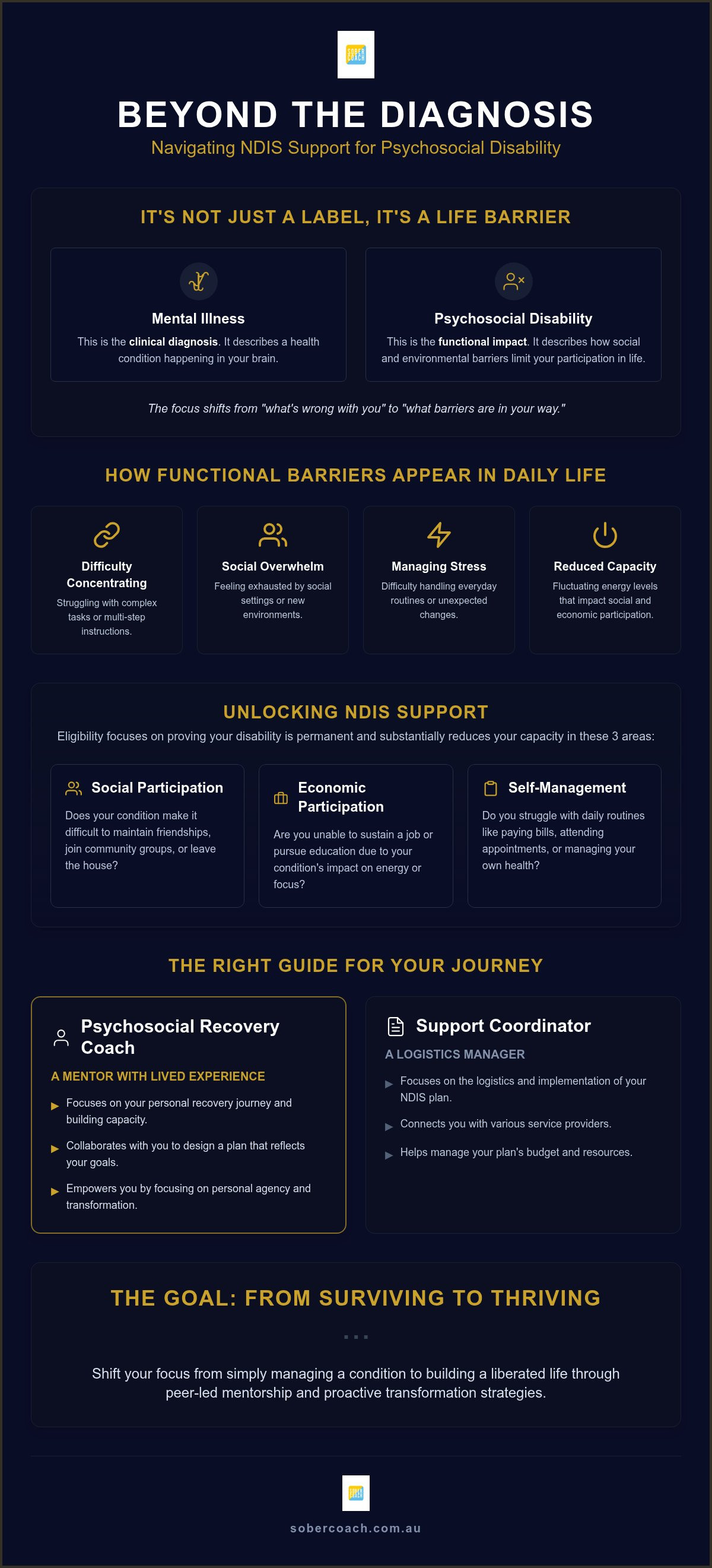
A diagnosis tells you what's happening in your brain; a psychosocial disability tells you how that experience stops you from living your life. It's the friction between your mental health and the world you live in. For many, the word "disability" feels heavy and clinical. You might prefer the term "life barriers" instead. This perspective shifts the focus from what's "wrong" with you to the obstacles standing in your way. Psychosocial disability is the result of social and environmental barriers interacting with a mental health condition to limit your full participation in society, while your personal agency remains the key to your transformation.
Finding the right ndis support for addiction recovery starts with understanding this distinction. It isn't just about having a condition. It's about how that condition creates a functional gap in your daily existence and stops you from showing up as the person you want to be.
The Difference Between Mental Illness and Psychosocial Disability
Mental illness is a health condition. Psychosocial disability is the social consequence of that condition. You might have a diagnosis of depression or anxiety, but that doesn't automatically mean you have a psychosocial disability. To qualify for NDIS support, the impact must be likely to be permanent or long-term. In Australia, this means looking at how your condition prevents you from working, studying, or connecting with your community. It's about the Psychosocial factors that make simple tasks feel like climbing a mountain.
Signs of Functional Impact in Daily Life
What does this look like on a Tuesday morning? It's not just "feeling bad." It's the crushing weight of time pressure that makes you freeze. It's the lack of stamina that sees you exhausted after only two hours of social interaction. Common signs include:
Struggling to concentrate on complex tasks or follow multi-step instructions.
Feeling overwhelmed by social settings or new environments.
Difficulty managing the stress of everyday routines or unexpected changes.
A reduced capacity for social and economic participation due to fluctuating energy levels.
Trauma often sits at the heart of these barriers. It shapes how you perceive safety and how much energy you have left for the world. When these functional impacts become a pattern, they stop being symptoms and start being disabling barriers. Accessing ndis support for addiction recovery requires documenting these specific hurdles so you can get the practical help you need to move forward.
Navigating the NDIS for Psychosocial Support
The NDIS system can feel like a maze of bureaucratic jargon designed to keep people out rather than let them in. However, the 2026 reforms have shifted the focus toward functional eligibility. This means the NDIA is looking less at your specific diagnosis and more at how your condition stops you from living a full life. Finding ndis support for addiction recovery often starts with understanding Section 24 of the NDIS Act. In plain English, this section requires you to prove that your disability is likely to be permanent and that it substantially reduces your functional capacity in specific areas of your life.
To build a strong case for support, you need to show how your psychosocial barriers impact these three core pillars:
Social Participation: Does your condition make it difficult to maintain friendships, participate in community groups, or leave the house?
Economic Participation: Are you unable to sustain a job or pursue education because of fluctuating energy or cognitive barriers?
Self-management: Do you struggle with daily routines like paying bills, attending appointments, or managing your own health?
The NDIS looks for evidence that these impacts are significant and ongoing. For more detail on the official criteria, you can review the government's guidelines on NDIS support for psychosocial disability. Connecting with a recovery coach who has been in your shoes makes this process feel less like a clinical assessment and more like a partnership.
The Role of a Psychosocial Recovery Coach
A Psychosocial Recovery Coach (PRC) is a specialized support person who acts as a mentor rather than a manager. While a Support Coordinator focuses on the logistics of your plan, a PRC focuses on the recovery journey itself. They collaborate with you to design a plan that reflects your personal goals and agency. This role is most effective when the coach has lived experience. That shared history builds immediate trust; they don't just understand the theory of recovery, they know the reality of the struggle.
How to Use Your NDIS Plan for Coaching
If you're heading into a planning meeting or a review, you should specifically ask for "Psychosocial Recovery Coaching." This support is typically funded under the Capacity Building bucket of your NDIS budget. The beauty of this funding is its flexibility. You can use your hours for in-home recovery support to manage triggers in your actual living environment, or you can opt for online sessions via Zoom if that feels more accessible. It's about making the ndis support for addiction recovery work for your lifestyle, not the other way around.
Breaking Down Social and Environmental Barriers
Your recovery doesn't happen in a vacuum. It happens in the crowded aisles of a Coles, in a high-pressure office in the CBD, or at a family BBQ where the questions feel like an interrogation. In the Australian social landscape, the "unseen" barriers are often the most exhausting. Stigma creates a disabling environment where you feel you have to hide your struggles just to fit in. This constant performance drains your energy and reinforces the idea that you're the problem. It's not true. Often, it's the environment that needs to change, not your worth as a human being.
Routines and habits are the tools we use to dismantle these external walls. By building intentional daily patterns, you start to reclaim control over your immediate space. This is the core of our approach: recovery coaching focuses on environmental mastery rather than clinical fixing. When you master your environment, you stop reacting to the world and start living in it on your own terms. Seeking ndis support for addiction recovery is a proactive choice to build a life that supports your growth instead of hindering it.
Managing Stamina and Social Interaction
Navigating public Sydney spaces, from the noise of Town Hall station to the intensity of a weekend market, requires more than just "powering through." It requires pacing. Pacing is the practice of managing your mental health stamina so you don't hit a wall by Wednesday. You can learn to communicate your needs to employers or family without feeling "broken." It's okay to say, "I need a quiet space for ten minutes to reset my focus." This isn't a weakness; it's a strategy for long-term success. It's about knowing your limits and respecting them so you can show up fully when it matters most.
The Importance of Trauma-Informed Care
Trauma sensitivity is non-negotiable because your past experiences shape how you navigate the present. A recovery coach provides a safe space for transformation that avoids the clinical coldness of traditional settings. We look at how past trauma creates current functional barriers, but we do it without judgment. According to the official NDIS guidelines on psychosocial disability, support should always be recovery-oriented and person-centred. By linking your history to your current hurdles, we can find practical ways to move forward. This human-to-human connection is what makes ndis support for addiction recovery truly effective. It bridges the gap between where you've been and where you're going.
Recovery Coaching vs. Traditional Therapy: Which Do You Need?
Therapy looks back to heal roots; coaching looks forward to build a life. It's not an "either/or" choice, but a "yes, and" approach. Many people find that while therapy helps them understand their history, they still feel paralyzed when facing their current environment. This is exactly where ndis support for addiction recovery through coaching fills the void. You might have the insight, but you lack the practical tools to change your Tuesday afternoon. Coaching provides the bridge between clinical understanding and real-world action.
The clinical model is traditionally focused on diagnosis and treatment. It's essential for managing the underlying mental health conditions that contribute to your psychosocial disability. However, the coaching model is built on goals and action. It’s about what you do when the session ends and you're back in the real world. If you've ever thought, "I’ve already tried therapy and I’m still struggling with my daily life," it’s likely because you need support that touches your habits, not just your history. You don't need more medicalized labels. You need a practical map for transformation.
The Power of Lived Experience
Shared history is a powerful currency in recovery. When you sit down with a mentor who has walked the same path, the dynamic of support changes instantly. You aren't a patient being studied under a microscope; you're a person being guided by someone who knows the weight of the struggle. This peer-led approach is central to how we work. It moves you from a feeling of powerlessness to one of empowerment. By utilizing lived experience, we build a level of trust that clinical distance simply cannot reach. It's about human-to-human connection that recognizes your agency as the primary driver of change.
Practical Tools for Daily Living
Sustainable change happens in your living room, your kitchen, and your community. Our in-home recovery support is designed to help you manage triggers in the actual environment where they occur. This real-world focus is what makes coaching a vital part of ndis support for addiction recovery. While a therapist might help you process an emotion, a coach helps you navigate the grocery store without being overwhelmed. We focus on the functional barriers that traditional clinical settings often overlook.
Accountability is also handled differently here. In a coaching relationship, we're partners in your daily progress. We focus on habit transformation that sticks, helping you build a lifestyle that supports your long-term goals. This isn't about a weekly check-in; it's about creating a proactive, goal-oriented framework for your entire life. It’s about building a foundation that lasts long after the session is over.
Ready to move beyond the clinical box and start your transformation? Reach out to Sober Coach today to find a mentor who understands your journey and can help you build a liberated life.
Taking the First Step Toward a Liberated Life
Moving from the confusion of NDIS jargon to a place of personal agency is a significant shift. You've explored what psychosocial disability actually means and how the system's focus on functional capacity can finally work in your favour. Now, the focus moves from understanding your barriers to dismantling them. Recovery isn't an end point or a destination where you're suddenly "cured" of your history. It's a powerful beginning. It's the moment you decide that your life will no longer be defined by what you can't do, but by the purpose you choose to pursue.
Reaching out for help is often the hardest part of the process. We've stripped away the clinical coldness to offer a human-to-human connection that respects your journey. Whether you're looking for ndis support for addiction recovery or simply need a mentor who understands the functional hurdles of mental health, the path forward is built on shared history and mutual respect. You can start with a personalized one-on-one session to map out exactly what your version of a liberated life looks like.
Integrating Support into Your Routine
Transformation doesn't require a total life overhaul on day one. In fact, the most sustainable changes often start small. You might begin with in-home recovery support to help manage the specific triggers that make your mornings difficult. Or, you could join one of our intensive recovery workshops to gain practical tools for habit change. Setting your first goal with a recovery coach helps build the momentum you need to tackle larger challenges later on. For those seeking a deeply tailored approach, One-on-One Recovery Coaching provides a clear path-finding service that adapts to your specific needs and pace.
Accessing Support in Sydney and Beyond
We believe that high-quality, peer-led support should be accessible to every Australian, regardless of their postcode. For local residents, we offer Sydney-based in-person support options that allow for face-to-face connection in your own environment. If you're located elsewhere, you can join our national community through our online rehab programmes and group coaching sessions via Zoom. These digital spaces provide the same level of empathy and direct, no-nonsense guidance as our in-person sessions.
The goal is to provide ndis support for addiction recovery that fits into your life, not a programme that forces you to change who you are to fit a clinical box. You have the power to redefine your relationship with your environment and your habits. You don't have to navigate these barriers alone. We're here to walk beside you as you take these first courageous steps toward a life of independence and vibrant health.
Build Your Foundation for a Liberated Life
Understanding the functional impact of psychosocial disability is the first step toward reclaiming your personal agency. You've seen how the right ndis support for addiction recovery can bridge the gap between clinical treatment and the vibrant life you deserve. By focusing on environmental mastery and practical daily habits, you can dismantle the barriers that have held you back for too long. Whether you're navigating the complexities of the NDIS or seeking a mentor who truly understands your history, professional support is within reach.
Sober Coach provides NDIS-aligned support frameworks delivered by mentors with lived experience. We offer flexible one-on-one coaching and in-home recovery support across Sydney, as well as online rehab options for those living anywhere in Australia. You don't have to face these social and environmental hurdles alone. Take the next step toward your transformation today. Book a discovery session with a Sober Coach today and start building a life defined by your choices rather than your limitations. Your recovery is a powerful beginning.
Frequently Asked Questions
What is the difference between psychosocial disability and mental illness?
Mental illness is a clinical diagnosis, while psychosocial disability is the functional impact that condition has on your life. Not everyone with a mental illness experiences a disability. PSD specifically refers to the social and environmental barriers that prevent you from participating in society. It's about how you function in the world, not just the symptoms you experience. This distinction is vital for accessing NDIS support because the scheme funds help for the disability, not clinical treatment.
Can I get NDIS support for addiction recovery if I have a dual diagnosis?
Yes, you can access ndis support for addiction recovery if you have a dual diagnosis. The NDIS focuses on the functional impairment caused by your primary mental health condition. If your addiction issues co-occur with a psychosocial disability, the scheme can fund supports that help you manage daily life and build capacity. The key is demonstrating how your mental health condition creates barriers to your independence, regardless of other challenges you are facing.
What does a psychosocial recovery coach actually do on a daily basis?
A recovery coach works as your practical mentor to navigate daily life barriers. On a typical day, they might help you set achievable goals, manage social triggers in your environment, or build routines that support your stamina. They don't just talk about problems; they focus on action. This might include in-home support to organize your space or online sessions via Zoom to practice communication strategies before a difficult family event or a workplace meeting.
Is a psychosocial disability considered permanent by the NDIS?
The NDIS requires a disability to be permanent or likely to be permanent. For psychosocial disabilities, this includes conditions that are episodic or fluctuating in nature. Even if you have "good days," the impact on your life must be ongoing. The NDIA recognizes that mental health journeys aren't linear. They look for evidence that you will require support over the long term to manage the functional barriers that your condition creates in your daily life.
How do I know if I am eligible for NDIS mental health support?
Eligibility is determined by your functional capacity rather than just a specific diagnosis. Under Section 24 of the NDIS Act, you must show that your condition significantly impacts your ability to manage social interaction, self-care, or economic participation. If you struggle with daily tasks like maintaining a routine, leaving the house, or managing stress in public, you may be eligible. Focus on documenting the barriers you face in your real-world environment when applying for support.
What is the difference between a support coordinator and a recovery coach?
A support coordinator focuses on the logistics and architecture of your NDIS plan. They help you find providers and manage your budget. In contrast, a recovery coach is a mentor who focuses on the recovery journey itself. They work with you on habit transformation and building personal agency. While the coordinator handles the paperwork, the coach sits beside you to tackle the actual life barriers that prevent you from reaching your personal goals.
How can a recovery coach help me if I am already seeing a therapist?
While your therapist helps you process past trauma and clinical symptoms, a recovery coach helps you apply those insights to your daily life. Think of coaching as the bridge between the therapist's office and the real world. A coach provides practical ndis support for addiction recovery by helping you manage triggers in real-time. They offer accountability and hands-on strategies for navigating social settings, making them a perfect complement to traditional clinical therapy.
Do I need a formal diagnosis to access psychosocial recovery coaching?
To access this support through NDIS funding, you generally need a formal diagnosis from a health professional. This provides the medical evidence required to prove your condition is likely to be permanent. However, the NDIS assessment focuses heavily on your functional capacity. You must demonstrate how that diagnosis creates specific disability barriers in your life. If you don't have NDIS funding yet, you can still access peer-led coaching through private arrangements to start your transformation.
Comments