

Celebrating Sober Milestones: Meaningful Ways to Honour Your Progress in 2026

What if the most significant part of your sobriety anniversary isn't the number on a chip, but the quiet strength you've built to get there? For many, the idea of celebrating sober milestones feels like a minefield of social anxiety or the fear that a party without a drink will feel hollow. You've worked hard to reclaim your agency, yet reaching a goal can sometimes leave you with the "milestone blues" or a sense of emptiness. It's a common hurdle in the journey toward a liberated life, but it doesn't have to be your reality.
We understand that true transformation isn't about deprivation; it's about growth and self-discovery. In this guide, you'll discover how to transform these dates from simple calendar markers into powerful tools for long-term identity growth. We'll move past clinical labels and explore practical, non-triggering ways to honour your progress in 2026. By leveraging the rapidly expanding range of non-alcoholic options and creating personalised rituals that reinforce your pride, you'll build a framework for staying motivated. Let's look at how you can make your next milestone a launchpad for the vibrant, alcohol-free life you deserve.
Table of Contents
Why Sobriety Milestones Are Strategic Anchors for Your New Identity
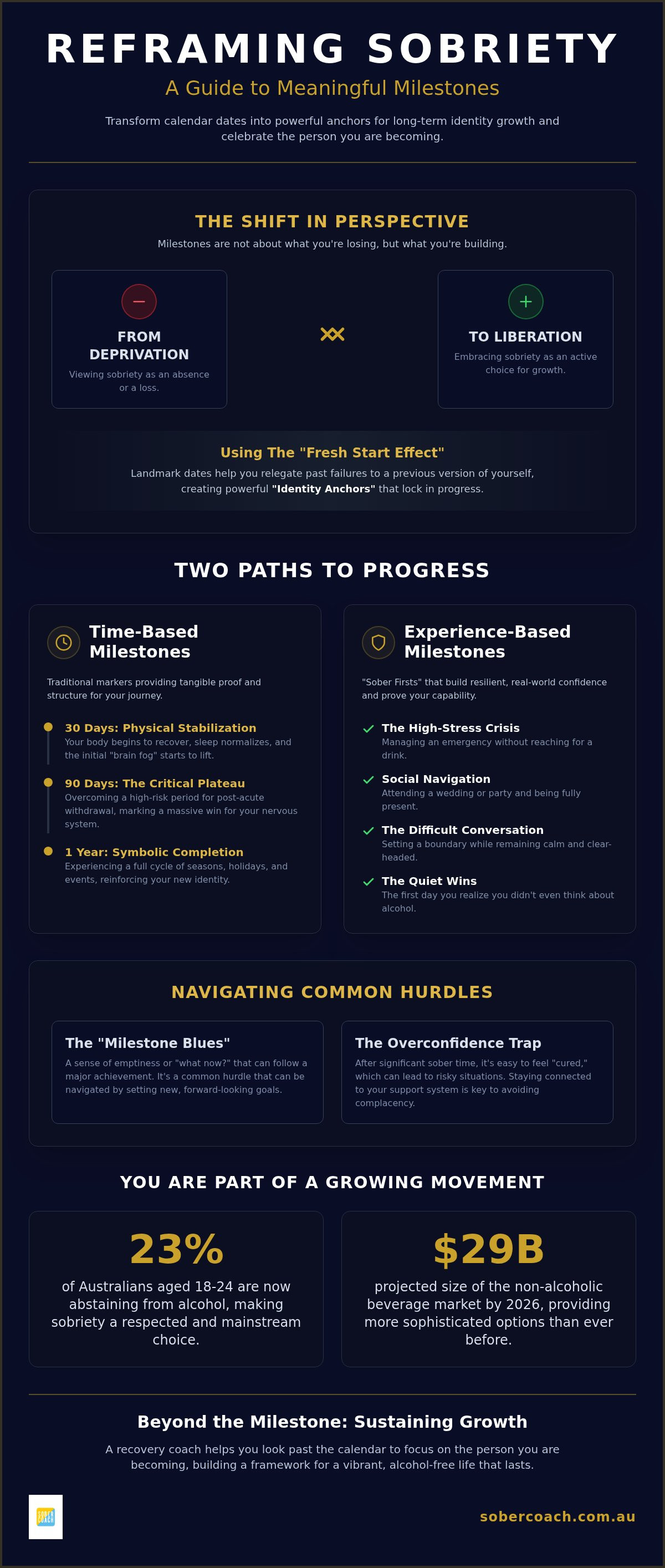
A milestone is more than a circled date on a calendar. It's a conscious recognition of your personal evolution. While the traditional definition of sobriety focuses on the simple absence of alcohol, we view it as the presence of agency. Celebrating sober milestones allows you to pause and acknowledge that you aren't just "quitting" something; you're building a new version of yourself. This shift is vital. It moves you from a state of perceived deprivation to one of active liberation. By marking these moments, you create "identity anchors" that lock in your progress and make your new habits feel permanent.
Psychologists often refer to the "Fresh Start Effect." This is the phenomenon where landmark dates, like New Year's Day or even a Monday, help us relegate past failures to a previous version of ourselves. In 2026, with the non-alcoholic beverage market projected to hit nearly 29 billion dollars, choosing not to drink is becoming a mainstream power move. When you celebrate a milestone, you use that momentum to reinforce the belief that you're no longer someone who "can't" drink. Instead, you're becoming a person who simply doesn't.
The Psychology of Progress: Why Our Brains Need Wins
Your brain craves evidence of success. Every time you hit a small win, whether it's 24 hours, one week, or your first sober wedding, your brain receives a hit of dopamine. These natural rewards are essential because they begin to compete with the old, destructive craving cycles. This process builds self-efficacy, the internal belief that you're capable of managing your life and your choices. While some people find that counting every single day creates unnecessary pressure, for many, those numbers provide the tangible proof needed to keep going during difficult patches. It's about finding the rhythm that supports your growth without becoming a source of stress.
Moving Beyond the Stigma of Recovery
Language has power. We prefer to think of milestones as "liberation markers" rather than "rehab anniversaries." This reframing removes the weight of traditional stigma and positions your journey as a proactive choice. You don't have to feel awkward when talking about your progress with non-sober friends. In fact, with 23% of Australians aged 18 to 24 now abstaining from alcohol, your choice is more respected than ever. You have the right to choose the vocabulary that fits your experience. By owning your story and celebrating your wins on your own terms, you transform your sobriety from a secret to a source of immense pride.
Time-Based vs. Experience-Based Milestones: A New Framework
While counting days provides a clear metric, it doesn't always capture the depth of your transformation. Traditional time-based markers are the foundation, but functional "firsts" are the architecture of a new life. By rethinking recovery and recovery support, we can see that true progress is often measured in moments of pressure rather than just pages of a calendar. Celebrating sober milestones should involve both the passage of time and the accumulation of capability.
The Traditional Timeline: 30, 90, and 365 Days
The first 30 days are about physical stabilisation. Your liver is recovering, your sleep cycles are beginning to normalise, and the initial "brain fog" starts to lift. It's a period of intense readjustment. By the 90-day mark, you often hit a critical plateau. This is when post-acute withdrawal symptoms can peak, making it a high-risk period for many. Surmounting this "90-day hump" is a massive win for your nervous system. One year represents a full trip around the sun. You've experienced every season, every holiday, and every birthday without a drink. It's a symbolic completion that reinforces your new identity as a permanent reality.
Functional Milestones: Celebrating Real-Life Wins
Experience-based milestones are often more resilient against relapse because they provide evidence of your strength. They prove you can handle life on its own terms. These "Sober Firsts" are the real-world tests that build lasting confidence. Consider these functional wins:
The High-Stress Crisis: Managing a car breakdown or a work emergency without reaching for a bottle.
Social Navigation: Attending your first sober wedding or funeral and actually being present for the people there.
The Difficult Conversation: Setting a boundary with a family member while remaining calm and clear-headed.
Don't overlook the "Quiet Wins" either. These are internal shifts, like the first day you realise you didn't even think about a drink until late afternoon. Or the moment you find yourself genuinely laughing at a party without needing "liquid courage." These internal markers are proof that your brain is rewiring itself for joy. If you're looking to turn these moments into a sustainable lifestyle, one-on-one recovery coaching can help you navigate these transitions with expert guidance.
Meaningful Ways to Celebrate Your Sober Milestones in Sydney
Celebrating sober milestones shouldn't feel like a consolation prize. It's an opportunity to lean into a vibrant, liberated lifestyle that alcohol used to mask. In Sydney, the shift toward "sober curious" living means your options for an elevated experience have never been better. Whether you prefer a quiet moment of reflection or a high-energy community event, the key is to choose an activity that honours the person you're becoming. This isn't about deprivation. It's about marking your territory in a life you've fought hard to reclaim.
Sydney-Specific Celebration Ideas for 2026
Start your milestone day with a sunrise walk from Bondi to Coogee. There's a profound symbolism in watching the day begin over the Pacific Ocean. It grounds you in nature and physical movement, reminding you of the clarity you've gained. If you're a foodie, explore the sophisticated non-alcoholic pairing menus in Surry Hills or the CBD. The non-alcoholic beverages market in Australia is projected to reach USD 48.01 billion by 2034, which means the variety of complex, fermented, and botanical options in Sydney's top restaurants is staggering. For those looking to deepen their transformation, booking an Intensive Recovery Workshop is a powerful way to reinvest in your future self. It turns a single date into a weekend of profound growth and peer connection.
Alcohol-Free Rituals That Don't Feel Childish
You don't need a "sober party" with balloons to mark your progress. Consider a high-end wellness retreat in the Blue Mountains. The crisp mountain air and professional treatments provide a sensory reward that alcohol never could. Many people also choose to create a permanent visual anchor, such as a piece of custom jewellery or a "sobriety tattoo." This serves as a daily, tangible reminder of your agency. You might also consider the "Gift of Sobriety" by taking the money you've saved from not drinking and donating it to a local Sydney charity. It's a way of turning your personal victory into a collective good. When you are celebrating sober milestones, this act of giving back reinforces your new identity as a person of value and impact. It proves that your growth has a ripple effect far beyond your own life.
Coping with the 'Milestone Blues' and Potential Triggers
Reaching a major goal often brings a strange sense of anticlimax. You expected fireworks, but instead, you feel a bit flat. This is the "milestone blues." It's a common emotional dip that occurs when the adrenaline of the build-up fades. Recognising this early prevents it from becoming a trigger. It's also easy to fall into the "I've got this" trap. Reaching 100 days or a year can lead to dangerous overconfidence. You might start to believe you can handle a single drink because you've been "so good" for so long. Stay vigilant. Your progress is a shield, not a license to return to old patterns.
The 'Arrival Fallacy' in Sobriety
Many people subconsciously believe that reaching a specific date will magically resolve all their underlying problems. This is the "Arrival Fallacy." Hitting one year sober is a magnificent achievement. However, it won't fix your career stress or relationship dynamics on its own. Prepare for the reality that Day 366 looks a lot like Day 364. The key is to keep the momentum by setting new, life-focused targets. These should be about who you are becoming, not just what you are avoiding. If you experience a "slip" just before a major date, don't throw away your progress. One day doesn't erase months of growth. Reframe it as valuable data rather than failure. Get back on track immediately and keep moving forward.
Managing Social Pressure During Celebrations
Even when you are celebrating sober milestones, you might encounter people who don't understand the gravity of your journey. You'll likely hear the classic "Just one drink to celebrate!" from well-meaning but uninformed friends or family. This is where your exit strategy becomes essential. Know exactly what you'll say and when you'll leave if the environment shifts from supportive to triggering. You don't owe anyone an explanation for your liberation. Using a support network, such as a coaching circle, provides the external accountability needed to navigate these high-stakes dates safely. If you find the emotional weight of milestones difficult to manage alone, our one-on-one recovery coaching offers the personalised support you need to stay grounded and focused on your long-term growth.
Beyond the Milestone: How Recovery Coaching Sustains Your Growth
A milestone is a snapshot in time. It captures where you've been, but it doesn't necessarily dictate where you're going. This is where professional guidance becomes your greatest asset. A coach helps you look past the specific date to the person you're actually becoming. While celebrating sober milestones provides a necessary pause, long-term success requires a sustained vision. We call this "high-performance sober living." It's the point where you stop counting the days you've lost and start counting the opportunities you've gained.
By utilising One-on-One Recovery Coaching, you gain a strategic partner who understands the nuances of emotional recovery. They help you navigate the complexities that arise after the initial "pink cloud" phase fades. If you're planning a celebration at home, In-Home Recovery Support can be instrumental. It allows you to create a meaningful ritual in your own space, ensuring the environment remains a sanctuary rather than a source of stress. This personalised approach ensures that your home life reflects your new values of clarity and agency.
The Sober Coach Advantage: Mentorship vs. Peer Support
Peer support is valuable, but mentorship provides a different level of depth. A mentor with lived experience offers a sense of shared history that builds immediate trust. They aren't just telling you what to do; they're showing you what's possible. There's a fundamental difference between "staying sober" and truly "thriving in sobriety." Professional guidance helps you identify the psychological blocks that might be holding you back from your full potential. You can also leverage community-based Zoom sessions to share your milestone with people who truly understand the gravity of your win. It's about celebrating sober milestones within a culture of growth rather than just a circle of abstinence.
Next Steps: Building Your 2026 Sobriety Roadmap
Your journey doesn't end when the anniversary party is over. In fact, that's often when the real work begins. To deepen your tools and reinforce your identity, consider booking an Intensive Recovery Workshop. These sessions are designed to act as milestones in themselves, providing a concentrated burst of growth and self-discovery. Scheduling a check-in session before a major anniversary can also help you preempt the "milestone blues" we discussed earlier. It's about being proactive rather than reactive. Ready to make your next milestone your most powerful yet? Book a session today.
Own Your Progress: Turning Milestones into a Lifetime of Growth
Your sobriety is a testament to your personal agency. By shifting your focus from simply counting days to honouring functional "firsts" and "quiet wins", you transform your journey into a permanent identity. Celebrating sober milestones in 2026 isn't just about marking the past; it's about anchoring your future. You've learned that navigating the "milestone blues" and social pressures requires a strategic roadmap and the right support network to keep your momentum steady.
True liberation happens when you stop looking back at what you've left behind and start focusing on the vibrant life you're building. Whether you need the deep immersion of our Intensive Recovery Workshops in Sydney or the tailored guidance of Professional One-on-One Coaching, we offer non-judgmental, peer-led support designed for your lifestyle. You don't have to navigate these transitions alone. Start your personalised recovery journey with Sober Coach today. Your next milestone is just the beginning of a much larger, more courageous story.
Frequently Asked Questions
How do I celebrate one year sober without a party?
You can celebrate by investing in a high-end experience that nourishes your new identity. Consider a solo weekend retreat in the Blue Mountains or a sunrise hike along the Bondi coastal track. Many people choose to reinvest the money they've saved from alcohol into a permanent memento, like a piece of custom jewellery. The goal is to honour your growth through reflection and self-care rather than social performance.
Is it normal to feel sad on my sobriety anniversary?
Yes, feeling a sense of anticlimax or "milestone blues" is a very common experience. You might have built up the date in your mind, only to find that life feels much the same on the other side. This emotional dip often happens when the adrenaline of reaching a goal fades. It's helpful to acknowledge these feelings without judgement and focus on the quiet, steady strength you've developed.
How should I tell my family about my sober milestones?
You should share your milestones in a way that feels safe and empowering for you. If your family is supportive, a simple conversation about what the date represents can strengthen your bond. If they don't fully understand your journey, you might choose to keep the celebration private or share it only with your sober community. Setting clear boundaries about how you want to mark the occasion ensures the day remains about your progress.
What are some good sober-friendly places in Sydney for a celebration?
Sydney offers an incredible range of elevated, alcohol-free experiences in 2026. You could explore the sophisticated non-alcoholic pairing menus at top-tier restaurants in Surry Hills or the CBD. For a more active celebration, the Bondi to Coogee coastal walk provides a stunning backdrop for a symbolic new beginning. If you prefer wellness, the city has several high-end spas and infrared sauna studios that offer a luxurious way of celebrating sober milestones.
What if I relapse right before my one-year sober milestone?
A slip doesn't erase the months of clarity and growth you've already achieved. It's vital to reframe the situation as a learning opportunity rather than a total failure. While the calendar date might change, the skills you've built remain yours. Reach out to your support network immediately to process the event. Focus on getting back to your routine and remember that your worth isn't defined by a single number.
Should I count days or months in my recovery journey?
The choice between counting days or months depends entirely on what fuels your motivation. Counting days provides frequent dopamine hits and tangible proof of progress, which is often helpful in the early stages. However, some find that focusing on months or years reduces pressure and allows for a broader perspective on their evolution. Choose the metric that reinforces your agency and makes you feel proud of your daily choices.
How can a recovery coach help me with my sober milestones?
A recovery coach acts as a strategic mentor who helps you navigate the emotional complexities of significant dates. Through One-on-One Recovery Coaching, you can create a personalised roadmap for your anniversary that avoids common triggers. They provide the external accountability needed to stay grounded when the "milestone blues" hit. A coach ensures you're not just reaching a date, but actively thriving while celebrating sober milestones in your new lifestyle.
What is a 'dry-versary' and how is it different from a milestone?
A dry-versary is typically a time-based anniversary, such as one month or one year since your last drink. While it's a significant marker, we view a milestone as a broader recognition of personal evolution. This could include experience-based wins, like your first sober holiday or managing a crisis without alcohol. Both are important, but milestones often carry more weight because they represent the functional application of your new sober identity.
Comments