

When to Hire a Sober Companion for Lasting Recovery
- angie391
- 9 hours ago
- 12 min read

Imagine the moment the clinic doors close behind you and the quiet of your own home feels suddenly, terrifyingly loud. You have the tools, but the fridge is still there, the stress of work is waiting, and your family is walking on eggshells. This is the exact moment many people start wondering when to hire a sober companion to bridge the gap between clinical safety and the chaos of real life. It isn't about admitting defeat. It's about recognizing that the first few weeks back in your own environment are often the most volatile.
You probably feel like you should be able to do this on your own by now, or perhaps your family is exhausted from playing the role of the recovery police. We understand that the pressure to stay perfect can be paralyzing. In this guide, you will discover the critical transition points where 24/7 professional support is the difference between a relapse and a breakthrough. We will look at how intensive in-home support handles high-trigger events like weddings or business trips and why having a mentor by your side can transform your recovery from a fragile state into a vibrant, liberated lifestyle.
Table of Contents
The Recovery Gap: Why Post-Rehab is the Highest Risk Period
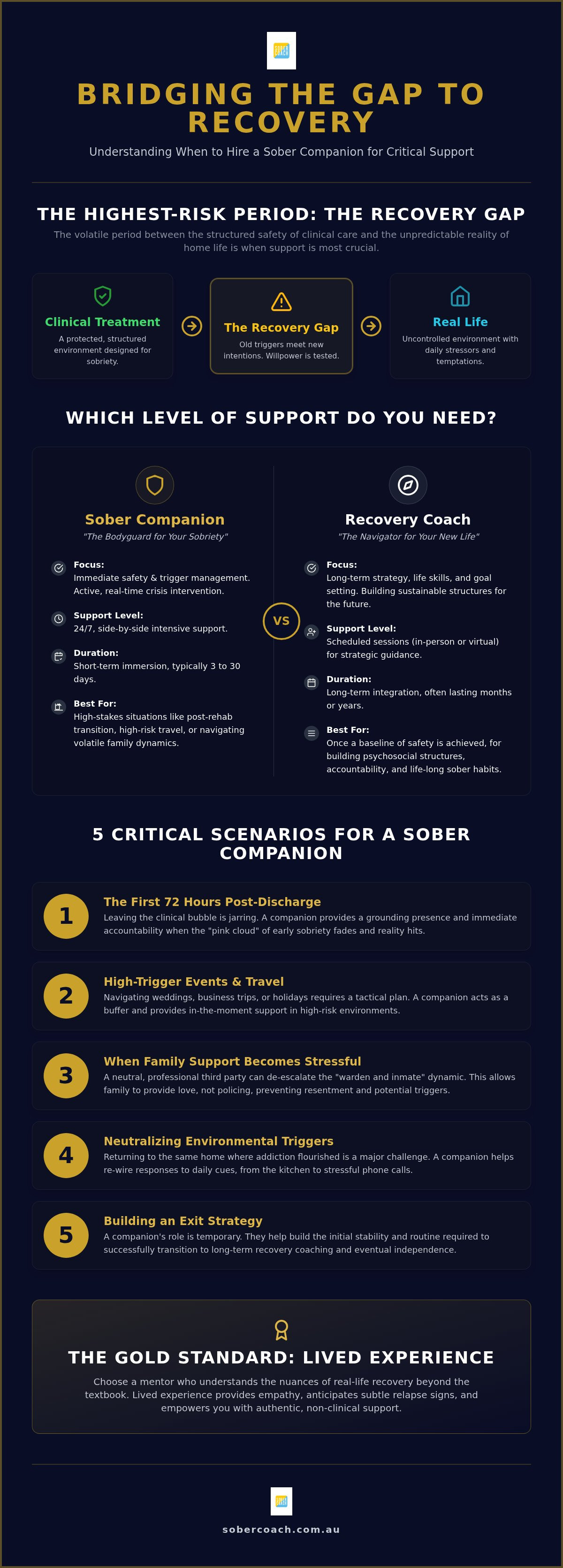
Leaving a residential treatment facility is a massive achievement, but it's also where the real work begins. In clinical care, you're protected. You're in a bubble where every meal, conversation, and hour of the day is designed to support your sobriety. The "Recovery Gap" is the volatile space between that clinical discharge and the moment your new habits actually become sustainable. It's the period where your old life meets your new intentions, and for many, the collision is violent. This is the primary window for when to hire a sober companion to act as a tactical bridge between those two worlds.
Willpower is a finite resource. When you return to the same house, the same kitchen, and the same stressors where your addiction once flourished, your brain naturally reverts to old survival cues. It isn't a lack of character; it's biology. A professional companion helps neutralize these immediate environmental triggers by being physically present. They don't just talk about change; they help you navigate the grocery store aisle or the stressful phone call in real time. Moving from a "safe" clinical setting to an "uncontrolled" real-world scenario requires more than just a discharge plan. It requires active, side-by-side reinforcement.
The "Pink Cloud" and the Reality Check
Many people leave rehab on a "pink cloud," a state of early sobriety euphoria where everything feels possible. You're confident, clear-headed, and certain you'll never touch a substance again. Then the cloud dissipates. The bills are still there. Relationships are still strained. When that reality check hits, the risk of a snap-back relapse is at its highest. A sober companion provides a grounding reality check during these first 72 hours post-discharge. They offer immediate accountability when the initial excitement fades and the heavy lifting of daily life begins.
When Family Support Isn’t Enough
Your family loves you, but they aren't trained to manage your recovery. Often, family members inadvertently fall into the role of "recovery police," checking your eyes, sniffing your breath, and hovering with anxiety. This dynamic creates a "warden and inmate" relationship that breeds resentment and stress, often triggering the very relapse everyone is trying to avoid. A sober companion is a neutral, professional third party with lived experience who provides intensive support without the emotional baggage of past family conflicts. They allow your family to go back to being your family, while we handle the intensive, in-home recovery support needed to keep you on track.
Neutrality: No history of arguments or broken promises.
Expertise: They recognize the subtle signs of a brewing relapse before you do.
Agency: They empower you to make choices rather than forcing compliance.
Sober Companion vs. Recovery Coach: Which Level of Support Do You Need?
Choosing the right level of support isn't about how "severe" your history is. It's about how much of your current environment is actively working against your desire to change. Deciding when to hire a sober companion often comes down to the intensity of your immediate situation. While both roles aim for the same outcome, their methods differ. One is a bodyguard for your sobriety; the other is a navigator for your new life.
Knowing when to hire a sober companion is essentially about identifying if you are in a state of "immersion" or "integration." Immersion is for those moments when your own willpower is under siege. You need someone physically present to disrupt old patterns before they take hold. Integration, on the other hand, is for when you've achieved a baseline of safety but need help building the psychosocial structures to keep it. The cost of intensive support is often a point of hesitation, but the value lies in preventing a relapse that could cost far more in both financial and emotional terms.
The Companion: Short-Term Immersion
A sober companion provides 24/7, side-by-side support. Their primary focus is your immediate safety and trigger management. They are physically there when you wake up, when you go to work, and when you're tempted to make a detour on the way home. Typical durations for this level of care range from 3 days to 30 days of round-the-clock support. This is the ideal choice for high-risk travel or the high-pressure period immediately following a detox. Many clients find that starting with In-Home Recovery Support provides the stability needed to eventually transition into a less intensive routine.
The Coach: Long-Term Strategy
A recovery coach doesn't live in your pocket. Instead, they provide strategic, one-on-one sessions focused on habit maintenance and goal setting. This is about building a life you don't want to escape from. Coaching sessions often happen via Zoom or scheduled in-person meetings, providing a layer of accountability that fits into a functioning work and family schedule. At Sober Coach, our one-on-one coaching bridges the gap to total independence. It moves you away from the need for a constant physical presence and toward a state of self-governance where you possess the internal tools to handle life's complexities on your own terms.
Companion: Focuses on the "now" and physical abstinence.
Coach: Focuses on the "future" and emotional growth.
Hybrid: Many successful journeys start with a companion for 7 days before moving into weekly coaching.
5 Critical Scenarios: When to Hire a Sober Companion
Recovery isn't lived in a vacuum. It's lived in the real world, often in the middle of high-stakes environments that don't pause just because you're making a change. Recognizing when to hire a sober companion often comes down to identifying specific windows of vulnerability where your current tools might feel thin. It's about being proactive rather than waiting for a crisis to occur. When you're facing a situation where your willpower is the only thing standing between you and a drink, that's your signal to bring in professional reinforcement.
Leaving Residential Treatment: This is the most common transition point. The move from a controlled environment to your home requires a tactical handover to ensure your new habits don't evaporate the moment you see your old triggers.
Shared Living Spaces: If your partner, spouse, or housemate continues to use substances, your home is no longer a safe zone. A companion provides the necessary buffer to maintain your path while you navigate these complex dynamics.
Post-Relapse Stabilization: A slip doesn't have to become a full-scale disaster. Hiring a companion for a few days acts as a circuit breaker, providing the intensive support needed to stop the spiral and get back to your recovery goals immediately.
Navigating the Australian Corporate and Social Circuit
For many professionals in Sydney, Melbourne, or Brisbane, the corporate ladder is often slippery with social pressure. High-pressure board meetings, industry galas, and networking dinners almost always revolve around alcohol. In these settings, a companion acts as a discreet professional buffer. They provide 100% accountability without drawing unwanted attention, allowing you to maintain your professional reputation while staying firm in your commitment to a liberated life. This is particularly effective for those who cannot step away from their careers but need to ensure their environment remains safe during high-stakes events.
Safe Passage: Sober Travel Support
Isolation is a major trigger, and nothing creates isolation quite like a hotel room in a foreign city. Travel, whether domestic or international, removes your usual support structures and replaces them with the anonymity of airports and hotel bars. Understanding when to hire a sober companion for travel means recognizing that you don't have to white-knuckle these trips alone. A companion manages the logistics, ensures your environment stays trigger-free, and helps you execute a "safe" itinerary so you return home with your sobriety intact. They act as a constant presence, neutralizing the "vacation" trigger that often leads to impulsive decisions.
Vetting Your Support: How to Choose a Professional in Australia
Choosing who to let into your private life during your most vulnerable moments is a decision that requires both intuition and strategy. When you're deciding when to hire a sober companion, you're looking for more than a babysitter. You're looking for a mentor who has walked the path you're currently on. Lived experience is the gold standard here. It creates an immediate bridge of trust that clinical degrees simply cannot replicate. A peer-led approach ensures the support you receive is grounded in the reality of cravings, social pressure, and the messy process of rebuilding a life from the ground up.
The vetting process should be rigorous. You need to know exactly how this person will react when things get difficult. A vital question to ask any potential support person is: "What is your protocol for a trigger event?" A professional should have a clear, non-punitive strategy for de-escalation and safety. They must also be a fit for your specific lifestyle and personality. If you're a high-performing professional in a fast-paced environment, you need someone who understands that world, not someone who feels like an intruder in your boardroom or your home.
The Professionalism Checklist
Look for a mentor who offers a direct, no-nonsense approach. You don't need a cheerleader who ignores the hard truths; you need someone who will hold up a mirror with empathy. Professionalism in this field is non-negotiable. This means establishing clear boundaries, signing strict confidentiality agreements, and ensuring an alignment with a philosophy of personal agency. We believe you're the driver of your own recovery. Our role is to provide the map and the tactical support, not to take the wheel. If you're ready to find that level of dedicated reinforcement, you can explore our In-Home Recovery Support options.
Logistics and Locations
Practicality often dictates the success of a support arrangement. We provide intensive in-home support across New South Wales, Victoria, and Queensland. Whether you're navigating the social scene in Sydney or seeking a quiet transition in regional VIC, the support should be mobile and adaptable to your environment. It's also important to understand the travel requirements for the companion if your lifestyle involves frequent movement. You should verify the companion’s experience with your specific substance of choice to ensure they understand the unique behavioral patterns and craving cycles you're facing. This specificity is often the difference between a general support person and a true recovery specialist.
Directness: They should be comfortable challenging your perceptions.
Discretion: They must blend into your life without drawing unwanted attention.
Availability: Ensure they can commit to the 24/7 nature of the initial transition.
The Exit Strategy: Transitioning to Sustainable Recovery Coaching
A sober companion is a high-impact, short-term intervention designed to get you through the most volatile days of early sobriety. However, the goal of any intensive support is eventually to become unnecessary. Staying in the companion phase too long risks creating a new kind of dependency where your safety feels tied to another person's presence rather than your own internal strength. True transformation happens when you move from being kept sober by external forces to choosing to stay sober because your life is finally big enough to want it. While the initial decision regarding when to hire a sober companion is often driven by a fear of relapse, the transition away from that support should be driven by the confidence of your new habits.
The transition is about shifting your focus. In the beginning, we focus on abstinence and neutralizing triggers. As you stabilize, the work shifts toward purpose, career, and rebuilding the relationships that may have been damaged. This "off-ramp" ensures you don't feel a sudden drop in support, but rather a gradual increase in your own personal agency. It is the difference between a fragile recovery and a liberated life.
From In-Home Support to One-on-One Coaching
The move from 24/7 in-home support to scheduled coaching sessions is a significant milestone. It involves decreasing the physical "touchpoints" while simultaneously increasing the depth of the work. You start utilizing the practical tools you learned during the intensive phase on your own, while still having a dedicated mentor to check in with. This phase is less about preventing a drink and more about designing a future. We look at the nuances of your daily routine and help you navigate the psychosocial complexities of work and family life without the need for a constant shadow. This strategic shift is what makes the initial investment in when to hire a sober companion pay off in the long run.
Your Path Forward with Sober Coach
We provide a comprehensive ecosystem of support that adapts as you grow. For those who need a deep dive into the psychological patterns behind their habits, our Intensive Recovery Workshops offer a space for profound insight and breakthrough. For others, the flexibility of our Rehab online programs and group coaching via Zoom provides a vital sense of community that fits around a busy Australian lifestyle. You don't have to navigate the space between intensive support and total independence alone. We offer a structured path that keeps you connected to mentors who have lived experience every step of the way.
Ready to bridge the gap? Explore our One-on-One Recovery Coaching to see how we can support your long-term success.
Designing Your Path to Lasting Liberation
Recovery isn't just about surviving the next hour; it's about building a life that feels worth living. We've explored the critical moments that define when to hire a sober companion, from the volatile "Recovery Gap" immediately following residential treatment to navigating high-pressure corporate events in Sydney or Melbourne. By choosing peer-led support rooted in lived experience, you aren't just buying time. You're investing in the practical tools needed for long-term transformation across NSW, VIC, and QLD. This isn't clinical babysitting. It's a strategic partnership designed to help you reclaim your agency.
The transition from 24/7 support to strategic one-on-one coaching is your off-ramp to independence. It's time to stop playing defense against your old habits and start playing offense for your future. If you're ready to bridge the gap between where you are and where you want to be, we're here to walk that path with you. Book a discovery call with a professional recovery coach today and discover how a mentor who has been there can help you stay there. You have the power to choose a different story; let's start writing it now.
Frequently Asked Questions
How much does a sober companion typically cost in Australia?
Costs for professional support vary based on the level of intensity you need, as the industry in Australia isn't subject to government-mandated price structures. Deciding when to hire a sober companion often involves weighing the investment against the high cost of a potential relapse. Since these services are generally not covered by insurance, providers typically offer quotes based on whether you require hourly check-ins or 24/7 live-in support.
Is a sober companion the same as a sponsor in AA?
No, a sober companion is a professional service, whereas a sponsor is a volunteer mentor within a 12-step framework. While both provide peer-led support, a companion offers a level of intensive, round-the-clock accountability that a volunteer cannot provide. This is a dedicated professional relationship focused on real-time habit disruption and navigating the practical complexities of your daily life.
Do sober companions live in my house?
Yes, during the most intensive phases of recovery, a companion can live in your home to provide 24/7 safety. This physical presence is often the primary reason families consider when to hire a sober companion, as it eliminates the "unmonitored" gaps where cravings usually take hold. It's about creating a safe, trigger-free bubble within your own environment while you build your new habits.
Can a sober companion help with mental health issues alongside addiction?
We provide peer-led, non-clinical support that focuses on lifestyle transformation and habit management. While we offer a compassionate ear and practical tools for emotional strength, we don't provide medical or psychological treatment. We often work in tandem with your clinical team to ensure your daily home life aligns with the professional mental health care you're receiving.
What happens if I have a craving while my companion is with me?
Your companion acts as an immediate circuit breaker to disrupt the craving before it leads to action. Instead of struggling in isolation, you'll have someone by your side to help you use your tools, change your physical setting, or talk through the urge. This real-time support turns a high-risk moment into a breakthrough, teaching you exactly how to handle cravings in the future.
How long do people usually hire a sober companion for?
Most intensive support arrangements last between 3 and 30 days, depending on the complexity of your transition. This period is designed to get you through the highest-risk window of early sobriety. Once you've established a stable routine and feel confident in your environment, we typically transition you into a less intensive recovery coaching model to maintain your long-term growth.
Is hiring a sober companion confidential?
Yes, discretion and confidentiality are the cornerstones of professional recovery support. We understand the importance of privacy, particularly for those in high-profile roles or sensitive corporate environments. All support is delivered with a focus on your anonymity, ensuring you have the protection you need without compromising your professional or personal reputation.
Comments