

NDIS Addiction Recovery: Coaching & Support Guide 2026
- angie391
- 5 hours ago
- 12 min read

What if the key to your recovery isn't found in a hospital ward, but in the way you reclaim your daily agency? You're likely exhausted by the clinical "patient" labels and the confusing maze of rules regarding functional impact. It's frustrating when the system asks you to prove your struggle rather than supporting your strength. We understand that the traditional rehab model doesn't fit everyone, especially when you're looking for long-term support that actually sticks after the initial detox is over.
In this guide, we'll show you how to effectively use ndis funding for addiction recovery to access professional, non-clinical coaching that respects your lived experience. You'll learn how the 2026 NDIS reforms, including the updated psychosocial recovery coach rate of $105.43 per hour, can be used to build a life of liberation. We're moving beyond medicalized language to explore practical tools for daily living, helping you find a mentor who truly understands the path you're walking. By focusing on your capacity rather than your limitations, you can finally bridge the gap between surviving and thriving.
Table of Contents
Does the NDIS Cover Addiction Recovery? Understanding the 'Functional Impact' Rule
You might have been told that the NDIS doesn't cover addiction. That's a half-truth that keeps too many people from getting the help they deserve. While the scheme doesn't fund "treatment" for substance use in the traditional sense, it absolutely funds the support you need when addiction creates a significant functional impairment. The focus isn't on the substance itself; it's on how your life has been impacted. If your struggle is tied to a primary mental health condition, you can often access ndis funding for addiction recovery through the lens of psychosocial disability.
As of June 2025, approximately 65,300 Australians were accessing the scheme with a primary psychosocial disability. This category recognizes that mental health challenges can be just as disabling as physical ones. To qualify, you must show that your condition is permanent and that it creates a barrier to your "Reasonable and Necessary" daily activities. It's about looking at your life as a whole. The NDIA isn't interested in clinical "patient" labels; they want to know if you can participate in your community, manage your home, and build a stable future. We're moving away from the idea of being "broken" and toward the idea of being supported while you rebuild.
The Difference Between Treatment and Support
The National Disability Insurance Scheme (NDIS) operates on a strict divide between health services and disability support. Clinical "treatment," such as medical detox or hospital-based psychiatric care, remains the responsibility of the mainstream health system. However, NDIS is built for "capacity building." This is why coaching falls under the NDIS umbrella while detox does not. Coaching is about "Choice and Control," giving you the agency to design a life of liberation rather than just surviving from one clinical appointment to the next.
Identifying Your Functional Capacity Barriers
Think about the practical walls addiction has built around your life. Perhaps you find it impossible to maintain a routine, or maybe social anxiety prevents you from engaging in community activities. These are functional capacity barriers. Recovery coaching helps you dismantle these obstacles by focusing on daily-life tools and personal accountability. Functional impact is the gap between your current struggle to manage daily tasks and the liberated, independent future you're working toward. By identifying these gaps, you can secure the funding needed to hire a mentor with lived experience who helps you cross that bridge.
The Role of a Psychosocial Recovery Coach in Your NDIS Plan
A Psychosocial Recovery Coach is more than a service provider. They are a professional partner in your transformation. While other roles in your plan might focus on the "what" of your funding, your coach focuses on the "how" of your daily life. They work with you to design a recovery plan that reflects your personal agency. This isn't about being told what to do. It’s about having a mentor who understands the weight of your habits and the effort required to change them. By utilizing ndis funding for addiction recovery, you gain access to someone who bridges the gap between clinical advice and real-world survival.
The value of lived experience cannot be overstated. It strips away the clinical coldness of traditional rehab. When your coach has been where you are, the power dynamic shifts from "patient and doctor" to "mentor and student." This shared history builds a foundation of trust that is often missing in medicalized environments. You aren't just a case number. You're a person reclaiming their future with someone who knows exactly how steep the climb can feel.
It’s easy to confuse a Recovery Coach with a Support Coordinator. Think of it this way: your coordinator builds the house by managing your plan's logistics, but your coach helps you live in it. They help you navigate the system’s complexities without losing sight of your sobriety. They are there for the day-to-day challenges that a coordinator simply doesn't have the time or the specific training to address.
Building Capacity for Long-Term Sobriety
We don't just talk about change; we practice it. Building capacity means developing the emotional strength to handle triggers in your natural environment, not just in a protected clinical bubble. We move beyond the restrictive labels of traditional models toward a goal-oriented life plan. This involves setting clear boundaries and creating new routines that prioritize your well-being. Exploring one-on-one recovery coaching can be the catalyst for this practical transformation.
Collaboration with Your NDIS Team
Your coach is your advocate within the NDIS ecosystem. They collaborate with your Occupational Therapist and Support Coordinator to ensure everyone is pulling in the same direction. When it’s time for a plan review, your coach provides the detailed reports and evidence the NDIA requires. They frame your progress in terms of social and economic participation, ensuring your funding remains secure as you move toward independence. This collaborative approach ensures your recovery goals aren't just dreams, but documented milestones in your NDIS journey.
Recovery Coaching vs. Clinical Rehab: Finding the Right NDIS Fit
Clinical rehab often feels like a sterile pause button. You're removed from your life, your triggers, and your responsibilities for a month or two. While this "clinical bubble" offers a temporary sense of safety, it often fails to prepare you for the Tuesday afternoon when life gets heavy again. Recovery coaching is fundamentally different. It happens in the context of your real life. When you use ndis funding for addiction recovery, you're investing in support that integrates with your world rather than isolating you from it. It’s about building a liberated life while you’re actually living it, not just dreaming about it from a hospital bed.
Many people find the traditional medical model patronizing. They're tired of being treated like a diagnosis or a set of symptoms. A mentor with lived experience offers a direct, no-nonsense connection that clinicians often can't match. This human-to-human bond is professional yet deeply personal. It’s far more cost-effective than a residential stay; it allows you to maintain your family ties and work commitments while you grow. In-Home Recovery Support means your progress isn't tied to a specific facility; it’s tied to your own kitchen table and your own community. This approach turns your daily environment into a training ground for resilience rather than a place of isolation.
When you access ndis funding for addiction recovery, you're tapping into a system designed for long-term capacity building. The 2026-27 weekday rate for a Psychosocial Recovery Coach is $105.43 per hour, which allows for consistent, ongoing support that can last for years if necessary. This is a stark contrast to the "one and done" nature of many clinical programs. You aren't a patient waiting to be cured; you're a participant actively designing a lifestyle that no longer requires the substances you once relied on.
Bridging the Gap After Detox
The first 90 days after detox are notoriously difficult. The clinical system often drops people right when they need the most scaffolding. This is where capacity building truly matters. Coaching provides the structural support needed to prevent a return to old patterns. Intensive recovery workshops can accelerate this transformation, giving you a concentrated burst of insight that helps you navigate early sobriety with confidence. We focus on the practical, daily-life tools that make liberation a reality, ensuring you don't just survive the post-detox period but thrive within it.
Online Rehab: Accessibility for All Australians
Geography shouldn't dictate your access to quality support. Whether you're in regional QLD, rural VIC, or a busy suburb in NSW, online rehab programs bridge the distance. Group coaching via Zoom creates immediate community connection without the need for travel. These digital tools fit seamlessly into a flexible NDIS plan, allowing you to access world-class mentorship from the safety of your own home. It’s a modern approach for a demographic that values both privacy and connection. You get the benefit of professional accountability without the logistical stress of traditional appointments.
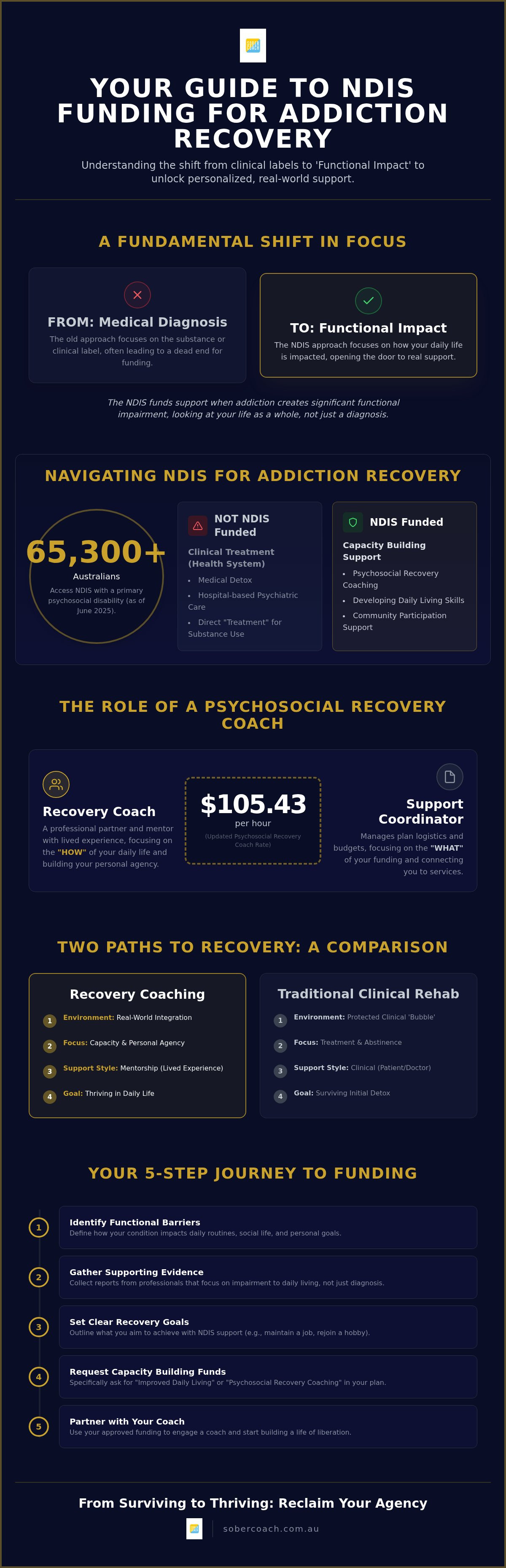
5 Steps to Securing NDIS Funding for Your Recovery Journey
Securing ndis funding for addiction recovery requires a strategic shift in how you present your story. The system doesn't fund the addiction itself, but it does fund the support needed to overcome the functional barriers that addiction leaves in its wake. With approval rates for psychosocial disabilities seeing a 62% drop over recent years, being precise with your application is more important than ever. Follow these five steps to build a case for your liberation.
Step 1: Gather Evidence of Functional Impact. You need documentation from health professionals that focuses on how your co-existing mental health condition impacts your daily life. It isn't about the diagnosis; it’s about the struggle to manage self-care, social interactions, or basic tasks.
Step 2: Define Clear Recovery Goals. Avoid clinical language. Instead of saying you want to "stop using," frame your goals around capacity building. Use phrases like "I want to rebuild my ability to manage a household" or "I want to develop the social skills needed to return to the workforce."
Step 3: Request a Psychosocial Recovery Coach. During your planning meeting, ask specifically for this role. This is a dedicated support item designed for people with psychosocial disabilities to help them navigate the system and maintain their personal agency.
Step 4: Choose Your Management Type. Opt for self-managed or plan-managed options. These give you the flexibility to choose a coach who truly fits your personality and needs, rather than being restricted to a narrow list of government-registered providers.
Step 5: Connect with a Professional Mentor. Partner with a provider who understands both the NDIS framework and the reality of recovery. If you're ready to take this step, you can get started with one-on-one recovery coaching today to ensure your plan is used effectively.
Self-Managed vs. Plan-Managed: Which is Best?
Self-management offers the ultimate level of choice and control. It allows you to hire a mentor based on their lived experience and effectiveness, even if they aren't NDIS-registered. This is vital for finding a specialist who speaks your language. Plan-managed plans are a great middle ground; a plan manager handles the invoicing and paperwork, but you still keep the freedom to choose your own coach. NDIA-managed plans are the most restrictive and often prevent you from accessing specialized, non-clinical recovery support.
Advocating for Yourself in a Planning Meeting
When you speak with a planner, use their terminology to describe your needs. Focus on "capacity building," "social participation," and "daily living support." You might say: "I require a recovery coach to help me build the daily routines and emotional resilience necessary to manage my home and participate in my community independently." If the NDIA initially says no, don't lose hope. You have the right to request an internal review. The goal is to show that a coach is a "reasonable and necessary" support that helps you move toward a life of independence and purpose.
Reclaiming Your Life with Sober Coach Australia
Transformation isn't about what you're giving up. It’s about what you’re gaining. At Sober Coach, we’ve moved past the sterile, clinical models that focus on what’s "wrong" with you. Our methodology is built on a foundation of profound empathy balanced with a direct, no-nonsense approach to personal change. When you secure ndis funding for addiction recovery, you aren't just buying a service; you're investing in a partnership with a mentor who has walked the path before you. This shared history builds immediate trust and strips away the weight of traditional stigma.
One-on-one recovery coaching provides the personalized accountability that group settings often lack. It’s a brave, transparent connection that focuses on your specific triggers and your unique goals. For those looking for a more structured environment for growth, our intensive recovery workshops offer a deep dive into the mechanics of habit and the nuances of emotional strength. We don't use medicalized labels or treat you like a patient. You're an individual reclaiming your agency, and we’re here to provide the scaffolding for that new life.
The promise of this journey is a liberated life, one that is no longer defined by substance use or the perceived deprivation of change. It’s a powerful beginning, not a clinical endpoint. By focusing on your capacity rather than your limitations, we help you build a lifestyle that is vibrant, purposeful, and entirely your own. This is the proactive, goal-oriented approach that distinguishes our work from traditional medical frameworks.
Your Recovery, Your Way
We understand that your life doesn't stop just because you're in recovery. That's why we offer flexible Sydney-based in-home recovery support and Australia-wide online options, including group coaching via Zoom and online rehab. Our non-clinical advantage means there are no restrictive labels and no judgment; we focus entirely on results. Our methodology ensures that ndis funding for addiction recovery is used for practical, real-world capacity building. You learn to manage your habits in your own kitchen, your own community, and your own life, rather than in a hospital ward.
Starting Your Transformation Today
The first step toward liberation is often the most courageous. When you book an initial consultation, you'll meet with an authentic mentor who understands the complexities of the NDIS system and the reality of personal change. In your first session, you can expect a human-to-human connection that feels steady and inviting. We’ll discuss your goals, explore your current barriers, and determine if our coaching style aligns with your NDIS plan. It’s time to move toward a future where you are the architect of your own experience. Book your free discovery call with Sober Coach today and begin the journey toward a life of true agency.
Step Into Your Liberated Future
You've seen how the system can work for you when you focus on functional impact rather than just a diagnosis. By choosing a path that prioritizes personal agency, you're moving away from clinical labels and toward a life of genuine purpose. We've explored how ndis funding for addiction recovery can be the bridge to professional mentorship that actually understands the weight of your history. This isn't about sitting in a hospital ward; it's about building resilience in your own home and community.
Our professional mentors bring lived experience to every session, offering a direct and empowering approach to personal transformation. Whether you're in a major city or a remote area, our flexible online rehab ensures that distance is never a barrier to your growth. You don't have to navigate this maze alone. It's time to stop surviving and start designing the life you deserve.
Start your recovery journey with an NDIS-compatible Sober Coach. Your transformation is a powerful beginning. You have the strength to redefine your story starting today.
Frequently Asked Questions
Can I use NDIS funding for a drug and alcohol detox?
No, the NDIS does not fund medical detox services. Detox is classified as a clinical health treatment, which remains the responsibility of the mainstream Australian health system and Medicare. The NDIS is designed to provide "capacity building" supports that help you manage your daily life and community participation once the medical intervention is complete.
Is a Sober Coach the same as an NDIS Psychosocial Recovery Coach?
They are similar in purpose but different in their official NDIS designation. A Sober Coach is a professional mentor who focuses specifically on the habits and emotional patterns of addiction. An NDIS Psychosocial Recovery Coach is a funded role within your plan specifically for participants with mental health challenges. Many participants use their recovery coach funding to work with a mentor who has lived experience in addiction.
What if my NDIS plan is NDIA-managed? Can I still use Sober Coach?
NDIA-managed plans are restricted to providers who are officially registered with the NDIS. If a specialist coach is not registered, you won't be able to access them under a restricted plan. To gain more "Choice and Control" over your mentors, you can request to move to a plan-managed or self-managed plan during your next review. This change allows you to hire the professional who best fits your personal journey.
Do I need a specific diagnosis to get NDIS funding for recovery support?
Yes, you must have a primary psychosocial disability, which is a mental health condition that causes a permanent and significant functional impairment. The NDIS does not recognize addiction as a primary disability. However, most people seeking ndis funding for addiction recovery have a co-existing mental health condition that qualifies them for support based on how it impacts their daily routines and independence.
How much of my NDIS budget should I allocate for coaching?
Your allocation depends on the intensity of support you need to reach your goals. The 2026-27 NDIS pricing guide sets the weekday rate for a Psychosocial Recovery Coach at $105.43 per hour. You should work with your planner to determine how many hours of "Capacity Building" support are reasonable and necessary to help you rebuild your social and economic participation.
Can NDIS pay for my family to receive support during my recovery?
No, NDIS funding is strictly for the participant's individual needs and cannot be used for family therapy or support services for others. However, the scheme can fund training or coaching for your family and carers if it directly helps them support your independence. This is often framed as "training for carers" to help you maintain a stable living environment.
What happens if my NDIS application for recovery support is rejected?
If your application is rejected, you have the right to request an internal review of the decision. Rejections are common for psychosocial claims, often because the "functional impact" wasn't clearly distinguished from the addiction itself. You'll need to provide stronger evidence showing how your primary mental health condition creates a permanent barrier to your daily life, regardless of substance use.
Are online rehab programs as effective as in-person coaching for NDIS participants?
Online programs are highly effective because they allow you to practice recovery tools in your actual living environment. This removes the "rehab bubble" effect where participants struggle to adapt after leaving a facility. For NDIS participants in regional areas, online rehab and Zoom-based coaching provide essential access to professional mentorship and community connection that might not be available locally.
Comments