

What to Drink When You're Not Drinking: Sober Guide

What if the most empowering choice you make at the bar tonight has nothing to do with the alcohol percentage and everything to do with how you feel when you wake up tomorrow? It's a common struggle. Standing in a crowded room in Sydney or Melbourne, you might feel like the odd one out while holding a glass of plain water. The boredom of basic juice or soda can make social gatherings feel like a test of endurance rather than a celebration. You want to participate in the ritual without the regret, yet the anxiety of social triggers often looms large.
Figuring out what to drink when you're not drinking shouldn't feel like a social sacrifice or a medical prescription. It is an act of personal agency. In this guide, you will discover the best alcohol-free alternatives that actually taste adult and the tactical strategies needed to handle social pressure with ease. We will explore everything from sophisticated functional beverages to the latest spirits hitting Australian shelves in 2026. You will learn how to maintain your sobriety while feeling fully included and vibrant, turning every occasion into a powerful beginning for your new, liberated lifestyle.
Table of Contents
Reclaiming the Ritual: Why What You Drink Matters
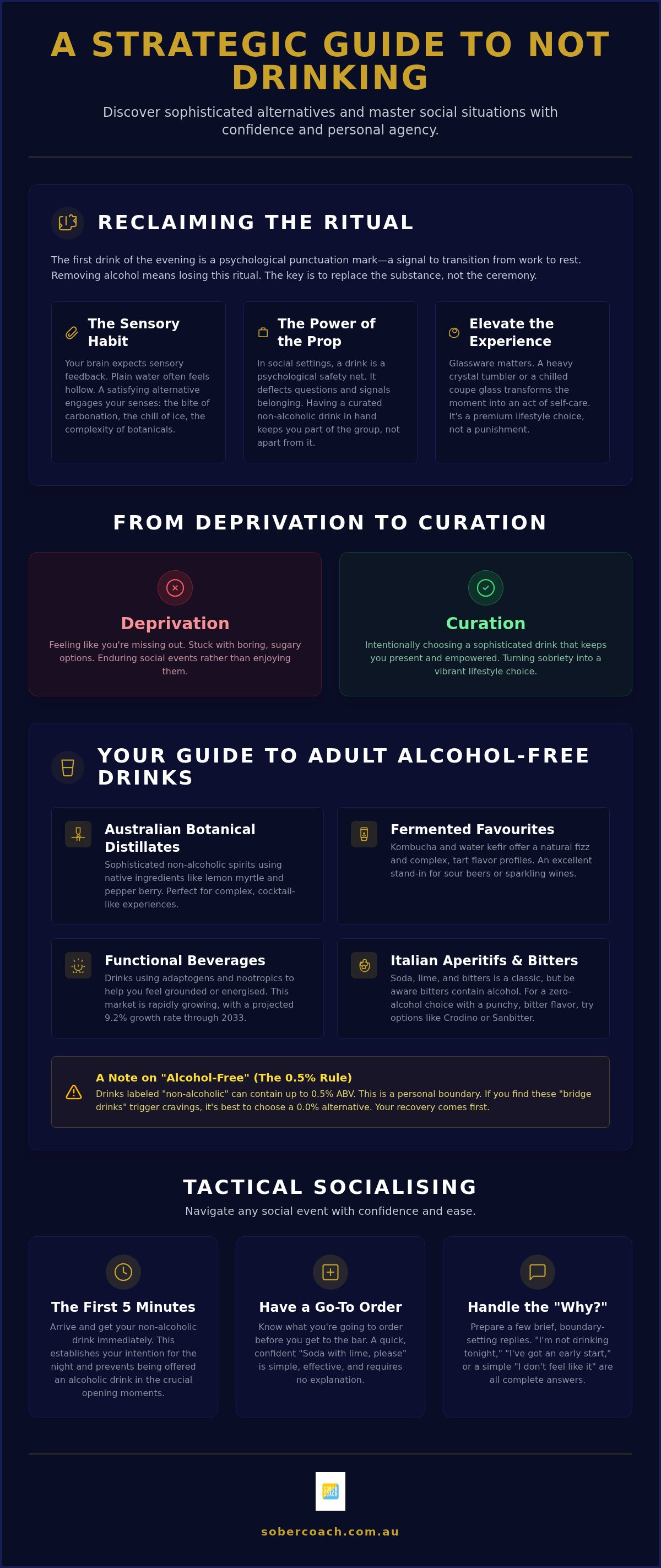
The first drink of the evening is often a psychological punctuation mark. It signals to your brain that the workday is done and it's time to downshift. When you remove alcohol, you don't just lose a liquid; you lose that ritual of transition. This is why a simple glass of tap water often feels so hollow. It doesn't provide the sensory feedback your habit expects. Deciding what to drink when you're not drinking is an exercise in personal agency. It's about reclaiming your right to unwind without compromising your clarity.
Your choice of glassware matters more than you might think. A heavy crystal tumbler or a chilled coupe glass changes the experience entirely. It elevates the moment from a basic necessity to an act of self-care. By focusing on the vessel and the ritual, you tell yourself that your sobriety is a premium lifestyle choice, not a punishment. You aren't just hydrating; you are honoring the transition from the chaos of the day to the peace of the evening.
The Psychology of the Social Prop
Holding a drink in a social setting serves as a psychological safety net. In a bustling bar in Melbourne or a house party in Brisbane, a full glass acts as an invisibility shield. It stops the well-meaning but intrusive questions about why you aren't drinking. When you have a drink in hand, you are part of the group. You shift your mindset from deprivation to curation. You aren't missing out on a cocktail; you are intentionally enjoying a curated alternative that keeps you present and empowered. Learning what to drink when you're not drinking helps you navigate these crowded rooms with a sense of belonging rather than isolation.
Identifying Your Personal Drink Triggers
To find a successful replacement, you must deconstruct what you actually enjoy about your old habits. Is it the sharp bite of carbonation? The cooling sensation of crushed ice? Or perhaps the complex, bitter notes of a botanical blend? Identifying these sensory cravings allows you to find a match that hits the spot without the hangover. Be mindful of bridge drinks. If an alcohol-free spirit feels too close to the real thing and triggers a physical craving for more, it might be a risk rather than a tool. Ritual reclamation is the intentional act of preserving the soothing rhythms of your life while replacing the substance with a choice that supports your vibrant, liberated future.
The Best Alcohol-Free Alternatives for Every Occasion
The days of being relegated to the kids' menu are over. Modern sobriety is about curation, not deprivation. In 2026, the global non-alcoholic market is projected to reach nearly USD 1.5 trillion, and Australia is at the forefront of this shift. Finding what to drink when you're not drinking now means choosing from a massive range of botanical distillates, fermented elixirs, and functional brews designed for an adult palate.
Consider these top-tier alternatives for your next outing:
Australian Botanical Distillates: Local producers are crafting spirits using native ingredients like lemon myrtle and pepper berry. These are widely available at major retailers like Dan Murphy's or Coles across Sydney and Brisbane.
Fermented Favourites: Kombucha and water kefir provide a natural fizz and a complex, tart flavour profile. They serve as excellent substitutes for sour beers or sparkling wines.
Functional Beverages: These drinks use adaptogens and nootropics to help you feel grounded or energised. With a projected 9.2% growth rate through 2033, these are becoming a staple in Melbourne’s sober-curious scene.
The Sophisticated Sippers: Bitter and Botanical
Soda, lime, and bitters remains the undisputed king of Australian bars. It's refreshing and socially invisible. However, you should be aware that traditional bitters contain alcohol. A few dashes in a large glass usually keep the drink under 0.5% ABV, which meets the standard for non-alcoholic labelling, but for some, this trace amount is a personal boundary. If you want something punchier, look for Italian aperitifs like Crodino or Sanbitter. Their intense bitterness and vibrant colour make them the perfect companion for the Golden Hour on a Friday afternoon. Learning what to drink when you're not drinking during these social windows is about finding flavours that signal relaxation to your brain without the fog of ethanol.
Hydration with Flare: Infused Waters and Teas
You don't always need a complex replacement spirit. Sometimes, simplicity is the ultimate sophistication. Cold-brew teas, steeped slowly in cold water for twelve hours, offer a delicate tannin structure that mimics the mouthfeel of wine. At home, you can create a Signature House Water by infusing sparkling mineral water with cucumber, mint, and a thin slice of jalapeño for a surprising kick. A top-tier recovery hack is simply using a wine glass or a heavy crystal tumbler. The vessel changes your psychology, making the experience feel intentional rather than accidental. If you're struggling to navigate these social shifts, one-on-one recovery coaching provides the practical support needed to feel confident and empowered in any setting.
The Mocktail Debate: Is Alcohol-Free Beer a Trigger or a Tool?
The decision of what to drink when you're not drinking often leads to a polarizing crossroads: alcohol-free (AF) beer and wine. In March 2026, updated regulatory guidance clarified that beverages with less than 0.5% ABV are classified as "non-alcoholic," while only those with 0.0% can claim to be "alcohol-free." This trace amount is often less than what you would find in a ripe banana or a slice of sourdough bread. For many, these drinks are a vital bridge to social inclusion. For others, they feel like playing with fire. Understanding your own boundaries is the first step in deciding if these alternatives belong in your toolkit.
Using AF options comes with a distinct set of pros and cons that vary based on your personal history:
Pros: You get to enjoy the familiar ritual and social "camouflage" in bars across Sydney or Melbourne. The familiar taste can also trigger a "placebo" relaxation effect, helping you unwind without the neurotoxic consequences.
Cons: Sensory triggers can be powerful. If the taste of a non-alcoholic IPA makes you crave the real thing, it's a signal that the drink is a threat to your agency. It can be a slippery slope that leads back to old patterns.
Before you take an AF beer into a high-stakes social situation, test your reaction in a safe, controlled environment at home. Observe your thoughts. If you find yourself "chugging" the AF version or feeling a restless itch for the "real" thing, it’s a sign to stick to options that don't mimic your old favorites. Your sobriety is about growth, not white-knuckling your way through a simulated version of your past.
The Sensory Trap: Smell and Taste Triggers
The smell of hops or the specific acidity of wine can trigger an immediate dopamine spike in the brain before the liquid even hits your throat. This is the brain’s reward system anticipating a "hit" that isn't coming. If you find this frustrating rather than satisfying, choose a drink that tastes nothing like your previous go-to. The placebo effect in alcohol-free consumption is a psychological phenomenon where the brain mimics the relaxation associated with drinking simply because the sensory experience of the beverage is familiar.
Navigating the 'Near Beer' Market in Australia
The Australian AF beer market has exploded in 2026, with local craft breweries producing stouts and lagers that are virtually indistinguishable from their full-strength counterparts. While beer has reached a high level of sophistication, AF wine remains the hardest category to master; many options still feel like overpriced grape juice. If you are dining out in Brisbane or Perth and the AF wine list looks uninspired, stick to "virgin" versions of classic cocktails like a Mojito or a Bloody Mary. These offer a complex, adult flavor profile without the sensory baggage of a dealcoholized wine.
Tactical Socialising: How to Order and Handle the 'Why?'
Socialising in Australia often feels like a high-contact sport where a drink in hand is your only piece of protective gear. The anxiety of being the "odd one out" in a Sydney pub or a Melbourne rooftop bar is real. However, the secret to social survival isn't just about what to drink when you're not drinking; it's about how you manage the environment. You need a tactical plan that prioritises your comfort and protects your agency without making the night feel like a chore.
The "First Five Minutes" strategy is your most powerful tool. When you arrive at a venue, walk straight to the bar before you even find your group. Secure your drink immediately. When you greet your friends with a full glass already in hand, you bypass the inevitable "What can I get you?" interrogation. You've already made your choice. You're already part of the ritual. This simple move removes the immediate pressure and allows you to settle into the conversation on your own terms.
Bar Tactics for the Sober Australian
Ordering like a pro is about confidence and brevity. Don't browse the menu for ten minutes; have a "go-to" order ready. If you're in a busy venue, tip your bartender early. A few extra dollars on that first round of soda and lime often ensures your glass stays full and your "special" mocktail is prioritised all night. When it comes to the Australian culture of buying rounds, don't feel obligated to participate in the traditional way. Simply say, "I'm right for now, but I'll grab the next one." You can still buy a round for your mates while sticking to your own alcohol-free choice. Knowing what to drink when you're not drinking is only half the battle; knowing when to leave is the other. Recognise the "sloppy shift," that moment when the conversation turns repetitive and the vibe changes. That is your cue to exit with your dignity and your sobriety intact.
If you find the social pressure of the Australian drinking culture overwhelming, one-on-one recovery coaching offers the tactical support and lived experience to help you navigate these settings with total confidence.
Scripts for the Socially Anxious
You don't owe anyone a medical history or a deep dive into your personal transformation. "I'm not drinking tonight" is a complete sentence. If someone pushes, you have several scripts at your disposal:
The Health Angle: "I've got a massive session at the gym/a huge meeting tomorrow morning." People generally respect a performance-based goal.
The Truth Bomb: "I've retired from drinking; I went pro and finished my career early." This usually gets a laugh and ends the questioning.
The Deflection: "I'm driving tonight." It's the classic Aussie fallback that few people will ever challenge.
Handling a "piss-taker" requires a direct, no-nonsense approach. If a friend becomes pushy, a simple "I'm good, mate, let's talk about something else" is usually enough to signal that the topic is closed. Your choice is an act of strength, not a sign of weakness.
Beyond the Glass: Building a Life You Don't Need to Escape
Sobriety isn't about the absence of a substance. It's about the presence of a vibrant, liberated life. While the tactical choice of what to drink when you're not drinking is a vital skill for social survival, it is ultimately just the surface layer. The real transformation happens when you stop looking at what you've "given up" and start focusing on what you've gained. You gain clarity. You gain time. You gain the ability to show up for your life without a chemical filter. This shift from deprivation to liberation is where your true power lies.
In cities like Sydney and Melbourne, social life is often synonymous with the pub. Breaking that cycle requires finding high-vibration activities that offer genuine connection. Think sunrise surfs at Bondi, coastal walks from Coogee, or exploring the burgeoning alcohol-free bar scene. These experiences don't need a hangover to be memorable. They provide a natural dopamine hit that far outlasts the temporary buzz of a cocktail. Professional coaching helps you navigate these shifts by addressing the deeper reasons you reached for the bottle in the first place. It turns a perceived challenge into an act of personal agency. Knowing what to drink when you're not drinking is the first step, but building a life you love is the ultimate goal.
Designing Your Sober Lifestyle
Your evening wind-down doesn't have to disappear; it just needs a new shape. Replace the 5 PM glass of wine with a 6 AM ocean swim or a meditative morning ritual. Finding a tribe of like-minded people who value growth over consumption is essential for long-term success. You can use our One-on-One Recovery Coaching to build these long-term tools and design a schedule that supports your new identity. Accountability is the bridge between a good intention and a permanent change. It's about creating a lifestyle that is so fulfilling you no longer feel the need to escape from it.
Taking the Next Step
Willpower is a finite resource. It's rarely enough to sustain a total lifestyle shift in a culture that remains obsessed with drinking. Professional support provides the scaffolding you need when your own resolve feels thin. Our Intensive Recovery Workshops offer a deep dive into your new identity, stripping away the stigma and replacing it with practical strength. You don't have to do this alone. Ready to reclaim your life? Book a session with a Sober Coach today and start living the vibrant life you deserve.
Your Vibrant, Liberated Life Awaits
Choosing what to drink when you're not drinking is about more than just avoiding a hangover. It's an intentional act of personal agency that allows you to reclaim your evening rituals and navigate social settings with total confidence. By focusing on sophisticated alternatives and mastering tactical social strategies, you transform the experience from one of perceived deprivation into a powerful, curated lifestyle. You aren't just changing your beverage; you're changing your entire relationship with how you unwind and connect.
True transformation often requires more than just a list of mocktails. It requires a mindset shift that professional support can facilitate. We offer professional one-on-one recovery coaching led by mentors with lived experience. Whether you're in Sydney, Melbourne, or anywhere else, our support is available Australia-wide via Zoom to help you build the practical tools needed for long-term success. Stop settling for a life you feel the need to escape from. Start your journey to a liberated life with a Sober Coach today and discover the strength that comes from living with clarity and purpose. You've got this.
Frequently Asked Questions
What is the best drink to order at a bar if I'm not drinking?
Soda, lime, and bitters is the gold standard for social invisibility in Australian bars. It looks like a standard mixed drink and has a sophisticated, adult flavour profile that isn't overly sweet. If you want something more adventurous, ask for a ginger beer with fresh mint and a squeeze of lime. Having a go-to order ready reduces social anxiety and ensures you maintain your personal agency from the moment you walk in.
Is it okay to drink kombucha if I'm in recovery?
Whether kombucha is a safe choice depends entirely on your personal boundaries and triggers. Most commercial kombucha contains trace amounts of alcohol, usually under 0.5% ABV, due to the natural fermentation process. For some, this is a non-issue; for others, the vinegar-like tang can be a sensory trigger. If you're unsure, test your reaction in a safe environment at home before ordering it out. Your sobriety is a personal journey, not a clinical rulebook.
Does alcohol-free beer actually have zero alcohol?
Not always. In 2026, regulatory standards clarify that "non-alcoholic" beverages can contain up to 0.5% ABV, while only "0.0%" drinks are truly alcohol-free. This trace amount is roughly equivalent to what you'd find in a very ripe banana or a burger bun. Figuring out what to drink when you're not drinking requires checking labels if your goal is absolute zero. Always verify the specific bottle if you have a strict personal boundary against any trace ethanol.
How do I handle friends who pressure me to drink?
Use a direct, no-nonsense approach that prioritises your comfort over their expectations. A simple "I'm not drinking tonight" is a complete sentence and requires no further explanation. If the pressure continues, use a deflection like "I'm driving" or "I've got a big session tomorrow." True friends will respect your choice once they see you're firm. If a social circle consistently disregards your boundaries, it might be time to find a tribe that values your growth.
What are some good non-alcoholic drinks that aren't full of sugar?
Sparkling mineral water with fresh garnishes like grapefruit, rosemary, or cucumber is the ultimate low-sugar choice. You can also explore botanical distillates, which are often sugar-free and designed to be paired with high-quality tonic water. Many Australian craft producers now focus on bitter, complex flavour profiles rather than the syrup-heavy sodas of the past. These options provide the adult taste you crave without the glucose spike and subsequent energy crash later in the night.
Can I still go to the pub if I'm trying to stay sober?
You can, but it requires a tactical plan and a clear exit strategy. The pub is a high-trigger environment, so it's vital to have a drink in your hand immediately to bypass the "what are you having" interrogation. Focus on the connection with your mates rather than the taps on the bar. If you find the environment shifting into a "sloppy" vibe or your resolve starts to thin, give yourself permission to leave early without guilt.
Is it a good idea to drink mocktails in early sobriety?
Mocktails are a great tool for social inclusion, but be mindful of "bridge" drinks that mimic your old favourites too closely. If a virgin mojito tastes exactly like the ones you used to drink in excess, it might trigger a physical craving. In early sobriety, it's often safer to choose flavours that are entirely new to you. This helps your brain break the association between celebration and your past habits, supporting a more liberated lifestyle.
What are adaptogen drinks and do they actually work?
Adaptogen drinks use plant-based ingredients like ashwagandha or medicinal mushrooms to help your body manage stress naturally. These functional beverages are designed to provide a gentle "shift" in mood or focus without the impairment of alcohol. While they aren't a magic fix, they are a popular proactive choice in the sober-curious community. With the functional market growing at 9.2% annually, these drinks offer a way to find a natural vibe while maintaining total clarity.
Comments