

What to Do After a Relapse: Reclaiming Your Recovery

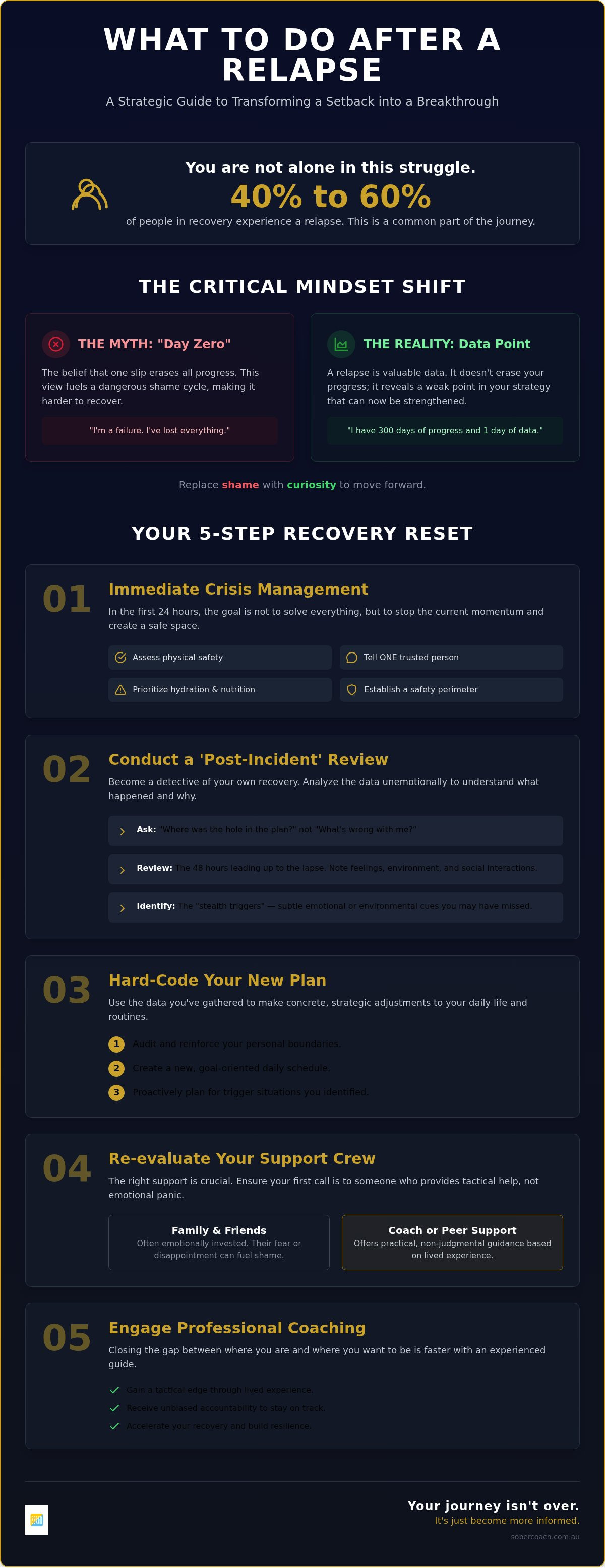
What if the most painful moment of your recovery journey wasn't a sign of failure, but the most valuable piece of data you've ever collected? You're likely feeling that crushing weight of "day zero" guilt and wondering how you ended up back here after so much hard-won success. It's exhausting to face the fear of telling your family or peers, especially when you feel like you've let everyone down. Since 40% to 60% of people in recovery experience a relapse, you're far from alone in this struggle.
Knowing exactly what to do after a relapse is the difference between a temporary slip and a total collapse. We're going to transform this setback into a strategic breakthrough. This guide provides a no-nonsense, 5-step recovery reset to help you stop the current usage immediately, decode your triggers without the clinical lecture, and reclaim your path to a vibrant, liberated life. Your journey isn't over; it's just becoming more informed. This is your moment to re-base and move forward with more clarity than you had before.
Table of Contents
Immediate Crisis Management: The First 24 Hours After a Relapse
The room feels heavy, and the guilt is likely louder than anything else right now. Stop. The very first thing you must do is breathe and assess your physical safety. If you're experiencing severe withdrawal symptoms or have consumed a dangerous amount of any substance, you need medical intervention immediately. While I provide professional coaching and peer-led support, I don't offer medical detox services. If you're physically stable, your primary objective is clearing the "chemical fog." This means prioritizing hydration, simple nutrition, and as much sleep as your body will allow. You can't think your way out of a crisis when your brain is physically depleted.
Strategic disclosure is your next move. You don't have to tell the whole world today. In fact, you shouldn't. Pick one person who can offer practical, non-judgmental help without a side of "I told you so." Sometimes, family members are too emotionally invested to be your first call, and their panic might only fuel your own. Determining what to do after a relapse starts with choosing a confidant who can help you stay grounded while you navigate the next few hours. Understanding Relapse as a temporary data point rather than a permanent identity shift is essential for keeping your perspective clear.
Establishing a Safety Perimeter
The first goal of the first 24 hours is not to solve the addiction, but to stop the current momentum of the relapse. You need to physically remove anything that facilitates the habit. Flush the stash. Toss the paraphernalia. Don't overthink it or wait for a "better time." Your digital environment needs a cleanup too. Block the numbers of people you use with, even if it's just a temporary measure to give yourself breathing room. Turn off notifications for apps that trigger your cravings. You're building a temporary fortress so your nervous system can settle down and stop reacting to external cues.
Identifying Your Immediate Support Crew
In Australia, we're lucky to have specific resources designed for this exact moment. If you're in a dark place at 3 AM, call Lifeline (13 11 14) or the Alcohol and Drug Foundation for immediate crisis support. However, if you're ready for tactical guidance, a professional coach can be a safer, more effective first contact than a family member. We've been in your shoes, and there's no lecture coming. If you're navigating the system, working with an NDIS psychosocial recovery coach can help you manage the logistics of getting back on track. They understand the local landscape and can help you bridge the gap between this moment and your next successful period of growth.
The Mindset Shift: Why Relapse is a Data Point, Not a Defeat
The hardest part of figuring out what to do after a relapse isn't the logistics; it's the mental gymnastics of the "Day Zero" myth. We've been taught that one slip wipes out months or years of progress. That's simply not true. You don't lose the neural pathways you've built, the skills you've practiced, or the self-awareness you've gained. If you've been sober for 300 days and used for one, you are 300 and 1. You haven't lost your progress; you've just encountered a hurdle. This "Binary Trap" of being either perfectly sober or a total failure is a dangerous illusion that fuels the shame cycle.
Shame is a biological shutdown. It makes your brain go offline, making it impossible to learn from what just happened. Curiosity, however, is an opening. Learning how to bounce back from a relapse requires replacing that shame with a cold, analytical curiosity. We call this "Tactical Recovery." Instead of asking "What's wrong with me?", we ask "Where was the hole in the plan?" This shift moves you from being a victim of your circumstances to being the architect of your own liberated life.
The Anatomy of a Slip
We need to distinguish between a lapse and a relapse. A lapse is a brief, isolated moment of usage. A relapse is a return to the old pattern of living. Your brain will try to convince you that because you had a lapse, you might as well go all the way back to the old life. Don't listen to it. That's just the addiction looking for a loophole. Instead, treat this moment as "Relapse Data." Relapse Data is the specific information revealed by a setback regarding previously unknown triggers or weak points in a recovery routine. It is evidence, not an indictment.
Reclaiming Your Agency
Owning the choice is the ultimate act of power. It's not about self-flagellation; it's about tactical awareness. If you blame the universe, your ex, or your job, you're essentially saying you're powerless. If you analyze the choice you made, you reclaim the ability to make a different one next time. Focus on "What's next?" instead of "Why me?" This forward-leaning posture is what separates those who get stuck from those who grow. If you're struggling to reframe the narrative on your own, our one-on-one recovery coaching can help you move from victimhood to agency, ensuring your next step is a proactive one.
Conducting a 'Post-Incident' Review: Identifying Stealth Triggers
Once the immediate crisis has passed, the real work begins. You need to become a detective in your own life. Identifying what to do after a relapse involves more than just saying "I won't do it again." It requires a deep dive into the 48 hours leading up to the event. This is the "Emotional Relapse" phase. You weren't using yet, but your defenses were down. In a fast-paced environment like Sydney, it's easy to fall into "lifestyle drift." You stop doing the things that kept you steady because you're busy, stressed, or frankly, just bored. These stealth triggers are often more dangerous than the obvious ones because they fly under the radar.
We often talk about HALT factors; Hungry, Angry, Lonely, Tired. In an Australian context, these manifest in specific ways. Are you "Tired" because you're grinding through a 60-hour week to keep up with the cost of living? Are you "Lonely" despite being surrounded by people at a rooftop bar in the CBD? These aren't just clinical terms; they're the cracks in your armor. Stealth triggers like overconfidence often show up after a period of success. You start thinking you've "beaten" the habit, so you stop being vigilant. That's exactly when the old patterns sneak back in. Distinguishing between external triggers, like a specific pub, and internal triggers, like the belief that you "deserve a reward," is the key to a robust defense.
The Timeline Analysis
The timeline analysis is where you map out the "why." When did the thought of using first enter your mind? It usually starts days before the actual event. You might have experienced the "fading affect bias," where your brain conveniently deletes the memory of the hangovers and the shame, leaving only the highlight reel of the "good times." Using one-on-one recovery coaching allows you to have an objective set of eyes on this timeline. A mentor can spot the micro-decisions you made that led you toward the edge, helping you see the patterns you're too close to notice yourself.
Environmental and Social Auditing
Sydney has a pervasive "after-work" culture that can be a minefield. If your social circle revolves around the pub or high-pressure networking events, you're playing on hard mode. You need to audit your environment. Are there specific geographic zones; a certain street, a specific bottle shop, or even a particular commute route; that trigger an automatic response? Identifying these external triggers is just as vital as managing your internal beliefs. If your workplace stress is a constant engine for your cravings, it's time to look at how you're protecting your "yes" by saying "no" to toxic environments that no longer serve your growth.
Hard-Coding Your New Plan: Strategic Life Adjustments
Knowing what to do after a relapse means moving beyond the passive hope that things will just be different this time. Hope isn't a strategy. To reclaim your recovery, you need to move from a "don't use" mindset to a "do this" proactive lifestyle. A plan built entirely on what you're avoiding is a plan built on a vacuum. Eventually, that vacuum will be filled by old habits if you haven't intentionally designed a new daily schedule. This is about tactical life adjustments that prioritize your agency and your future.
Start with a "Boundary Audit." This is a cold, hard look at where you need to say "no" to protect your "yes." If a specific social circle or a high-pressure work commitment consistently pushes you toward a slip, it's a liability you can no longer afford. Protecting your recovery is your primary job. This often requires professional support to see the blind spots you've missed. Our Intensive Recovery Workshops offer a space to re-base and build a deeper toolkit that goes beyond surface-level advice. We treat self-care; sleep hygiene, physical movement, and nutrition; as tactical requirements for your nervous system, not optional luxuries.
Building the 'Sober Toolkit'
Your new plan needs concrete tools for when the pressure builds. "Urge surfing" is a vital technique where you learn to observe a craving as a temporary wave that will peak and subside, rather than a command you must follow. If your domestic environment has become a trigger in itself, In-Home Recovery Support can help you establish new routines right where you live. You also need an Emergency Contact Protocol. This is a pre-written list of three people you will call, in order, the moment the thought of using crosses your mind. No thinking required; just execution.
Long-Term Lifestyle Design
Sobriety isn't the end goal; it's the foundation for a vibrant, liberated life. If your life feels like a series of deprivations, you'll eventually want to escape it. You need a life you actually enjoy. Finding a "New Purpose" is essential for long-term success. This might mean exploring sober activities in Sydney that replace the old pub culture with something that actually fuels your spirit. Focus on setting micro-goals. Rebuilding self-trust doesn't happen with one big promise; it happens through a thousand small, consistent wins that prove you are someone who keeps their word to themselves.
If you're ready to stop the cycle and start designing a life that feels like yours again, reach out to book one of our Intensive Recovery Workshops today.
Closing the Gap: How Professional Coaching Accelerates Recovery
Deciding what to do after a relapse often feels like choosing between two extremes: trying to white-knuckle it alone or checking into a clinical inpatient facility for 30 days. For many Australians, there's a vital middle ground called professional recovery coaching. While therapy often focuses on processing past trauma, a coach acts as a tactical mentor who focuses on your current reality. We don't just talk about the "why"; we focus on the "how." Having a mentor with lived experience cuts through the noise because there's a shared history that builds immediate trust. You aren't being analyzed; you're being guided by someone who's already navigated the terrain you're standing on right now.
The "Accountability Edge" is what prevents a temporary lapse from turning into a months-long isolation spiral. When you're alone, your brain can easily justify "just one more." When you have regular check-ins, that justification loses its power. For those who need high-intensity support but can't step away from work or family, online rehab options provide a flexible way to re-base from home. This is especially critical for bridging the gap between a rehab graduation and the messy, unscripted challenges of real life. Digital tools have been shown to improve engagement and retention in recovery by 15% to 25%, making them a powerful addition to your strategy.
Personalized Support Models
Every journey is unique, which is why a one-size-fits-all approach usually fails. Through one-on-one recovery coaching, we tailor strategies to your specific triggers, whether those are high-pressure boardrooms in Sydney or the quiet boredom of a Sunday afternoon. If you prefer a community feel, Zoom-based group coaching offers a non-judgmental space to connect with others who are also doing the work. This isn't just a service; it's a proactive investment in your future self. You're building the emotional strength and practical systems required to ensure this setback is your last one.
Taking the Next Step
It's time to move from "survival mode," where you're just trying to get through the day, to "thriving mode," where you're actually excited about your life. The first step is to stop hiding. Reach out and book a session to conduct your "Post-Incident Review" with a professional who understands the mechanics of habit change. We'll look at the data, close the gaps in your plan, and get you moving forward again. Your best life hasn't disappeared because of a mistake. It's still waiting for you, and you have the agency to claim it right now.
Your Path Forward Starts Right Now
A relapse is a heavy experience, but it isn't the end of your story. It's a critical moment of recalibration that reveals exactly where your previous strategy needed more support. You've learned how to secure your immediate safety, shift your mindset from shame to curiosity, and audit your lifestyle for those stealth triggers that lead to drift. Knowing what to do after a relapse is about taking the data you've gathered and using it to build a life you no longer feel the need to escape from. You still have every skill and every lesson you earned during your time in sobriety.
You don't have to navigate this transition alone. At Sober Coach, we provide a tactical, non-judgmental approach led by mentors with real lived experience. Whether you need flexible online support or in-home guidance across Australia, we're here to help you bridge the gap between where you are and where you want to be. Book a One-on-One Recovery Audit with Sober Coach today to conduct a professional post-incident review and hard-code your new plan. Your most vibrant, liberated life is still waiting for you. It's time to take the next step with clarity and courage.
Frequently Asked Questions
Is it normal to feel like a failure after a relapse?
Yes, it's a very common emotional response, but it's not a factual reflection of your progress. Between 40% and 60% of people with substance use disorders experience a relapse at some point; which is a rate similar to managing other chronic illnesses. Feeling like a failure is a byproduct of the "Binary Trap" we discussed earlier. Instead of viewing yourself as a failure, treat this experience as vital data to refine your recovery strategy.
Do I have to go back to rehab if I've relapsed?
Not necessarily. While some people benefit from a residential reset, many find that intensive coaching or online rehab programs provide the tactical support needed to get back on track without leaving home. Determining what to do after a relapse depends on your physical safety and the depth of the setback. If you don't require medical detox, a "re-base" through one-on-one coaching or an intensive workshop can often bridge the gap more effectively than a standard 30-day program.
How do I tell my family or partner that I've relapsed?
Lead with honesty and a clear action plan. It's natural to fear their reaction, but hiding a relapse often leads to a deeper isolation spiral. When you speak to them, focus on the facts of what happened and the specific steps you're taking to address the triggers. Showing them that you've already contacted a recovery coach or adjusted your daily schedule demonstrates that you're taking ownership of the situation rather than just apologizing for the mistake.
What is the difference between a lapse and a relapse?
A lapse is a brief, isolated incident where you use a substance, whereas a relapse is a sustained return to old patterns and behaviors. Think of a lapse as a slip on a mountain trail and a relapse as deciding to walk all the way back down to the base. Understanding this distinction helps you stop the momentum. Knowing what to do after a relapse starts with recognizing that a single slip doesn't have to become a total collapse.
Can a recovery coach help me more than a support group?
It's not about "more," but about a different type of support. While support groups offer community, a recovery coach provides personalized, tactical mentorship tailored to your specific life in Australia. We focus on one-on-one accountability and real-world tools that groups might miss. A coach with lived experience acts as a strategic partner who helps you navigate high-pressure work environments or complex social triggers that are unique to your personal journey and your specific goals.
How long does it take to feel 'normal' again after a relapse?
Physical regulation usually begins within 24 to 72 hours as the chemical fog clears. However, emotional re-regulation can take longer depending on how you handle the "Day Zero" guilt. If you focus on sleep, nutrition, and immediate action, you'll likely start feeling more grounded within a week. The goal isn't just to feel "normal" again, but to reach a state of clarity where you can objectively analyze your triggers and move forward with a stronger plan.
What are the most common triggers for a relapse in early sobriety?
The most frequent triggers involve the HALT factors; being hungry, angry, lonely, or tired. In early sobriety, overconfidence and "lifestyle drift" are also major risks. You might feel like you've beaten the habit and stop attending your workshops or coaching sessions. This drift creates a vacuum that old habits are eager to fill. Identifying these stealth triggers early is a key part of hard-coding a more resilient recovery plan that protects your long-term success and growth.
How can I get NDIS funding for a psychosocial recovery coach?
To access NDIS funding for recovery coaching, you typically need a psychosocial disability that is likely to be permanent and significantly impacts your daily life. You'll need to work with your NDIS planner to include "Psychosocial Recovery Coaching" in your plan. Since regulations can shift, you should verify specific NDIS psychosocial recovery coach billing requirements for 2026. This support is built to help you increase your agency and manage the complexities of long-term change and personal transformation.
Comments