

Support for University Students Drinking: Navigating Campus Culture with Confidence

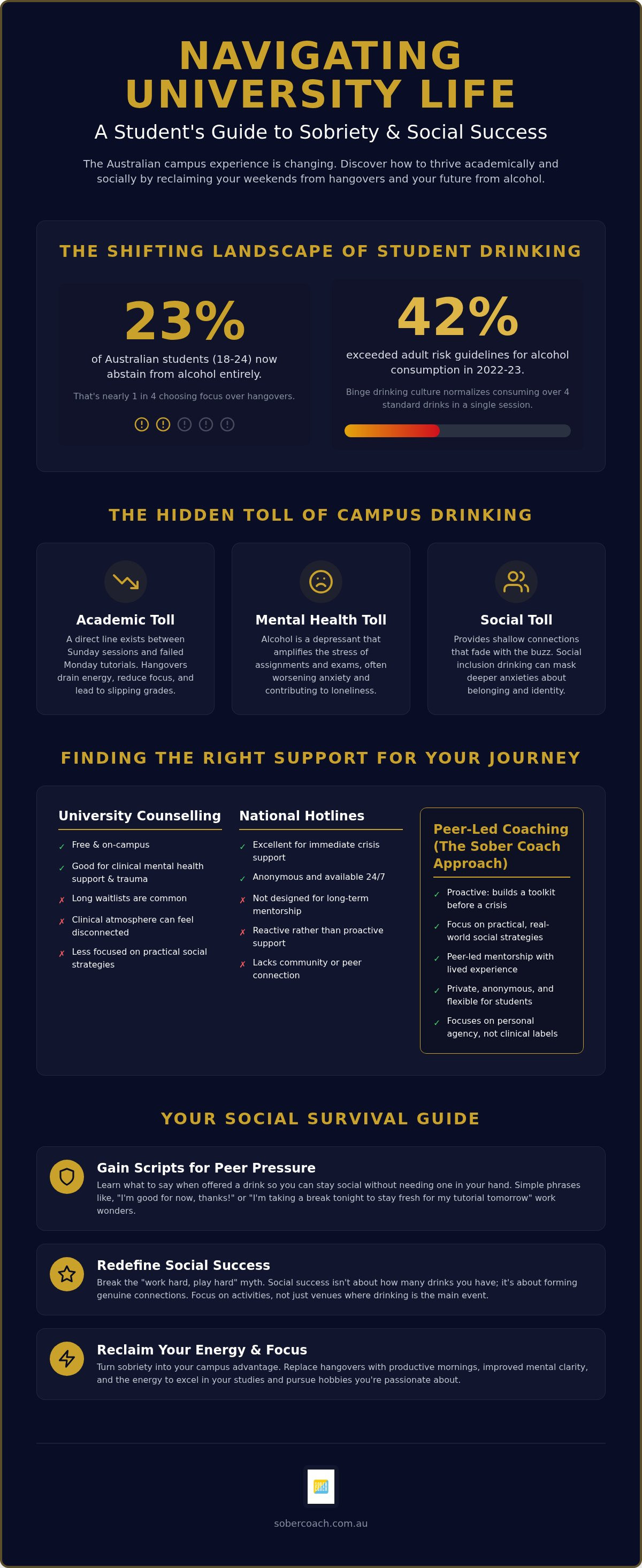
Did you know that 23% of Australians aged 18 to 24 now choose to abstain from alcohol entirely? That's nearly one in four students on your campus who have decided that a blurry night out isn't worth a wasted weekend. Finding authentic support for university students drinking doesn't mean you have to hide in the library while the rest of the world is at the pub. It's about reclaiming your time and your health without losing your connection to the community.
It's okay to admit that the pressure is real. Between the chaos of O-Week and the constant hum of house parties, the fear of missing out can feel heavy, especially when social anxiety starts to creep in. You want the grades and the social success, but the hangovers are starting to feel like a tax you no longer want to pay. This article shows you how to balance a thriving social life with peak academic focus using modern, peer-led strategies. We'll look at practical tools for handling peer pressure and how to turn sobriety into your ultimate campus advantage.
Table of Contents
Understanding the Australian University Drinking Culture in 2026
The Australian campus experience is often sold as a "work hard, play hard" lifestyle. It's a social blueprint that suggests academic success and heavy drinking are two sides of the same coin. This mantra validates the idea that after a week of intense study, you've earned the right to lose control. When you're looking for support for university students drinking, the first step is admitting that this constant pressure to perform both in the lecture theatre and at the bar is exhausting. Understanding this requires looking at the broader Australian drinking culture, where social bonding is often synonymous with alcohol.
In 2022-2023, 42% of Australians aged 18 to 24 exceeded adult risk guidelines for alcohol consumption. In a student context, harmful drinking isn't always about daily habits. It's the binge drinking culture where consuming more than four standard drinks in one session is the baseline. These "blackout" nights are often laughed off as traditions, but they carry a heavy weight. Social inclusion drinking is a temporary habit that often masks deeper anxiety about belonging and identity in a new environment.
The O-Week Trap: Why Early Habits Stick
The first six weeks of uni are a critical window. This is when your social habits solidify. In residential colleges, traditions often involve high-pressure drinking games that feel like a mandatory rite of passage. You're trying to find your tribe, and the easiest way to do that is to hold a red cup. This environment makes saying no feel like social suicide. Identifying the moment "fun" turns into a functional problem is difficult when everyone around you is doing the same thing. If you need a drink just to feel comfortable talking to your floor-mates, the habit is already taking root.
Academic and Mental Health Toll
There's a direct line between a Sunday session and a failed Monday morning tutorial. While it feels like everyone is partying, the reality is that alcohol often fuels the loneliness epidemic among first-year students. It provides a shallow connection that evaporates once the buzz wears off. The link between hangovers and slipping grades is obvious, but the mental health toll is more subtle. Alcohol is a depressant that amplifies the stress of assignments and exams. Finding support for university students drinking is about recognizing that your "normal" partying is actually draining your energy and your potential. It's the difference between just getting through your degree and actually thriving during it.
Types of Support for University Students Drinking
Finding the right support for university students drinking can feel like just another assignment. In Australia, the pathways usually fall into three categories. University Health Services are the most accessible. They are free and right on your doorstep, which is a massive win when you're on a student budget. However, the reality often involves long waitlists and a clinical atmosphere that feels disconnected from your actual Friday night experience. National hotlines are excellent for immediate crisis support, but they aren't designed to provide the long-term, proactive mentorship needed to navigate a three-year degree.
Recovery coaching has emerged as a powerful middle ground. Instead of waiting for a crisis, this model focuses on reducing risky drinking through lifestyle design and peer-led guidance. It’s about building a toolkit before the pressure of exam season or the social chaos of a residential college takes over. This approach moves away from medicalized labels and focuses on personal agency.
University Counselling vs. Private Coaching
You need to know which tool to use for the job. If you're dealing with clinical depression or deep-seated trauma, a campus psychologist is the right choice. They are trained for clinical mental health support. But if your challenge is habit change, social strategy, or figuring out how to handle a house party without a beer, a coach offers a different set of practical tools. Private coaching also provides a level of anonymity that campus services can't always guarantee. You aren't just another student ID number in a university database; you're a person building a new way of living.
Online Rehab and Group Support
Traditional residential programs are often too expensive and too disruptive for a student's life. Modern online rehab and Zoom-based group coaching provide a community of like-minded people without the campus stigma. These programs are built for flexibility. You can fit sessions around your tutorials or late-night library stints. Peer-to-peer accountability is a massive motivator for Gen Z. It’s about seeing others your age succeed and realizing that sobriety isn't a social death sentence. If you're ready to explore how this fits into your life, One-on-One Recovery Coaching can help you map out a plan that works for your specific timetable and goals.
Social Survival Guide: How to Be Sober on Campus
The biggest lie about university life is that your social value is tied to the volume of your cup. When you start looking for support for university students drinking, the primary fear isn't usually about health; it's about ending up alone. You worry that if you aren't drinking, you're invisible. But the reality is that the most interesting people on campus are often the ones who are fully present. Sobriety gives you a competitive edge in every conversation because you actually remember the people you've met.
Finding your sober tribe is easier than you think. Since 23% of young Australians are now choosing to abstain, you're definitely not the only person at the party who's over the hangover cycle. Look for the students who are genuinely engaged in their hobbies or those who show up to 9 AM tutorials looking refreshed. Ditching alcohol isn't about deprivation. It's about gaining a vibrant life where your energy isn't constantly being drained by a chemical depressant. For official resources and health facts, you can always check the Australian Government alcohol support pages to ground your decision in data.
Mastering the Party Scene Without a Cup
You don't need to explain your life story to every person who offers you a beer. A simple "I'm good for now" or "I've got a massive morning tomorrow" is usually enough. If you want to avoid the question entirely, keep a drink in your hand. A soda water with lime looks exactly like a gin and tonic, and it stops the "drink pushers" from targeting you. Setting an exit strategy is your secret superpower. Leaving a party at 11 PM means you've had the best of the social interaction without witnessing the messy, repetitive conversations that happen after midnight. You wake up on Sunday morning ready to live, while everyone else is losing their day to a darkened room.
Finding Alcohol-Free Activities in Sydney and Beyond
University culture is shifting. There are countless clubs focused on hiking, gaming, surfing, and sports where alcohol isn't the main event. These spaces allow for genuine connection based on shared interests rather than shared intoxication. If you're looking for inspiration, there are plenty of sober activities in Sydney that don't involve a pub crawl. You could try early morning coastal walks from Bondi to Coogee or join a late-night bouldering gym. Building a routine that prioritizes your physical health makes those early mornings much more attractive than the sticky floor of a nightclub. This shift in focus is a core part of effective support for university students drinking; it's about building a life you don't feel the need to escape from.
The Sober Coach Approach: Why Peer-Led Support Works
Textbooks can explain the chemistry of alcohol, but they can't tell you how it feels to walk into a residential college party sober. This is why peer-led support for university students drinking is so effective. It’s built on a mentor model. You're talking to someone who has actually been in the trenches of campus life and come out the other side. They understand the specific pressure of O-Week and the "work hard, play hard" trap. This shared history builds immediate trust that a clinical setting often lacks.
We reject restrictive labels. You don't have to call yourself an "alcoholic" to decide that drinking is no longer serving you. This isn't about admitting powerlessness; it's about reclaiming your personal agency. Coaching focuses on your future goals, like landing a dream internship or hitting a new fitness target, rather than dwelling on past mistakes. It bridges the gap between the chaos of a wild uni lifestyle and the successful professional future you're working toward.
One-on-One Accountability
Personalized sessions help you identify your individual triggers. Whether it's social anxiety at a mixer or the crushing weight of exam stress, your coach acts as a "sober travel companion" through the highs and lows of the semester. We provide custom tools to manage these moments without reaching for a bottle. It’s about building emotional strength that lasts far beyond graduation. This one-on-one focus ensures that the support for university students drinking is as unique as your own degree path.
Intensive Recovery Workshops for Rapid Change
Sometimes you need a hard reset. Our Intensive Recovery Workshops offer an immersive experience for students who want to build a solid foundation of resilience in a single weekend. It’s a chance to connect with others who are on the same path of self-discovery. You'll leave with a practical toolbox for handling campus pressure and a clear vision for your liberated life. If you're ready to start your transformation, our One-on-One Recovery Coaching provides the direct, no-nonsense guidance you need to thrive.
How to Get Started: Your First Steps to a Liberated Uni Life
Reaching out for help is often the hardest part because of the weight of campus stigma. You might feel like you're failing at the "uni experience" if you can't handle the heavy drinking culture. That's a lie. In reality, seeking support for university students drinking is an act of profound courage. It's a power move that says you're no longer willing to trade your potential for a blurred weekend. This is about taking control of your narrative before the habits of your early twenties dictate the direction of your thirties.
Your first practical step is a social audit. Look at your circle. Are these people you genuinely connect with, or are they just people you drink with? Be honest about your "why". Once you identify the triggers that lead you to reach for a drink, you can start building a strategy to navigate them. Whether you book a discovery call or join an online group session via Zoom, the goal is the same: a vibrant, high-energy future where you actually remember your university years. You're building a life where you don't need a chemical buffer to have a good time.
Preparing for the Conversation
Telling your mates you're taking a break doesn't have to be a dramatic announcement. Most people are far more concerned with their own lives than what's in your glass. A simple, direct statement like "I'm focusing on my fitness right now" or "I'm staying sharp for exams" is usually enough to end the conversation. If you face pushback, remember that their reaction is a reflection of their relationship with alcohol, not yours. Managing family expectations and academic pressure can be just as tricky. You can contact Sober Coach for a non-judgmental chat to help you navigate these social nuances with confidence.
Your 2026 Sobriety Checklist
Transformation happens through small, consistent actions. Use this checklist to kickstart your new chapter:
Download a tracker app: Seeing the days stack up provides a powerful visual reminder of your progress and the money you're saving.
Find a mentor: Connect with someone who has lived experience and understands the specific pressures of Australian campus life.
Clear the fridge: Remove the immediate triggers from your living space to make the "no" easier at 8 PM on a Tuesday.
Set a 30-day goal: Align this with a uni milestone, like a major assignment deadline or a mid-semester break.
Your degree is a massive investment of your time, energy, and money. Don't let alcohol tank the ROI of your education. Choosing clarity over the "work hard, play hard" myth is the smartest career move you'll ever make. You deserve to walk across that graduation stage with your head high and your health intact.
Take Control of Your Campus Story
You've discovered that the "work hard, play hard" mantra is a choice, not a requirement for a successful degree. By mastering the party scene without a cup and finding your sober tribe, you're already ahead of the curve. True support for university students drinking isn't about clinical labels; it's about personal growth and reclaiming your academic energy. You don't have to navigate the pressure of residential colleges or exam stress alone.
It's time to bridge the gap between where you are and the high-energy professional you're becoming. Our non-clinical, peer-led mentorship and Zoom-based group coaching are available Australia-wide to help you navigate these years with total confidence. Choosing liberation over deprivation means you'll actually remember the best years of your life while protecting your academic investment. Your degree is a launchpad; don't let a blurred social life hold you back from the vibrant future you deserve.
Book a One-on-One Recovery Coaching session tailored for students to start your transformation today. Your future self will thank you for the clarity you've chosen. You've got this.
Frequently Asked Questions
Is it possible to have a social life at uni without drinking?
Yes. Nearly one in four Australian students aged 18 to 24 are now choosing to abstain from alcohol entirely. Social life revolves around connection, not just consumption. You can join clubs for hiking, bouldering, or gaming where the focus stays on the shared activity. Having a sober tribe means you spend your weekends actually doing things rather than recovering from them. It's about trading shallow bar talk for genuine shared experiences.
What should I do if my roommates are heavy drinkers?
Set clear boundaries and find an external support network. Living in a party house is tough, so you need a space that feels safe for your new habits. Communicate your goals directly without judging theirs. If the environment becomes a constant trigger, consider spending more time in alcohol-free zones like the library or gym. External support for university students drinking can provide the perspective you need to stay firm in your choices.
Does my university offer free support for drinking problems?
Most Australian universities provide free, confidential counselling through their student health services. These are excellent for clinical mental health needs, though they often have waitlists during peak semester times. While these services are helpful, they can sometimes feel overly clinical. Many students find that supplementing campus counselling with peer-led coaching provides a more practical, lifestyle-focused approach to staying sober and building a vibrant, high-energy life in a high-pressure environment.
Will my grades really improve if I stop drinking?
You'll likely see a significant lift in your cognitive performance and focus. Alcohol disrupts REM sleep, which is critical for memory consolidation and learning. By removing the brain fog of hangovers, you gain back your Sunday study sessions and Monday morning lecture attendance. Better sleep leads to higher energy levels, allowing you to engage more deeply with complex course material and hit your assignment deadlines with much less stress.
How do I know if I need a sober coach or a doctor?
See a doctor if you're experiencing physical withdrawal symptoms or need a medical detox. We don't provide medical services. A sober coach is the right choice if you're physically safe but need a mentor to help you navigate social pressure and change your daily habits. Coaching is about lifestyle design and future goals. If you want a peer-led strategy to reclaim your university experience, a coach offers that practical partnership.
Can I join Sober Coach programs if I live in a rural uni town?
Yes, our programs are accessible Australia-wide through digital platforms. We offer comprehensive online rehab and group coaching sessions via Zoom, making it easy to connect from any campus or regional center. You don't need to be in Sydney or Melbourne to access high-quality support for university students drinking. This flexible model ensures you can maintain your privacy while building a community of peers who are on the same journey.
What is the difference between AA and recovery coaching for students?
AA is a traditional, 12-step peer support group based on the concept of powerlessness. Recovery coaching is a proactive, goal-oriented partnership that focuses on your personal agency. We don't use labels like alcoholic unless you choose them. Instead, we focus on building emotional resilience and practical social skills. Coaching is tailored to your specific university life, helping you bridge the gap between campus culture and your future professional career goals.
Is my drinking 'bad enough' to need help?
If alcohol is costing you more than just money, it's bad enough to explore a change. You don't need to hit rock bottom or lose your degree to justify seeking help. If you're feeling anxious, missing classes, or just tired of the cycle, that's reason enough. Seeking support is a proactive decision to improve your life. It's about moving toward a liberated, high-energy future rather than waiting for a crisis to happen.
Comments