

NDIS Recovery Coaching in Sydney: A Practical Guide

Being treated like a case number in a rigid clinical system isn't recovery; it's just management. You have likely felt the frustration of trying to fit your complex, episodic mental health journey into a neat NDIS box that doesn't account for the days when everything feels like too much. Finding an ndis psychosocial recovery coach sydney who understands that recovery isn't a straight line is the first step toward reclaiming your life. It's about finding a mentor who walks beside you, rather than a clinician who looks down at a clipboard.
We know the NDIS framework can feel like a maze of confusing categories and cold terminology. You deserve a space where your habits and history are met with empathy instead of stigma, especially when addiction is part of the story. This guide is your practical roadmap to navigating NDIS funding so you can access support that actually works in the real world. We will explore how to bridge the gap between clinical maintenance and genuine liberation, ensuring you have the tools to build a vibrant, self-directed future.
Table of Contents
What is a Psychosocial Recovery Coach in the NDIS Context?
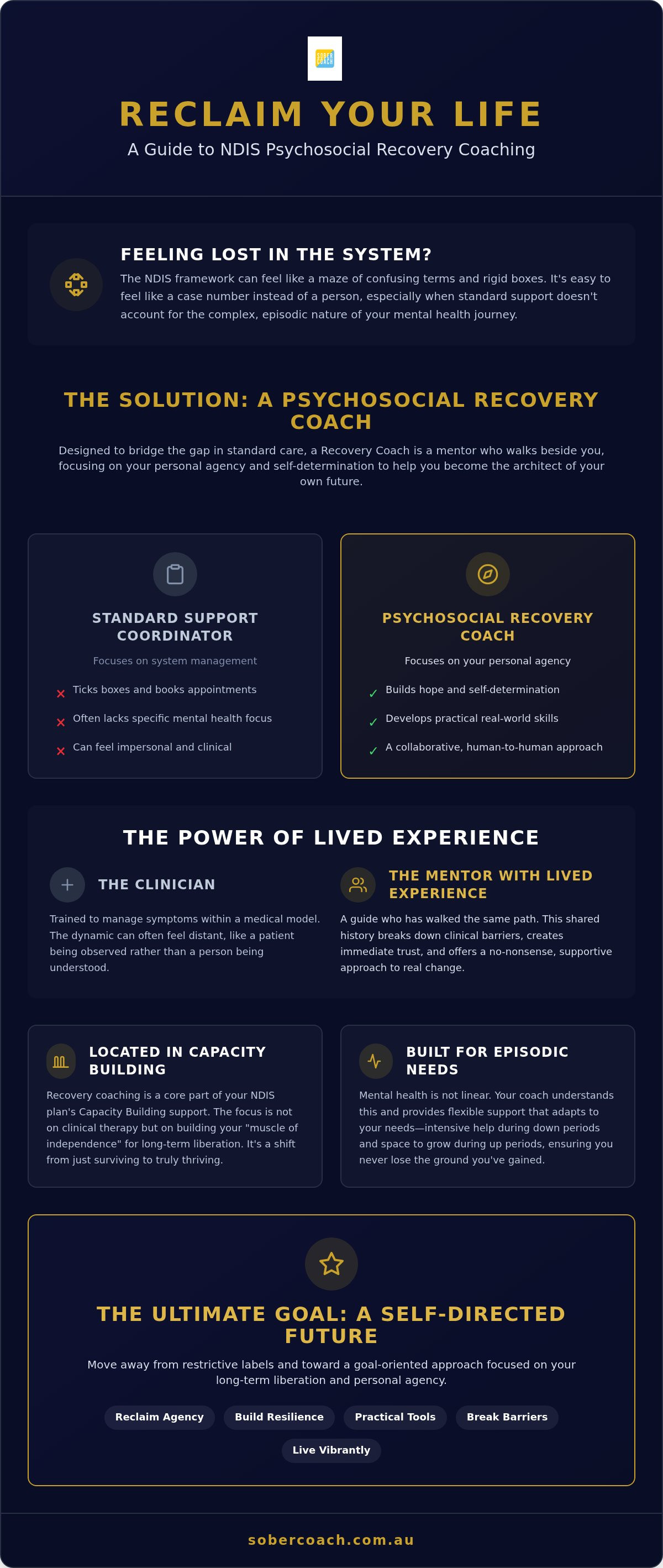
A psychosocial disability isn't just a diagnosis on a piece of paper; it's the way a mental health condition creates real-world barriers in your everyday life. Within the National Disability Insurance Scheme (NDIS), the role of an ndis psychosocial recovery coach sydney was specifically designed to bridge a gap that standard support coordinators often miss. While a coordinator might tick boxes and book appointments, a recovery coach focuses on your personal agency. They help you reclaim the driver's seat of your own life through recovery-oriented practice. This approach prioritizes hope and self-determination over clinical management, moving away from the feeling of being a passive recipient of care toward being an active architect of your future.
Capacity Building and Your NDIS Plan
Recovery coaching lives within the Capacity Building section of your plan. This is a crucial distinction. Unlike clinical therapy, which often focuses on symptom reduction or medical history, functional coaching looks forward. It's about building the muscle of independence. Many people are moving toward this model because they're tired of the revolving door of clinical settings. They want practical tools that help them navigate the supermarket, the workplace, or social circles without the weight of their diagnosis holding them back. It's a shift from surviving to thriving, focused on long-term liberation rather than just getting through the week.
The Episodic Nature of Mental Health
Mental health doesn't play by the rules of a standard schedule. It's messy, and it's almost always episodic. The NDIS introduced recovery coaches because they recognized that someone might need intensive support one week and very little the next. Your coach works with you to build a Recovery Plan that acts as a living document. It's a strategy for when the down periods hit, ensuring you don't lose the ground you gained during the up periods. In the context of NDIS funding, the episodic nature of psychosocial disability is defined by the fluctuating functional impact of a condition, requiring a flexible support framework that adjusts to your changing needs rather than sticking to a rigid, fixed schedule. This flexibility is the difference between simply managing a crisis and actually growing through it. You get the support you need when you need it, and the space to breathe when you're doing well.
The Power of Lived Experience in Sydney Recovery
Lived experience isn't a buzzword. It's a lifeline. When you search for an ndis psychosocial recovery coach sydney, you aren't just looking for a professional with a qualification; you're looking for someone who has survived the same fires you're currently walking through. This shared history breaks the clinical barrier that often keeps people feeling like "patients" rather than people. It creates immediate trust because you don't have to explain the nuances of the struggle. Your coach already knows. This human-to-human connection builds a foundation of credibility that no clinical degree can replicate.
At Sober Coach, we use this shared history to create a non-judgmental space where the weight of traditional stigma is lifted. We believe in a no-nonsense approach. This means direct truth-telling is used as a tool for personal transformation. It isn't about being harsh; it's about being real. When your coach can say, "I've been there, and I know the excuses you're making," it challenges your current perceptions in a way that feels supportive rather than confrontational. It's about stripping away the anonymity of typical services to offer a connection that feels brave and transparent.
Mentor vs. Clinician: Why the Distinction Matters
The distinction between a mentor and a clinician is vital for your growth. Clinicians are trained to manage symptoms, but a courageous mentor is focused on guiding your life toward liberation. Peer support significantly reduces the perceived deprivation often associated with lifestyle changes. Instead of focusing on what you are "giving up," a mentor helps you focus on the promise of a vibrant, liberated life. They are uniquely skilled at identifying non-binary behavioral patterns that a medical model might miss because they've navigated those same nuances themselves. This shift from powerlessness to personal agency is the cornerstone of genuine recovery.
Building Resilience in the Sydney Landscape
Sydney presents a unique set of social challenges. From the high-pressure environment of the CBD to the specific social triggers prevalent in the Eastern Suburbs, the local landscape is full of hurdles that can test your resolve. Finding a Recovery Coach who understands the Sydney recovery scene is essential. They know the local community-based supports and the specific pressures of living in this city. This local knowledge helps you build a practical strategy for staying grounded in your own neighborhood.
Having someone who walks beside you makes the journey feel less like an uphill battle and more like a proactive path to self-discovery. If you're ready to move beyond clinical management, our One-on-One Recovery Coaching provides the authentic connection and practical tools you need to build a life you don't need to escape from.
How to Access Recovery Coaching with Your NDIS Funding
Navigating the bureaucracy shouldn't be the hardest part of your recovery. To get started with an ndis psychosocial recovery coach sydney, you first need to ensure the right funding is allocated in your plan. This support isn't automatically included; you or your advocate must request it during your planning or review meeting. Once approved, the process moves from paperwork to personal transformation. It is about finding a mentor who understands that your journey is unique and requires more than a one-size-fits-all approach.
Step 1: Confirm your funding. Look for the specific line item for "Psychosocial Recovery Coaching" in your NDIS plan. It is distinct from Support Coordination and focuses specifically on mental health recovery.
Step 2: Check the rates. The NDIA sets price limits for these services to ensure fairness. As of July 2026, the national price limit for weekday daytime coaching is $110.44 per hour. If you require support on a Sunday, the rate increases to $200.39 per hour.
Step 3: Choose your approach. You can opt for a coach with a clinical background or one with lived experience. At Sober Coach, we believe shared history is the most powerful tool for change, offering a level of trust that clinical models often lack.
Step 4: Define your vision. Your first session involves creating a Recovery Plan. This isn't a clinical checklist. It is a roadmap for the vibrant, liberated life you want to build, focusing on your strengths rather than your limitations.
Self-Managed vs. Plan-Managed NDIS Funds
Your management type determines how much control you have over who you work with. If you are self-managed, you have the ultimate freedom to choose a provider like Sober Coach, even if they aren't NDIS-registered. This allows you to prioritize the "vibe" and lived experience of your coach over clinical red tape. If you are plan-managed, your manager facilitates the payments, but the choice of coach still rests with you. Don't be afraid to advocate for a coach who understands the nuances of addiction and mental health during your NDIS meetings. You are the expert on your own life, and your funding should reflect that.
Transitioning from Rehab to NDIS Support
Leaving a controlled environment like rehab can feel like jumping into the deep end without a life jacket. Coaching bridges the gap between clinical detox and the complexities of real-world liberation. By integrating In-Home Recovery Support into your post-rehab plan, you ensure that your home environment supports your new habits rather than triggering old ones. Psychosocial recovery coaching is typically funded under the 'Capacity Building' support category in an NDIS plan. This focus on capacity building ensures you are learning the tools to maintain your own wellbeing long after the formal support ends. It is about building a foundation for a life that feels both steady and exciting.
Finding the Right NDIS Recovery Coach in Sydney
Choosing an ndis psychosocial recovery coach sydney isn't about filling a vacancy on your care team. It's about selecting a partner for your personal transformation. Many providers offer "management," but few offer the authentic connection required to bridge the gap between clinical support and real-world liberation. You need a mentor who understands that recovery isn't a 9-to-5 task. It's a lifestyle. Start by looking for shared history. A coach with lived experience doesn't just sympathize with your struggle; they recognize the patterns because they've walked the same path. This immediate credibility strips away the clinical coldness often found in traditional disability frameworks.
You also need to apply the "no-nonsense" test. Ask yourself if a potential coach will challenge your current perceptions or simply manage your symptoms. True growth happens when someone is brave enough to tell you the truth about your habits without the weight of stigma. Sydney is a high-pressure environment. From the frantic pace of the CBD to the social expectations of the Eastern Suburbs, the city itself can be a trigger. You need a coach who knows the practicalities of Sydney life and can help you stay grounded while navigating the local "scene."
Evaluating In-Home vs. Online Support
The delivery model you choose should reflect the reality of your daily life. In-home recovery support is invaluable for identifying triggers within your immediate environment. When a coach enters your space, they see the nuances that a clinician in an office will always miss. However, the modern recovery journey often benefits from a hybrid approach. While in-person sessions build deep trust, online group coaching via Zoom adds a layer of community support that reminds you that you aren't alone. For many Sydney residents, this mix of face-to-face accountability and digital community provides the flexibility needed to maintain momentum, regardless of how busy or episodic life becomes.
Questions to Ask a Potential Coach
Don't be afraid to interview your coach. You are the one in charge of your NDIS funding, and you deserve a mentor who aligns with your vision of a vibrant life. Consider asking these specific questions during your first meeting:
What is your personal philosophy on habit transformation? Look for an emphasis on personal agency rather than powerlessness.
How do you handle the episodic nature of my mental health? Ensure they have a plan for when things get tough, not just when you're doing well.
Can you help me integrate my recovery into my Sydney lifestyle? They should have local knowledge of community supports and social triggers.
If you're looking for a mentor who prioritizes authentic connection over clinical red tape, our One-on-One Recovery Coaching is designed to help you reclaim your agency. We don't just manage your plan; we walk beside you as you build a life of genuine strength and discovery.
Reclaiming Agency: Why Sober Coach is Different
Recovery isn't a clinical destination. It's a vibrant, ongoing choice. While many providers focus on medicalized anonymity, Sober Coach prioritizes authentic, human-to-human connection. We believe that your history is a source of strength, not a reason for shame. When you work with an ndis psychosocial recovery coach sydney from our team, you aren't getting a case manager. You're getting a courageous mentor who has walked the same streets and faced the same social triggers you encounter every day in Sydney. Our approach is built on shared history; this creates a safe space to explore your habits without the crushing weight of traditional stigma.
We focus on providing practical tools for long-term sobriety maintenance. This isn't about just "getting through" the week. It's about building a life that feels liberated and self-directed. Our support is flexible and Sydney-wide, offering several ways to engage that fit your specific NDIS goals:
In-Home Recovery Support for real-world accountability in your own environment.
One-on-One Recovery Coaching for deep, personal transformation and mentorship.
Intensive Recovery Workshops to build practical skills and resilience.
Group coaching online via zoom and Rehab online for those who need digital flexibility and community.
Beyond the 12 Steps: A Modern Approach
We reject restrictive labels that imply powerlessness. Instead, we champion personal agency. Framing your journey as a positive lifestyle choice rather than a perceived deprivation changes everything. This methodology aligns perfectly with NDIS goals for increased social and economic participation. When you feel empowered and in control, you're better equipped to engage with your community and pursue your career goals. We see recovery as a powerful beginning, not a restrictive end point. It's a path to self-discovery that focuses on growth and liberation rather than what you've left behind.
Getting Started with Sober Coach in Sydney
The process to begin is straightforward and designed to reduce the anxiety often associated with seeking help. We work closely with your Support Coordinator to ensure our services maximize the capacity-building potential of your NDIS plan. Whether you're self-managed or plan-managed, our team facilitates a smooth integration into your existing support network. We're here to bridge the gap between clinical management and real-world liberation. If you're ready to move beyond the clinical box and start building your future on your own terms, Book a discovery session with a Sober Coach today.
Your Path to Real-World Liberation
Navigating the NDIS doesn't have to feel like a battle against a cold, clinical system. You've learned that the right ndis psychosocial recovery coach sydney is more than just a support worker; they're a mentor who walks beside you. By focusing on lived experience and personal agency, you can move beyond the "case number" mentality and start building a life that feels authentic and self-directed. Recovery is an episodic journey that requires flexibility, not a rigid schedule that ignores your reality.
At Sober Coach, we bridge the gap between clinical management and the vibrant life you deserve. Our peer-led methodology focuses on empowerment through professional one-on-one coaching and flexible in-home support available across Sydney. We don't believe in restrictive labels or powerlessness. Instead, we offer the practical tools and shared history needed to sustain long-term transformation. It's time to stop managing your condition and start living your life on your own terms.
Start your recovery journey with a lived-experience mentor in Sydney. You have the strength to change, and you don't have to do it alone.
Frequently Asked Questions
Can I use NDIS funding for addiction support if it's related to my mental health?
Yes, NDIS funding covers addiction support when it arises from a psychosocial disability. The scheme focuses on the functional impact of your mental health condition rather than just a medical label. A recovery coach helps you address the habits and behaviors that interfere with your daily life. This peer-led support empowers you to reclaim your agency and build a lifestyle that isn't defined by your struggles or past habits.
What is the difference between a recovery coach and an NDIS support coordinator?
A support coordinator handles the logistics of your NDIS plan, like managing budgets and connecting you with various services. However, an ndis psychosocial recovery coach sydney provides direct, hands-on mentorship. They focus on your emotional resilience and personal transformation. While a coordinator manages the administrative side of the system, a coach walks beside you to help you navigate the complexities of daily life and build a vibrant, self-directed future.
Do I need a clinical diagnosis to get an NDIS psychosocial recovery coach?
To access a recovery coach, you must have an NDIS plan that recognizes a psychosocial disability. While you need evidence of a condition that significantly impacts your daily life, the coaching itself is non-clinical. It doesn't dwell on your medical history or diagnosis labels. Instead, it focuses on your personal agency and the practical tools you need to move toward a liberated life. It's about your future, not your medical file.
How many hours of recovery coaching can I get on my NDIS plan?
The hours allocated for recovery coaching vary based on your individual needs and the goals outlined in your NDIS plan. Some participants receive enough funding for several hours of support each week, while others use it more flexibly during episodic periods. You should advocate for the level of support you need during your planning meeting. This ensures you have enough mentorship to build the long-term tools required for genuine independence and growth.
Can a recovery coach help me find work or return to study in Sydney?
Absolutely. One of the primary goals of NDIS recovery coaching is to increase your social and economic participation. Your coach helps you build the resilience and practical routines needed to succeed in a work or study environment. Whether you're navigating the high-pressure Sydney CBD or looking for local community education, your coach provides the accountability and encouragement to help you reclaim your place in the professional or academic world.
Is Sober Coach an NDIS registered provider or for self-managed participants?
Sober Coach provides support to self-managed and plan-managed NDIS participants. This allows you the freedom to choose our lived-experience mentorship and in-home support without being restricted to registered-only providers. If you have Capacity Building funding, we can work with you to integrate our coaching into your plan. We focus on authentic, human-to-human connection, ensuring that your funding is used for practical transformation rather than just ticking boxes in a clinical system.
What happens if my mental health improves; do I lose my recovery coach?
Improvement is the ultimate goal of recovery coaching. As your mental health stabilizes and your capacity grows, your coach helps you transition toward greater independence. The NDIS is designed to be flexible; if you need less intensive support, your plan might shift to focus on other areas of your life. You won't suddenly lose support, but your coach will work with you to ensure you have the tools to maintain your own wellbeing.
Does a recovery coach provide medical advice or detox services?
No, recovery coaches do not provide medical advice or detox services. Our methodology is peer-led and non-clinical, focusing on personal agency and long-term sobriety maintenance. If you need medical detox, you must consult a clinical professional or facility. Sober Coach provides the vital support that comes after the medical phase, offering the mentorship and practical tools you need to bridge the gap between clinical management and a liberated, real-world life.
Comments