

Navigating Relationships in Early Sobriety: A Guide to Healthy Connection

Sobriety isn't a loss of connection; it's a necessary audit that reveals which relationships are built on substance and which are built on soul. It's completely normal to feel a spike of anxiety when you think about your first wedding or Friday night out without a drink in your hand. You might worry you've lost your "fun" edge or feel exhausted by the thought of explaining your choices to skeptical relatives. We understand that the fear of being perceived as boring is a heavy weight to carry when you're just trying to heal. Navigating relationships in early sobriety feels like learning a new language while everyone else is still shouting in the old one.
This guide is your roadmap to protecting your peace and setting firm boundaries without losing your spark. You'll learn how to rebuild trust with your partner and children while gaining a clear framework for which connections to nurture and which to let go. We're moving past the anxiety of social settings and stepping into a life where your presence is your greatest power.
Table of Contents
The Social Shift: Why Early Sobriety Changes the Room
When you stop drinking, the energy in the room shifts. It’s not just about what is in your glass; it’s about the person holding it. You might feel like a stranger in your own skin, grappling with an identity crisis that makes every social interaction feel like a high-stakes performance. This is the reality of navigating relationships in early sobriety. It’s a period where you aren’t just changing your habits; you’re recalibrating your entire social ecosystem. You’re moving from a life centered on consumption to one centered on connection, and that transition is rarely seamless.
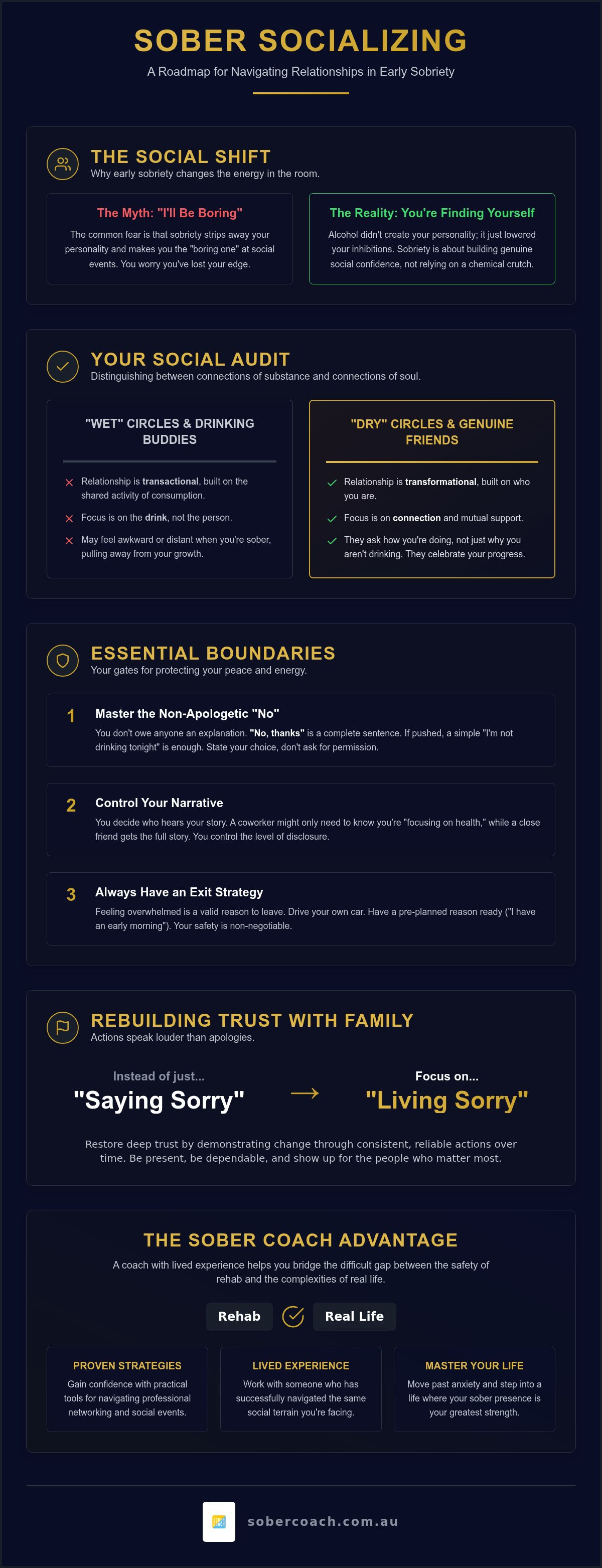
In Australia, our "mate-ship" culture is often built on the foundation of the local pub or the backyard BBQ. When you step away from that, some friends might feel uncomfortable. It’s rarely about you. As you commit to Understanding Sobriety in its truest sense, you'll notice that your change holds up an accidental mirror to those around you. Some will cheer you on. Others will pull away because your growth highlights their own stagnation. You’ll quickly learn the difference between a drinking buddy and a genuine friend. A drinking buddy is there for the shared activity of consumption. A friend is there for the person. One relationship is transactional; the other is transformational.
The Myth of Being "Boring"
The fear of being "the boring one" is the most common hurdle for anyone new to this journey. Here’s a truth: alcohol didn’t give you a personality; it gave you a lower inhibition. The silence you feel in a group right now isn’t a lack of character. It’s often just unmasked social anxiety. Alcohol was the lubricant that helped you bypass that discomfort, but it also prevented you from building genuine social muscles. Finding your sober voice takes time. It’s about learning to listen, respond, and engage without the fuzzy filter of a buzz. You aren't losing your edge; you're finding a sharper, more authentic version of yourself.
Identifying Your "Wet" and "Dry" Circles
The first 90 days of your recovery require a strict social audit. You need "dry people and dry places" to serve as a temporary safety net. This isn't about hiding forever. It's about giving your nervous system time to settle without constant triggers. If a relationship only exists because of a shared bottle, it’s likely a "wet" connection that won't survive your evolution. Navigating relationships in early sobriety means choosing connections that fuel your growth rather than those that tether you to your past. Look for the people who ask how you're doing, not just why you aren't drinking.
Essential Boundaries for Navigating Relationships in Early Sobriety
Boundaries are often misunderstood as walls designed to keep people out. In reality, they are the gates that allow the right people in under the right conditions. When you are navigating relationships in early sobriety, these gates are your primary defense against burnout and social fatigue. You're learning to prioritize your mental safety over other people's comfort. This isn't selfish. It's a fundamental part of your transformation. You're no longer willing to trade your peace for a seat at a table that drains you.
You get to decide who sees the full map of your recovery. Your coworkers might only need to know you're "focusing on health," while a partner or close friend gets the deep dive. Regardless of the setting, an exit strategy is non-negotiable. If the vibe shifts or the "pushers" start circling, you need a pre-planned reason to leave. Drive your own car. Have an "early morning" excuse ready to go. If you feel overwhelmed by these social logistics, intensive recovery workshops can help you practice these high-pressure scripts in a safe, supportive environment.
The Art of the Non-Apologetic "No"
You don't owe anyone a medical history or a confession just because they offered you a drink. "No, thanks" is a complete sentence. If someone pushes, a simple "I'm not drinking tonight" or "I've had my fill for a lifetime" usually does the trick. You aren't asking for permission to be sober. You're stating a fact. Maintaining your power means refusing to treat your sobriety like a secret shame or a temporary diet. It’s a proactive lifestyle choice that requires zero apology to anyone else in the room.
Managing Family Expectations and Pressure
Family dynamics are often the most complex part of navigating relationships in early sobriety. Relatives might minimize your journey because they "don't think you had a problem" or feel judged by your new clarity. Set hard time limits on visits. If Sunday lunch usually turns into a wine-soaked afternoon, plan to stay for only an hour. Be clear about your needs for upcoming holidays. If you need a dry event to feel safe, say so early. If they can't accommodate that, it’s okay to skip the event to protect your progress. Your peace is worth more than a tradition that no longer fits the person you are becoming.
Rebuilding Trust: Healing the Damage with Partners and Family
Trust isn't a light switch that flips the moment you decide to stop drinking. It's more like a bank account that has been overdrawn for years. Even if you've started making deposits today, the balance is still in the red. This "Trust Deficit" is often the most painful part of navigating relationships in early sobriety. You feel like a new person, but your partner or parents are still looking at you through the lens of who you used to be. Their suspicion isn't an insult; it's a trauma response. They've spent a long time waiting for the other shoe to drop, and your consistency is the only thing that will eventually help them let their guard down.
You might feel the urge to "say sorry" repeatedly, but in recovery, apologies have lost their value. Your loved ones have heard them all before. Instead, you must focus on "living sorry." This means your actions do the talking. It also involves dismantling the codependent patterns that likely defined your past. If you used to rely on a partner to cover for your mistakes, or if they relied on your chaos to feel in control, those roles must be retired. You're building a new dynamic based on mutual respect rather than mutual survival.
Consistency Over Intensity
Grand gestures don't rebuild a broken foundation. You can't buy back trust with expensive gifts or dramatic speeches. Real healing happens in the boring, daily moments. It’s answering the phone every time they call. It’s being exactly where you said you’d be at 6:00 PM. It’s following through on small household tasks without being reminded. These tiny acts of reliability prove that your word finally has weight again. Time is the only true currency of trust because it is the only thing that cannot be manufactured or manipulated to suit a narrative.
Addressing Resentment and Past Hurt
Your sobriety is a gift to yourself, but it doesn't automatically erase the hurt you caused others. Your family has a right to their anger. Navigating relationships in early sobriety requires you to create a safe space where they can express that pain without you becoming defensive or "checking out." You have to listen to the hard truths about how your behavior impacted them. If the resentment feels too heavy to handle alone, seeking professional coaching can provide the mediation needed to repair these bonds. A mentor who has lived through this can help you navigate these high-stakes conversations without triggering a relapse or a total relational collapse.
Practical Strategies for Social and Professional Navigation
Sydney's professional networking often feels like it's sponsored by a brewery. From the CBD to North Sydney, the "quick drink" after work is a social minefield where business deals and office politics collide. Navigating relationships in early sobriety in this high-pressure environment requires a tactical approach. You aren't just avoiding a glass of wine; you're managing your professional reputation while staying true to your new path. It’s about being present without being compromised. If you're "outed" in a group, keep your response brief and confident. A simple "I've retired from the drinking game" is often enough to shut down unwanted curiosity.
Dating also brings a unique set of challenges. Traditional recovery models often suggest a "one-year rule" before starting new romantic relationships. While this is a helpful guideline to ensure you aren't using romance as a substitute for a substance, it's not a law. Your personal agency matters most. The goal is to wait until you can offer a partner a whole, grounded person rather than someone still in the middle of a major identity shift. Focus on finding activities that don't feel like "rehab" but still support your clarity. Group coaching online via Zoom offers a safe space to practice these social scripts and relationship skills before you hit the real-world pavements of Sydney.
The Sober Social Toolkit
Success in social settings depends on your preparation. Never leave your comfort to chance. Always have your own transport, which acts as your "getaway car" the moment the vibe shifts or the pressure builds. Keep a non-alcoholic drink, like a soda and lime, in your hand at all times. This prevents people from constantly offering you a refill. Arrive early to connect with people while they are still sober, and leave early before the repetitive, alcohol-fueled conversations begin. Always check in with a support buddy or your coach before you walk through the door to ground your intentions.
Exploring Sydney’s Sober Scene
Building a new "tribe" is easier when you step away from the pub-centric culture of NSW. Sydney offers incredible outdoor alternatives that foster genuine connection without the hangover. Suggest a sunrise walk from Bondi to Coogee or a coffee meeting in the hidden cafes of Surry Hills. These environments allow for the deep, reflective conversations that early recovery demands. You'll find that many people are actually relieved when someone suggests a "dry" activity. By leading the way, you aren't just protecting your own sobriety; you're creating a new standard for what healthy, vibrant connection looks like in your city.
How a Sober Coach Helps You Master Your New Social Life
Clinical settings provide a vital foundation for recovery, but they often stop at the door of the real world. While rehab offers a safe bubble, it doesn't always prepare you for the raw reality of a Friday night in the city or a tense family reunion. This is where a Sober Coach steps in. We act as social strategists, bridging the gap between clinical theory and the messy, beautiful reality of daily life. Successfully navigating relationships in early sobriety is less about following a rigid set of rules and more about developing a personalized game plan for every interaction you face.
We use a process called "relationship mapping" to look at your current social circles with objective clarity. We identify which connections are supportive, which are neutral, and which are high-risk. Instead of just telling you to avoid certain people, we role-play the exact conversations you're afraid to have. You get to practice your "no" in a safe space before you ever have to say it at a business lunch. This practical rehearsal builds the muscle memory you need to stay grounded when social pressure peaks. Having a mentor who has lived through these exact scenarios provides a level of accountability that clinical support simply can't match.
One-on-One Mentorship for Real Transformation
Personalized coaching allows us to dive deep into your unique triggers and social anxieties. We don't believe in a one-size-fits-all approach because your life in Sydney is unique to you. We move you from a state of simply "surviving" social events to actually thriving in them. You'll learn to walk into any room with a sense of agency rather than a sense of lack. This isn't about deprivation; it's about liberation. If you're ready to build a social life that actually fuels you, Book a one-on-one session with a Sydney Sober Coach today.
Group Coaching: A Laboratory for Connection
Building a new community is essential, and our group coaching sessions via Zoom serve as a laboratory for new connection. In these spaces, you can learn from the shared experiences of others navigating relationships in early sobriety within the Australian recovery scene. Peer-led support is powerful because it strips away the clinical stigma of "getting help" and replaces it with human-to-human mentorship. You aren't a patient; you're an individual choosing a more vibrant way of living. These groups provide a safe environment to practice your new relationship skills with people who truly understand the cultural nuances of Australian mate-ship and the pressure to conform.
Embrace the Freedom of Authentic Connection
Your sobriety isn't just about what you've left behind; it's about the vibrant, honest life you're building right now. Successfully navigating relationships in early sobriety requires you to trade the shallow safety of old habits for the depth of genuine connection. You've learned that setting firm boundaries is an act of self-respect, not isolation, and that rebuilding trust is a marathon of small, consistent actions rather than one-off apologies. Whether you're mastering the office happy hour in Sydney or healing bonds with your family, you have the agency to choose who belongs in your new chapter.
At Sober Coach, we provide peer-led support from mentors who have walked this exact path and understand the social terrain. We offer one-on-one coaching tailored to your lifestyle and intensive workshops designed for deep personal transformation. You are capable of creating a social world where you feel fully seen and respected without needing a drink to bridge the gap. Start your path to a liberated life with Sober Coach Australia. Your future is waiting, and it's clearer and more connected than ever before.
Frequently Asked Questions
Should I tell my boss that I am in early sobriety?
You aren't legally or morally obligated to disclose your recovery status to an employer. If your drinking was previously impacting your performance, a brief conversation about your commitment to health can rebuild professional trust. However, many people choose to keep it private or use neutral phrases like "taking a break for health reasons." Focus on your output and reliability. If you need specific accommodations, consult your HR policy first.
How long should I wait before dating in early recovery?
While the "one-year rule" is a widely recognized guideline, it isn't a hard law. The goal is to ensure you aren't using a new romance to distract from the emotional work of recovery. You need time to discover who you are without a substance before trying to merge your life with another person. Wait until you feel grounded enough to handle the inevitable rejection or stress that dating brings without risking your peace.
What do I do if my partner still drinks at home?
Open communication is vital when navigating relationships in early sobriety with a partner who still drinks. You can't control their choices, but you can set boundaries for your shared environment. Request that alcohol is kept out of sight or ask for certain "dry" times in the house. If their drinking becomes a trigger you can't manage, you may need to spend more time in sober spaces until your foundation is stronger.
How can I handle friends who keep asking me why I’m not drinking?
You don't owe anyone a detailed medical history just because they are curious. Short, confident scripts like "I've had my fill" or "I'm retired from the drinking game" usually end the questioning. If a friend continues to push after you've said no, it’s a sign they are uncomfortable with their own habits. Real friends will respect your boundary without making it a debate. Your "no" is a complete sentence.
Is it okay to go to a pub if I only drink soda water?
It is possible, but it’s often playing with fire in the first 90 days. The "dry people, dry places" rule exists to protect your nervous system from constant triggers. If you must go, always have an exit strategy and a non-alcoholic drink in your hand from the moment you arrive. If you find yourself white-knuckling the table or feeling intense cravings, leave immediately. Your sobriety is more important than any social obligation.
How do I rebuild trust with my children after years of addiction?
Rebuilding trust with children requires radical consistency and time. Children often feel the "trust deficit" deeply and may be skeptical of your changes. Don't push for immediate forgiveness; instead, show up exactly when you say you will. Be present for the small, boring moments of their lives. Over time, your reliable actions will speak louder than any apology. They need to see that your new life is a permanent shift, not a temporary phase.
What if I feel like I have no friends left after getting sober?
Feeling lonely is a common part of the social shift. Many "friendships" were actually just shared consumption habits that couldn't survive your growth. This silence is a blank canvas. It’s an opportunity to build a new tribe based on shared values rather than shared bottles. Look for sober-friendly communities, hobby groups, or group coaching where you can meet people who value your clarity. Real connection is worth the temporary discomfort of starting over.
Can a Sober Coach help me if I’ve already relapsed due to social pressure?
Absolutely. A Sober Coach provides a non-judgmental space to analyze what went wrong without the weight of traditional stigma. We don't view a relapse as a total failure, but as a data point that reveals where your social boundaries need strengthening. We help you deconstruct the specific pressure points and role-play new strategies so you feel empowered next time. Navigating relationships in early sobriety is a skill that takes practice, and we are here to mentor you through it.
Comments