

Is One Drink a Relapse? Understanding the Difference Between a Slip and a Reset

What if your recovery isn't a fragile glass ornament that shatters the moment you take a sip? Most of us have been conditioned to believe that sobriety is a perfect streak, a line that, once crossed, sends us back to zero. You're likely sitting there asking yourself, is one drink a relapse, while feeling the heavy pull of shame and the fear that all your hard work has vanished. It's an exhausting way to live. I've been there, and I know that the weight of a "reset" can feel heavier than the drink itself.
The truth is that one drink doesn't have to mean the end of your journey. It's a data point, not a destination. You'll learn exactly how to stop a slip from turning into a week-long bender and why your progress is cumulative, not conditional. We're going to look at the difference between a temporary lapse and a total return to old habits. By the end, you'll have a clear plan to turn this moment into a powerful tool for your long-term growth. Your vibrant, liberated life is still waiting for you, and you don't need to start from scratch to reach it.
Table of Contents
Defining the Slip: The Critical Difference Between Lapse and Relapse
Recovery isn't a performance where one wrong move disqualifies you from the stage. Words matter. When we ask is one drink a relapse, we're often caught in a perfectionist trap that ignores the months of hard work and growth we've already achieved. This internal narrative is vital because the way you label your experience dictates your emotional recovery. If you call it a total failure, you're more likely to act like a failure. If you call it a lapse, you can treat it like a problem to be solved and move forward without losing your identity.
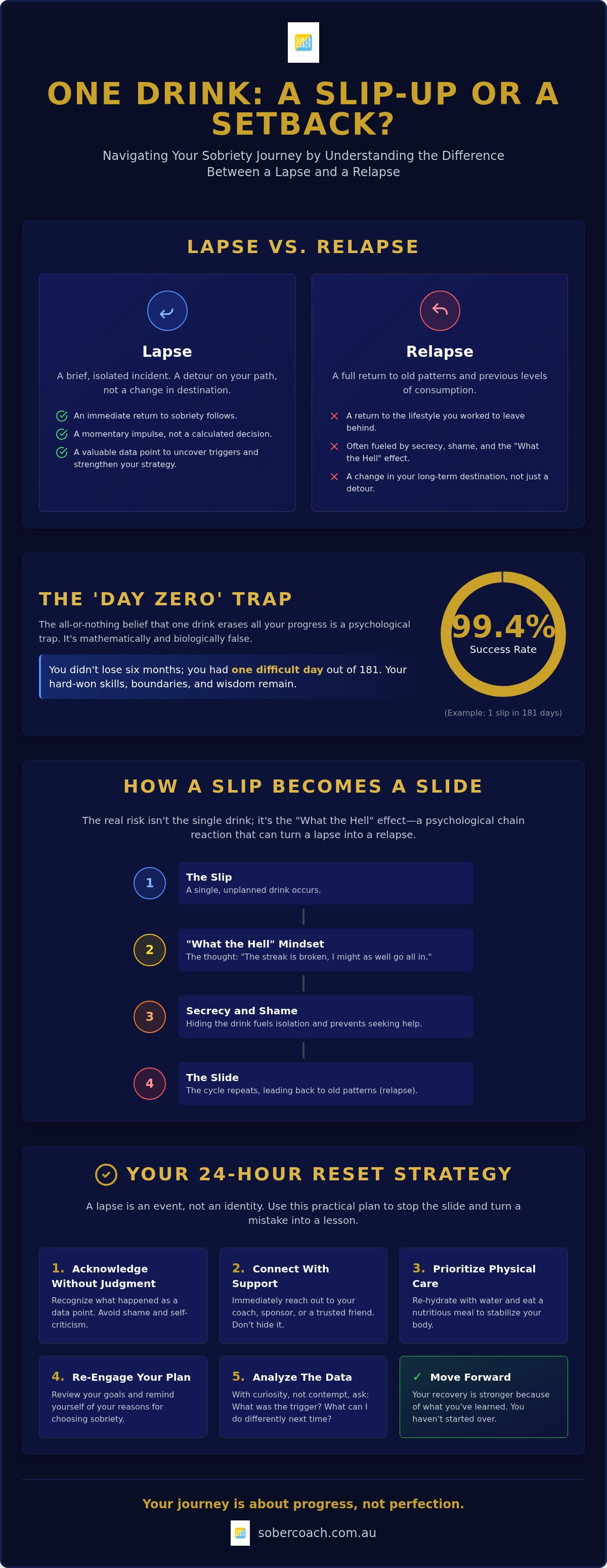
We need to get clear on the language because shame thrives in ambiguity. A lapse is a brief, isolated incident followed by an immediate return to sobriety. It is a detour on your path, not a change in destination. In contrast, a relapse involves a full return to old patterns of behavior and your previous levels of consumption. Understanding the nuance of Defining Relapse helps us strip away the stigma that often prevents people from reaching out for help. When you view recovery as a cumulative skill set rather than a fragile streak, a single drink loses its power to destroy your progress.
The Anatomy of a Lapse
A lapse is typically a momentary impulse rather than a calculated decision. In that split second, your brain's reward system reacts to a trigger, releasing a dopamine hit that momentarily overrides your logic. However, this doesn't mean your neural pathways have fully reverted to their old state. Think of a lapse as a warning light on your recovery dashboard. It is a signal that your current coping mechanisms or support structures need an adjustment. It’s an invitation to look at your environment and your internal stress levels with curiosity rather than contempt. It's data, not a death sentence.
When a Slip Becomes a Slide
The real risk isn't the single drink; it's the "What the Hell" effect. This is the psychological phenomenon where you feel that since the "streak" is broken, you might as well go all in. You tell yourself that the damage is done, so you might as well finish the bottle or the weekend. This mindset is often fueled by secrecy and the fear of judgment. When you hide a drink, you're essentially choosing to return to the shadows of your old life. Asking is one drink a relapse helps you bring the situation into the light. It allows you to stop the slide before it gains momentum and turns back into a lifestyle you've worked so hard to leave behind.
The Psychology of the 'Day Zero' Trap
Counting days is a double-edged sword. In the beginning, watching that number climb provides a tangible sense of achievement. But for many, the sober date eventually transforms from a badge of honor into a weapon used for self-sabotage. When you believe that is one drink a relapse, you are essentially saying that your history of growth has been erased by a single moment. This all-or-nothing thinking is a psychological trap that ignores the reality of human behavior.
Imagine you've been sober for six months and you have one glass of wine. The traditional "Day Zero" mentality insists you've lost 180 days of progress. This is mathematically and biologically false. You didn't lose six months; you had one difficult day out of 181. That's a 99.4% success rate. When we focus solely on the reset, we often trigger a dangerous mindset. If the count is already at zero, there's no perceived cost to having ten more drinks. This logic actually encourages a full-scale bender rather than a quick return to health.
Recovery as a Cumulative Skill
Think of sobriety like learning a second language. If you speak French fluently for a year and then forget a specific verb, you don't suddenly lose your ability to converse. You haven't unlearned the language. Your recovery is the same. The boundaries you've set, the triggers you've identified, and the new coping mechanisms you've practiced are still there. Recovery is the accumulation of sober hours and the wisdom gained during them. These skills don't vanish because of a single lapse. In fact, many experts view these moments as a part of the recovery process rather than a sign of failure. If you're struggling to see your progress beyond the numbers, working with a professional recovery coach can help you reframe your journey.
Dismantling the Shame Cycle
Shame is the enemy of personal agency. When you feel shame, your prefrontal cortex, the part of your brain responsible for logic and decision-making, essentially goes offline. You move into a survival state where the only goal is to numb the pain. This is why it's crucial to distinguish between guilt and shame. Guilt says, "I made a mistake," which allows for a correction. Shame says, "I am a mistake," which leads to paralysis. To break the cycle, you must detach your self-worth from your sober date. Your value as a human being isn't tied to a calendar. It's tied to your courage to keep showing up, even when things get messy. When you stop asking is one drink a relapse and start asking "What can I learn from this?", you reclaim your power.
Assessing the Damage: Was It a Slip or a Symptom?
Once the initial shock of a lapse subsides, it's time for an audit, not an autopsy. You don't need to dissect your character; you need to examine the mechanics of the event. Asking is one drink a relapse often leads to a spiral of "why" questions that focus on your perceived flaws. Instead, move toward "how" questions that focus on your environment and physiology. A post-drink review is about gathering evidence so you can fortify your future. It is a practical tool used to determine if that drink was a random stumble or a symptom of a deeper crack in your foundation.
Start with the basics: the HALT triggers. Were you Hungry, Angry, Lonely, or Tired in the hours leading up to that first sip? These aren't just acronyms; they are biological vulnerabilities that lower your impulse control. Look at the environment. Was this a spontaneous reaction to a sudden stressor, or was there a subtle, subconscious plan forming days in advance? If you found yourself "accidentally" at a bar you used to frequent, that's a symptom. If you were blindsided by a glass of champagne at a wedding and reacted without thinking, that's a slip. Be ruthless with the facts but gentle with your soul.
The most telling indicator is the Honesty Test. Secrecy is the lifeblood of a full-scale return to old habits. If you're keeping the drink a secret, you're essentially protecting the habit rather than your recovery. Telling a trusted friend or your coach immediately turns the lights on. It stops the shame from festering. If you can speak the truth about the lapse, you've already proven that your commitment to a vibrant, liberated life is still intact.
Internal vs. External Triggers
There is a significant difference between a social pressure slip and an emotional escape slip. External triggers, like being offered a drink at a party, are often easier to manage through better boundaries or exit strategies. Internal triggers, such as deep-seated anxiety or a sense of worthlessness, are more likely to turn a single drink into a relapse. These internal states suggest that you're still looking for a chemical solution to an emotional problem. Mapping your vulnerability window helps you see that the drink didn't happen in a vacuum; it was the end of a chain of events.
The Mindset Check
Are you currently looking for an excuse to keep going? Sometimes, we use a lapse as a "hall pass" to justify a weekend bender because we feel the "damage is done." This is the moment to evaluate if your "Why" for sobriety has truly changed or if it has just been temporarily obscured by a cloud of dopamine and regret. Ultimately, the drink itself is far less important than the complex thought process that follows it. If you're ready to learn from the data, you're still on the path. If you're ready to give up, it's time to ask is one drink a relapse or just the beginning of a much-needed course correction.
Your 24-Hour Reset Strategy: Stopping the Slide
The moment you realize you've taken a drink, your brain starts screaming for more or diving into a pit of despair. Stop the noise. Whether you are asking is one drink a relapse or just trying to breathe through the panic, your next moves are critical. This isn't about punishment; it's about containment. You need a tactical plan to stop the slide before it gains momentum.
Follow these five steps to regain your footing immediately:
Step 1: Immediate Cessation. Put the drink down. Right now. Pour the rest away and physically leave the room. Changing your environment breaks the immediate neural loop.
Step 2: Hydration and Nutrition. Alcohol triggers a blood sugar crash and chemical imbalance. Drink water and eat something nutrient-dense to stabilize your physiology and reduce cravings.
Step 3: The 'Safe Call'. Contact a coach or a trusted friend within two hours. Speaking the truth out loud strips the power from the secret.
Step 4: Radical Compassion. Acknowledge the mistake without the drama. Pivot your focus to the "next right thing" instead of the "last wrong thing."
Step 5: The 'Next 24' Commitment. Forget about next month. Focus entirely on the immediate 24-hour horizon.
Physical and Emotional First Aid
The morning after a slip is often characterized by "hangxiety," a mix of chemical depletion and psychological guilt. Your brain is essentially in a low-dopamine state, which makes everything feel catastrophic. You might catch yourself asking is one drink a relapse while staring at the ceiling, but that's just the chemical dip talking. Use grounding techniques, like the 5-4-3-2-1 method, to stay in the present moment. Avoid making any major life decisions for at least 48 hours. Your perspective is currently skewed by the physiological impact of the alcohol, and you need time for your system to return to baseline before you can trust your logic again.
Re-establishing Boundaries
A slip is a signal that your current boundaries were breached. For the next seven days, adjust your schedule to avoid high-risk situations, even if you thought you could handle them before. If you need immediate, non-judgmental support to unpack the triggers, you can book a one-on-one recovery coaching session to get back on track. Professional accountability provides a safe space to communicate the slip without the fear of traditional stigma. This isn't a reset to zero; it's an upgrade to your existing recovery plan. You've already done the hard work of building a new life, and one day doesn't take that away.
Beyond the Label: How Recovery Coaching Turns Slips into Strength
Traditional recovery models often leave you with two stark choices: maintain a perfect streak or return to the clinical cycle of rehab. For many, this binary approach is exactly what fuels the shame that turns a single mistake into a disaster. Recovery coaching serves as the missing link for those who don't fit the traditional mold. Instead of focusing on a clinical diagnosis, we focus on your personal agency. When you find yourself asking is one drink a relapse, you are often looking for a verdict on your character. Coaching offers a strategy for your life instead.
A Sober Coach helps you strip away the stigma and look at the event with curiosity rather than contempt. We treat a lapse as a data point. It is a specific piece of feedback that tells us where your current support system or coping mechanisms need an upgrade. This shift from "powerlessness" to "agency" is the cornerstone of the coaching relationship. You aren't a victim of your habits; you're the architect of your own transformation. Whether through One-on-One Recovery Coaching or Intensive Recovery Workshops, the goal is to build a foundation that is resilient enough to handle the complexities of real life.
Personalized Support vs. One-Size-Fits-All
The beauty of coaching lies in its flexibility. One-on-one coaching, whether in Sydney or through our Zoom sessions across Australia, allows us to tailor strategies to your specific triggers and lifestyle. We don't use a generic handbook. If your home environment is a primary source of stress, In-Home Recovery Support can help you navigate those physical cues in real-time. This level of personalization ensures that we are addressing the root causes of a slip rather than just the symptoms. We focus entirely on the future you are building, making sure that one bad day doesn't define the next year of your life.
Building a 'Vibrant, Liberated Life'
True sobriety isn't just about the absence of alcohol; it's about the presence of a life you don't feel the need to escape. We move beyond the concept of "staying sober" and toward the pursuit of a vibrant, liberated life. This proactive approach changes the energy of your recovery from deprivation to growth. Our Zoom-based group coaching provides a community of like-minded individuals who are also rejecting restrictive labels in favor of authentic self-discovery. You don't have to carry the weight of a mistake in isolation. If you're ready to stop the cycle and turn your experience into expertise, book a session with a Sober Coach today and let’s start building your way forward.
Reclaiming Your Path Forward
A single drink is a moment in time, not a verdict on your future. By shifting your focus from a fragile streak to a cumulative skill set, you strip away the power of shame. You've learned that a lapse is actually a valuable data point that can help you strengthen your boundaries and refine your plan. Asking is one drink a relapse shouldn't be about starting from zero; it should be the catalyst for your next level of growth. Your progress is real, and the wisdom you've gained during your sober hours remains yours to keep.
You don't have to navigate this transition alone. We provide professional, peer-led support based on lived experience, offering a non-judgmental space where personal agency is the priority. Whether you're in Sydney or anywhere else across Australia via Zoom, we're here to help you turn a slip into a breakthrough. It's time to stop looking back at the mistake and start pursuing the vibrant, liberated life you deserve. Take control of your recovery—Book a One-on-One Coaching Session today. You have the power to decide what happens next.
Frequently Asked Questions
Is one drink considered a relapse in the 12-step model?
In traditional 12-step models, total abstinence is the baseline, so any consumption is often viewed as a break in sobriety. This perspective focuses on the streak as the primary measure of success. While this works for some, it can also create intense pressure. We prefer to look at whether the drink was an isolated event or a return to old patterns, focusing on your personal growth rather than a rigid rule.
Should I reset my sobriety app to zero after one drink?
Whether you reset your app depends on your relationship with that number. If seeing a zero makes you want to give up entirely, don't do it. You haven't lost the weeks or months of wisdom you've gained. Some people prefer to track sober days out of the year instead of a consecutive streak. This approach acknowledges that is one drink a relapse isn't a simple yes or no, but a question of progress.
How do I tell my partner or family that I had a drink?
Honesty is the best way to kill the shame that follows a slip. Start by sharing the facts without making excuses, then immediately explain your plan to get back on track. Tell them what you've learned about your triggers and how you intend to adjust your boundaries. This shows them that you're still committed to your transformation and that you're taking proactive steps rather than hiding in secrecy. Connection is a powerful tool for recovery.
Can I still say I'm sober if I had a slip-up yesterday?
You absolutely can. Sobriety is a direction, not a destination or a perfect record. If you've returned to your commitment today, you are still living a sober life. One mistake doesn't strip you of your identity or the hard work you've put in. Focus on the fact that you stopped the slide and chose to show up for yourself again. That choice is what defines your character, not the isolated incident of the slip itself.
What is the 'What the Hell' effect in alcohol recovery?
The 'What the Hell' effect is a psychological trap where you feel that since you've already broken your streak, you might as well keep drinking. It's a form of all-or-nothing thinking that turns a small lapse into a full-scale bender. Recognizing this effect is the first step to stopping it. By understanding that the damage isn't done after one drink, you can make the choice to put the glass down and reset your focus immediately.
When does a lapse require professional intervention like coaching?
If you find yourself caught in a cycle of slips or if the shame of a single drink feels paralyzing, professional support can be the missing link. Coaching helps when you need a non-judgmental space to unpack the why behind your habits. It's especially useful if you feel like traditional models aren't working for you. A coach provides the accountability and practical tools needed to turn that data point into a plan for long-term liberation and growth.
Does one drink ruin the neuroplasticity I've built while sober?
Your brain doesn't instantly revert to its old state after one drink. The neural pathways you've built through months of sober habits are still there. Think of it like a path in a forest; one person walking off the trail doesn't make the path disappear. While alcohol does impact brain chemistry, the healing you've achieved is cumulative. The faster you return to your sober routine, the more you protect and reinforce those hard-won neurological changes.
Can I go back to 'moderate drinking' after a single slip?
For most people who have struggled with alcohol, a slip is a sign that moderation is a difficult and often exhausting goal. Asking is one drink a relapse often stems from a desire to find a way to drink normally again. However, the energy required to manage moderation often takes away from the vibrant life you're trying to build. Most find that total freedom from the negotiation of how much is far more empowering than trying to moderate.
Comments