

Coping with Anxiety Without Alcohol: A Guide to Sustainable Calm

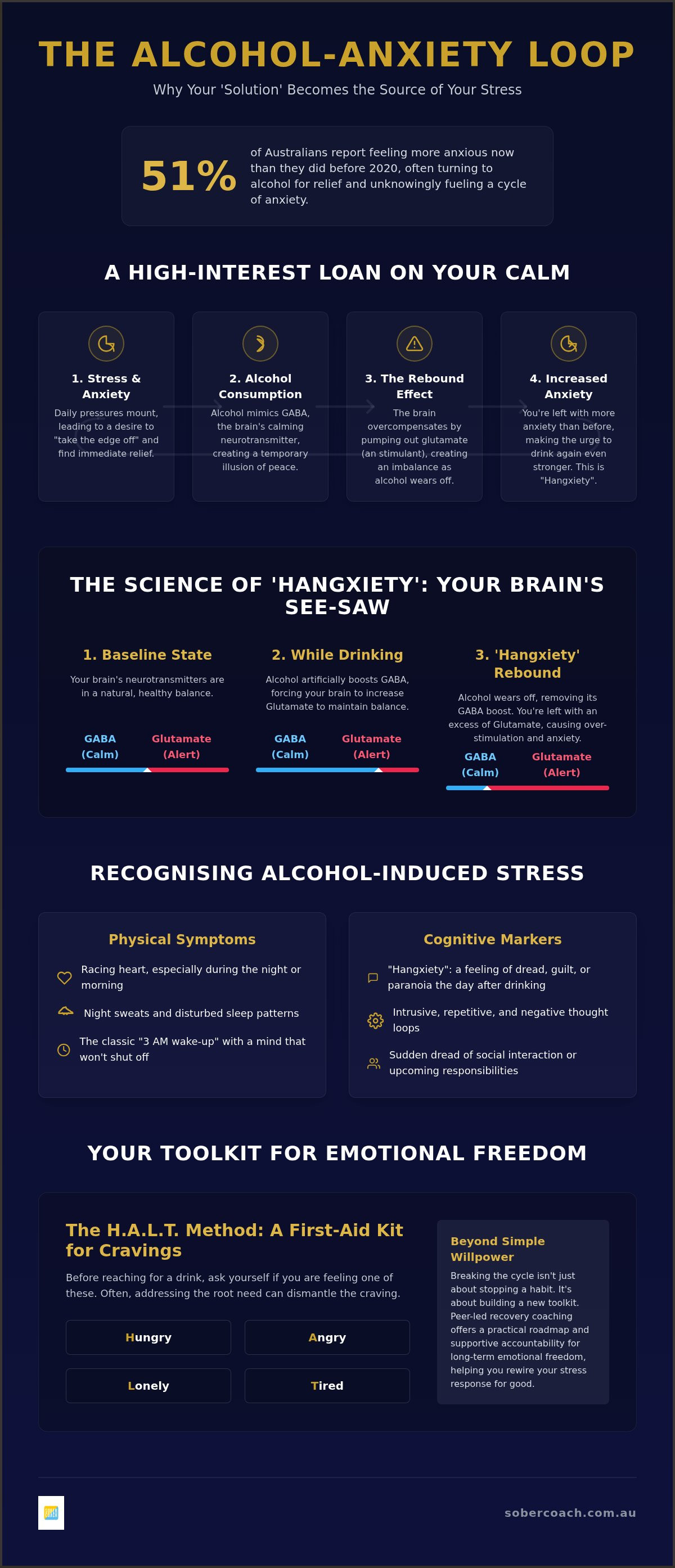
Alcohol isn't a cure for your anxiety; it's a high-interest chemical loan that eventually demands payment in the form of the very panic you're trying to escape. When 5 PM hits, that first drink feels like a lifeline, but by 3 AM, the "hangxiety" settles in with a racing heart and a mind full of regret. You aren't alone in this exhausting cycle. Recent data shows that 51% of Australians feel more anxious now than they did in 2020. Learning the art of coping with anxiety without alcohol isn't about deprivation; it's about reclaiming your agency and finally giving your nervous system the genuine rest it deserves.
I know how heavy that weight feels because I've carried it too. You deserve to feel steady in your own skin without needing a liquid crutch to survive a dinner party or a stressful Tuesday. This guide will show you how to break the alcohol-anxiety loop and build a practical, sustainable toolkit for emotional freedom. We'll explore how to lower your baseline stress levels, navigate social settings with quiet confidence, and replace the "witching hour" dread with strategies that actually work for the long haul.
Table of Contents
The Alcohol-Anxiety Loop: Why Your 'Medicine' is Making You Sicker
Many of us reach for a glass of wine or a cold beer to "take the edge off" after a brutal day. It feels like medicine. In those first twenty minutes, your brain experiences an illusion of relief as alcohol floods your system with dopamine and mimics GABA, the primary inhibitory neurotransmitter. You feel lighter. The noise in your head quiets down. But this relief is a biological lie. While you think you're managing The Alcohol-Anxiety Loop, you're actually setting the stage for a much more intense rebound of panic.
The difference between clinical anxiety and alcohol-induced anxiety is often a matter of timing. Clinical anxiety persists regardless of your habits; alcohol-induced anxiety is a direct physiological response to the substance leaving your body. It's vital to understand that this isn't a character flaw or a lack of willpower. It's a predictable neurochemical reaction. When you ingest a depressant, your brain fights to maintain balance by pumping out stimulants like glutamate. Once the drink wears off, you're left with an overstimulated nervous system and no "medicine" left to dampen the noise.
The Short-Term Fix vs. Long-Term Cost
Alcohol provides a temporary surge of GABA while simultaneously suppressing your body's ability to regulate its own calm. Over time, you stop trusting your natural resilience. You begin to believe you can only handle stress with a drink in hand. The Anxiety-Alcohol Loop is a self-perpetuating cycle of neurochemical depletion. Every time you use a drink to numb out, you're effectively outsourcing your emotional regulation to a toxin that eventually demands a high price for its services.
Recognising the Signs of Alcohol-Induced Stress
Identifying the markers of this cycle is the first step in coping with anxiety without alcohol. Physical symptoms often include a racing heart rate, night sweats, and that familiar 3 AM wake-up call where your mind won't shut off. These aren't just "hangovers." They are signs of your nervous system in crisis. Cognitive markers like "hangxiety," intrusive thoughts, and a sudden dread of social interaction are also common. These symptoms typically peak between 12 and 24 hours after your last drink, precisely when your blood alcohol level hits zero and your brain is screaming for balance. Understanding this timing helps you see the anxiety for what it truly is: a withdrawal symptom, not a permanent part of your identity.
The Science of 'Hangxiety': What Happens in the Australian Brain
To understand why you feel so fragile after a night of drinking, you have to look at the brain's delicate see-saw of neurochemistry. Alcohol acts as a massive weight on the GABA side of the scale, which is the neurotransmitter responsible for feelings of calm and relaxation. Your brain, being a master of balance, senses this artificial surge and reacts by piling weights on the opposite side: Glutamate. This is your brain's primary excitatory chemical, designed to keep you alert and awake. It's a survival mechanism, but it comes with a heavy price.
When the alcohol leaves your system, those GABA weights vanish instantly. However, the Glutamate weights remain, leaving your nervous system tilted violently toward a state of over-excitation. This is the chemical definition of "hangxiety." Over time, chronic drinking desensitises your brain's natural ability to handle stress. Your internal "calm" receptors become less effective, making you feel like you're naturally more anxious than everyone else. In reality, your biology is simply stuck in a defensive posture, waiting for the next chemical surge to level things out.
The 3 AM Wake-Up Call
This metabolic process is exactly why you find yourself staring at the ceiling in the middle of the night. About four to five hours after your last drink, your liver has finished its work, and your blood alcohol level drops toward zero. This triggers a state of hyper-arousal. Your brain over-corrects for the previous sedation by spiking cortisol, your body's primary stress hormone. You wake up with a racing heart, sweaty palms, and a mind full of intrusive thoughts. It's easy to mistake this rebound for baseline anxiety, but it's actually a predictable physiological reaction to the substance leaving your system.
Rewiring Your Stress Response
The most empowering part of this science is neuroplasticity. Your brain isn't broken; it's adaptive. Once you remove the alcohol, your neurochemistry begins the process of recalibration. In the first 30 days of sobriety, your GABA receptors start to regain their sensitivity, and your Glutamate levels begin to stabilise. You'll find that coping with anxiety without alcohol becomes significantly easier as your biology returns to its natural baseline.
This transition can feel intense, as you're essentially learning to regulate your emotions for the first time in years. Working with One-on-One Recovery Coaching can provide the bridge you need during this biological shift. Having a mentor who understands the lived experience of this rewiring process helps you stay grounded while your brain does the hard work of healing itself. You aren't just quitting a drink; you're giving your nervous system the chance to find its own sustainable calm.
Breaking the 'Witching Hour': Strategies for Daily Stress
The "Witching Hour" is that heavy window between 4 PM and 7 PM where the workday ends and the evening begins. For many, this is the primary trigger point. Your brain is fried, your cortisol is high, and the habit of reaching for a drink feels automatic. Coping with anxiety without alcohol during this time requires more than just willpower; it requires a strategy. Before you reach for the bottle, run through the HALT check. Ask yourself: Am I Hungry, Angry, Lonely, or Tired? Often, what we interpret as a desperate need for a drink is actually a physiological need for food, rest, or connection. By addressing the underlying physical state, you can de-escalate the urge before it becomes overwhelming.
It's about replacing the ritual, not just removing the drink. If your habit was to pour a gin and tonic as soon as you walked through the door, you need a new way to signal to your brain that the day is over. Building a "Sober Toolkit" means having high-quality non-alcoholic alternatives ready, or perhaps a specific playlist that shifts your mood. You are creating a new neural pathway that says "stress is ending" without the chemical crash that follows.
Managing the Work-to-Home Transition
The transition from "work mode" to "home mode" is a high-risk zone for anxiety. Practical rituals help bridge this gap. Change your clothes immediately upon arriving home to physically shed the day's stress. A 10-minute walk around the block can act as a circuit breaker, using physical movement to flush the cortisol that built up during your meetings. Setting boundaries is also crucial. Learning to say "no" to late-afternoon emails or stressors prevents the anxiety spike that usually leads to a glass of wine. Protect your peace during these hours like your recovery depends on it, because it does.
The Power of Micro-Habits
When the panic feels sharp, micro-habits offer immediate relief. Box breathing, inhaling, holding, exhaling, and holding again for four seconds each, is a proven way to reset your autonomic nervous system. Grounding techniques, like the 5-4-3-2-1 method, pull you out of an anxious spiral and back into the present moment. Don't underestimate the role of hydration and nutrition; stabilising your blood sugar prevents the mood dips that mimic anxiety. If you find the home environment itself is the trigger, In-Home Recovery Support can help you restructure your space and routines to support your new lifestyle. These small, intentional acts are the building blocks of a life where coping with anxiety without alcohol becomes your new, empowered normal.
Navigating Social Settings in Sydney Without 'Liquid Courage'
Walking into a Sydney bar or a friend's BBQ without the buffer of a drink can feel like stepping onto a stage without your lines. For years, you've relied on "liquid courage" to bridge the gap between your internal social anxiety and your external personality. But coping with anxiety without alcohol in these settings is entirely possible once you realise that the discomfort is temporary. Most social anxiety peaks within the first 20 minutes of arrival. If you can survive that initial window of "newness," your nervous system will naturally begin to settle without the need for a chemical sedative.
Preparation is your best defence. A solid "pre-game" strategy now involves mental grounding rather than downing a quick drink before you leave the house. Identify your "safe people" at the event before you arrive. These are the friends who won't pressure you and who already know your goals. Having an exit strategy is equally vital. Knowing you can leave the moment the vibe shifts from meaningful connection to sloppy intoxication gives you the psychological safety to show up in the first place.
Tactical Socialising: A Step-by-Step Framework
Navigating these events requires a tactical approach. Follow these four steps to maintain your peace and your sobriety:
Step 1: Arrive early and leave early. This "Sober Slink" technique allows you to have genuine conversations before the music gets too loud and the drinks hit too hard.
Step 2: Always have a non-alcoholic drink in hand. People are less likely to offer you a beer if your hands are already busy with a sparkling water or a mocktail.
Step 3: Focus on the conversation, not the consumption. Shift your attention outward. Ask open-ended questions and actually listen to the answers.
Step 4: Have your exit script ready. A simple "I've had a great time, but I'm heading off now" is all the explanation you need.
Reclaiming Your Social Identity
One of the biggest fears when coping with anxiety without alcohol is the myth that you'll become boring. In reality, the opposite is true. You become more present, more witty, and far more capable of forming authentic connections. Sober conversations have a depth that "drunk talk" simply can't match. You'll remember the details, the laughs, and the shared moments without the fog of regret the next morning. You aren't losing your personality; you're finally letting it breathe. If you're finding the transition to sober socialising difficult, our Group Coaching Online provides a safe space to share your social wins and troubleshoot challenges with others who are on the same path. You don't have to navigate the social scene alone.
Beyond the Quick Fix: How Recovery Coaching Bridges the Gap
Willpower is a finite resource. When you're exhausted at the end of a long day, that mental "muscle" is often too tired to resist the pull of a familiar habit. This is why so many people struggle when they try to quit on their own. Coping with anxiety without alcohol isn't a test of your character; it's a strategic shift in your lifestyle. While clinical therapy is invaluable for processing deep-seated trauma or managing mental health diagnoses, recovery coaching focuses on the practical "how-to" of your daily existence. It bridges the gap between understanding your past and actually living your future.
Coaching offers real-time accountability that a traditional clinical session often lacks. It's about having a partner who understands the visceral pull of the 5 PM witching hour because they've stood in those exact shoes. This lived experience builds immediate trust. It strips away the medicalised coldness and replaces it with a human-to-human connection that feels both brave and transparent. We don't view sobriety as a finish line or a state of deprivation. Instead, it's a powerful beginning. It's the moment you stop numbing your potential and start exploring who you are when you aren't perpetually recovering from a chemical loan.
Personalised Support for a Vibrant Life
Every person's relationship with stress is different. One-on-One Recovery Coaching creates a bespoke roadmap tailored specifically to your unique triggers and lifestyle. We move beyond the simple act of avoiding a drink and focus on the much more exciting goal of creating a life you don't feel the need to escape from. By mapping your triggers and identifying the specific moments your anxiety spikes, we build a tailored toolkit that works in the real world. This non-judgmental partnership allows you to explore your habits safely, focusing on the promise of liberation and self-discovery.
Taking the First Step Toward Liberation
If you're wondering what this looks like in practice, a typical coaching session involves goal setting, trigger mapping, and tool building. It's proactive and results-oriented. For those who need a more structured environment or group connection, Online Rehab via Zoom provides accessible, high-impact support for clients across Australia. You don't have to navigate this transition alone. The journey toward a sustainable calm is a courageous choice, and having a mentor to guide you makes all the difference. This is your chance to reclaim your agency and start a new chapter defined by genuine clarity and emotional strength.
Step Into a Life of Sustainable Calm
You now understand that your anxiety isn't a personal flaw; it's a physiological response to a chemical cycle that can be broken. By recognizing the GABA-Glutamate balance and mastering the daily work-to-home transition, you've already begun the work of reclaiming your agency. Coping with anxiety without alcohol is about building a toolkit that allows you to show up at a social event or navigate a stressful Tuesday with genuine, steady confidence. You are moving from a state of numbing to a state of truly living.
This journey doesn't have to be a solo mission. We provide professional, peer-led recovery support across Australia through flexible online and in-home delivery models. Our coaches bring lived experience to every session, offering a non-judgmental space to help you build a life you don't need to escape from. Book a free discovery session with a Sober Coach today and take the first step toward emotional freedom. You've spent enough time surviving the loop. It's time to start thriving in your own skin with a clear mind and a brave heart.
Frequently Asked Questions
Is it normal for anxiety to get worse when I first stop drinking?
Yes, this is a common physiological response called rebound anxiety. When you stop drinking, your brain is left with an excess of glutamate, the excitatory chemical, while your natural GABA receptors are still desensitised. This chemical imbalance makes you feel hyper-alert and panicky. It's a sign that your body is beginning to recalibrate. Understanding this helps in coping with anxiety without alcohol because you recognize the feeling as temporary withdrawal rather than your permanent baseline.
How long does it take for my brain's chemistry to return to normal?
While every person's timeline is unique, most people notice a significant shift in their baseline anxiety within the first 30 days. During this period, your neuroreceptors begin to "upregulate," meaning they become more sensitive to your body's natural calming chemicals again. Major cognitive improvements often continue for six to twelve months. This long-term healing process is why we focus on sustainable tools rather than quick fixes that don't allow the brain time to fully rewire.
Can I still be social in Sydney if I'm not drinking?
Absolutely, and you'll likely find your connections are more authentic. Sydney has a growing "sober curious" scene with plenty of non-alcoholic options in bars and restaurants. The key is to shift your focus from the consumption to the conversation. By arriving early and having an exit strategy, you can enjoy the social atmosphere without the pressure to drink. You'll wake up the next day with clear memories and zero social regret.
What is the 'witching hour' and why is it so hard to resist a drink then?
The 'witching hour' is typically the window between 4 PM and 7 PM when your workday ends and your willpower is at its lowest. It's hard to resist because your brain is conditioned to use alcohol as a "circuit breaker" to signal the end of stress. During these hours, your blood sugar often drops and your cortisol levels are high. Replacing this ritual with a walk or a non-alcoholic replacement drink helps retrain your brain's transition signals.
Do I need to go to detox if I only drink for anxiety?
We do not provide medical detox services or clinical advice on withdrawal safety. Whether you need a clinical detox depends on your level of physical dependence, not just your reasons for drinking. It's important to consult with a medical professional to assess your physical safety before stopping. Our role begins once you are physically stable, focusing on the long-term coaching and practical life-tools needed to maintain your sobriety and manage your anxiety effectively.
How is recovery coaching different from traditional therapy for anxiety?
Traditional therapy often focuses on clinical diagnoses and processing past traumas. Recovery coaching is a proactive, peer-led approach that focuses on the "here and now." We provide practical, real-world strategies for navigating your daily life and triggers. Our coaches use their lived experience to build a non-judgmental partnership, helping you restructure your environment and routines. It's about moving toward a vibrant life rather than just managing a medical condition.
What are some quick tools to stop a panic attack without alcohol?
When panic hits, you need immediate physiological "circuit breakers." Box breathing is incredibly effective: inhale for four seconds, hold for four, exhale for four, and hold for four. You can also use the 5-4-3-2-1 grounding technique to reconnect with your senses. These micro-habits are essential for coping with anxiety without alcohol because they work with your autonomic nervous system to signal safety to your brain without needing a chemical sedative.
How can I explain my decision to stop drinking to my friends?
You don't owe anyone a detailed medical history. A simple, direct statement like "I'm taking a break for my health" or "I've realized I feel much better when I don't drink" is usually enough. True friends will support your choice without interrogation. If you feel pressured, remember that their reaction is often about their own relationship with alcohol, not yours. Having a pre-planned "exit script" helps you maintain your boundaries with confidence.
Comments