

Building a Sober Life: Thriving in Australia (2026)

What if the hardest part of sobriety isn't putting down the drink, but actually figuring out what to do with the twenty four hours that follow? For many Australians, the initial relief of quitting is quickly replaced by a nagging sense of sober boredom and the fear that a social life in Sydney or Melbourne is a thing of the past. It's an uncomfortable truth that many programs don't address. You've stopped the self destruction, but you haven't yet started building a new life in sobriety that feels worth living. It's normal to feel lost when your old social circles revolve around the pub and your weekends suddenly feel like a vast, empty desert.
You aren't broken, and you certainly aren't powerless. You're simply in the middle of a massive lifestyle redesign. This article moves beyond the clinical "one day at a time" mantra to give you a strategic roadmap for thriving in 2026. We'll explore how to navigate high pressure social scenes without the anxiety, how to establish daily routines that support your wellness, and how to forge a powerful identity based on growth rather than labels. It's time to stop escaping your life and start creating one you're proud to inhabit.
Table of Contents
The "White Space" of Early Sobriety: Redefining Your Identity
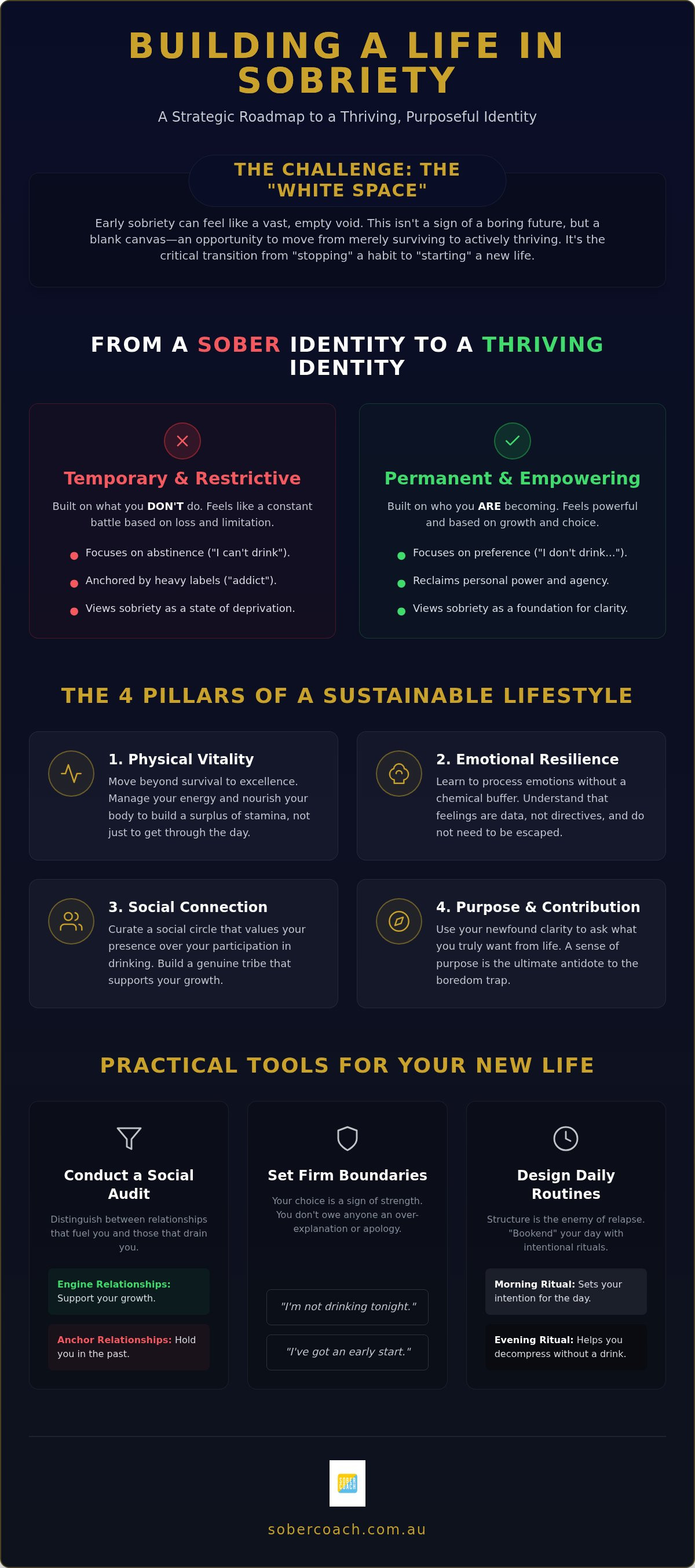
The "White Space" is that eerie, quiet gap that opens up once the noise of active drinking stops. Your old habits are gone, but you haven't filled that time with anything meaningful yet. It's the most vulnerable part of building a new life in sobriety because it feels empty. Most people mistake this emptiness for boredom or a sign that life without alcohol is dull. In reality, it's a blank canvas. This is where you move from a "Sober Identity," which is often a temporary bridge built on what you don't do, to a "Thriving Identity" built on who you actually are.
There is a massive difference between being "dry" and being truly sober. Being dry is just abstinence; it's white-knuckling your way through a Friday night while wishing you were elsewhere. True sobriety is about emotional and lifestyle alignment. It involves understanding sobriety not as a state of deprivation, but as a foundation for mental clarity. Sobriety is a proactive lifestyle choice that prioritises personal agency and growth over the numbing effects of substance use.
Moving Beyond the Labels
Labels like "addict" or "alcoholic" can be useful for some, but for many, they feel like heavy anchors. Rejecting restrictive labels allows you to reclaim your power. Instead of saying "I can't drink," which implies a loss of control, try "I don't drink because I have better things to do." It shifts the narrative from a restriction to a preference. When you're at a BBQ in Sydney or a bar in Perth and someone asks why you aren't drinking, you don't owe them a medical history. A simple "I'm not drinking tonight" or "I've got an early start tomorrow" is enough. Your choice is a sign of strength, not a deficit.
The Psychology of the New You
Your brain is incredibly resilient. Through neuroplasticity, it begins to heal and create new reward pathways the moment you stop. However, in early recovery, things often feel "flat." This is because your dopamine receptors, which were constantly flooded by alcohol, need time to recalibrate. Life might seem grey for a while, but this is a physiological phase, not your new permanent reality. Focus on small, achievable goals like a morning walk or finishing a book. These tiny wins are the bricks you use for building a new life in sobriety, slowly restoring the self-trust that substance use eroded.
The Four Pillars of a Sustainable Sober Lifestyle
Building a new life in sobriety isn't a passive event. It's a structural project. If the "White Space" we discussed earlier is the foundation, these four pillars are the load-bearing walls that keep your new house standing when the storms of life hit. Without a plan for your energy, your emotions, and your connections, you're just not drinking. With these pillars, you're actually living.
Pillar 1: Physical Vitality. This goes beyond standard health advice. It's about energy management. When you stop poisoning your system, you gain a surplus of time and stamina. Use it to nourish your body, not just to survive, but to excel. It's about finding the fuel that makes you feel alive.
Pillar 2: Emotional Resilience. Without the chemical buffer of alcohol, emotions feel loud. Resilience is the ability to sit with that volume without reaching for a remote to mute it. You learn that feelings aren't facts; they're just data points that don't need to be escaped.
Pillar 3: Social Connection. You need a tribe that values your presence more than your participation in a round of shots. This is vital for navigating the social pressures in cities like Sydney. It's about curating a circle that supports your growth.
Pillar 4: Purpose and Contribution. Sobriety provides the clarity to finally ask what you actually want to do with your life. Finding a way to give back or pursue a long-dormant passion makes the journey sustainable. Purpose is the ultimate antidote to the boredom trap.
Designing Your Daily Routine
Structure is the enemy of relapse. By "bookending" your day with specific rituals, you create a sense of safety. A solid morning routine sets your intention, while an evening ritual helps you decompress without a drink. For those struggling to transition back into their own space, In-Home Recovery Support can help bridge the gap by identifying triggers in your immediate environment. Replacing the old "wine o'clock" habit with high-value activities like a hobby or a Zoom-based group session is a cornerstone of building a new life in sobriety, ensuring that the old rituals don't have room to grow back.
Emotional Toolkits for Real Life
Life doesn't stop being stressful just because you're sober. You need practical tools like the HALT acronym. If you feel an urge, check if you are Hungry, Angry, Lonely, or Tired. Most cravings are just masked physical or emotional needs. While government advice on quitting alcohol often focuses on the initial cessation, long-term success comes from observing an urge rather than reacting to it. Think of a craving like a wave; it peaks and then breaks. You don't have to swim against it; you just have to stay on your board. If you find yourself struggling with the underlying "noise," exploring resources for coping with anxiety without alcohol can provide the mental shift needed to stay on track.
Why Traditional Rehab Ends and Recovery Coaching Begins
Traditional rehab is designed for crisis. It's a safe container where you learn how to stop. But what happens when the bubble pops? For many, the walk from the clinic doors back to the real world is where the plan falls apart. This is the gap where recovery coaching becomes essential. While clinical settings focus on the past and the "why" of habits, coaching is relentlessly focused on the "how" of your future. It's the difference between surviving a crash and learning how to drive again.
Professional coaching offers a non-clinical advantage: lived experience. When you speak to someone who's navigated the same social pressures and internal battles, trust is immediate. They aren't looking at you as a patient with a diagnosis; they're looking at you as a peer with potential. This relationship provides a level of radical accountability that family members, despite their best intentions, often can't provide. Families are often too close to the trauma to be objective mentors. By using Australian drug and alcohol resources alongside a dedicated coach, you create a safety net that catches you before a slip happens.
The Coach-Client Partnership
In a One-on-One Recovery Coaching session, the focus shifts from clinical observation to active life-design. You'll work on navigating non-binary behavioural patterns, those grey areas where you aren't necessarily in crisis, but you aren't yet thriving. This partnership empowers you to move from being a "recovering person" to an active architect of your own existence. It's about building a new life in sobriety that feels expansive, not restrictive. You aren't just following a program; you're co-creating a strategy for your specific reality.
Online vs. In-Person Support
Accessibility shouldn't be a barrier to growth. For those in regional Australia, Online Rehab and group coaching via Zoom offer the same high-level support as city-based services. Digital spaces have proven to be incredibly effective for community building, allowing you to connect with others who are also building a new life in sobriety from the comfort of your own home. Conversely, for residents in Sydney, In-Home Recovery Support provides a hands-on approach. A coach can enter your physical environment to help you identify and neutralise real-world triggers where they actually live. Whether you choose a digital or physical path, the goal remains the same: creating a life you don't need to hide from.
Practical Steps to Rebuild Your Social and Professional World
Building a new life in sobriety requires moving from the safety of your home into the friction of the real world. This is where the theory of your recovery meets the reality of Australia's pervasive pub culture. To thrive, you need a tactical approach to your environment. It isn't just about avoiding old haunts; it's about actively curating a world that supports your growth. This transition is a skill that can be practiced and mastered.
Step 1: Conduct a Social Audit. Identify the "engines" in your life, the people who propel you forward, and the "anchors," those who keep you stuck in old patterns. You don't necessarily have to cut everyone off, but you must be intentional about who gets your time and energy.
Step 2: Establish Boundaries. "No" is a complete sentence. You don't need to explain your choice to stay sober to a casual acquaintance or a pushy colleague.
Step 3: Practice Social Exposure. Don't start with a three day music festival. Start with a quick coffee or a lunch where alcohol isn't the focus. Treat socialising like a muscle that needs gradual training.
Step 4: Professional Realignment. Workplace drinking culture is a reality. Focus on your professional output and value rather than social participation at Friday night drinks. Performance is the best shield against social pressure.
Step 5: Find Sober-First Communities. The alcohol free scene is exploding in 2026. Seek out spaces designed for connection without the crutch of a drink.
Navigating Sydney’s Social Scene
Sydney is famous for its "sundowner" culture, but the city offers incredible alternatives for those building a new life in sobriety. Swap the morning hangover for a sunrise coastal walk from Bondi to Coogee. Engage with the growing morning rave culture or explore sophisticated non-alcoholic pairing menus at top tier restaurants. When you're at a BBQ, keep a non-alcoholic drink in your hand; people rarely ask questions if you already look like you're participating. For more inspiration, you can find plenty of 10 Fun Sober Weekend Ideas in Sydney to keep your calendar full and your mind clear.
Rebuilding Trust and Relationships
Repairing bonds with family requires an "actions over words" philosophy. You've likely made promises before; now is the time to let your consistent, sober presence do the talking. Some friends might not be ready for your change because it shines a light on their own habits. It's okay to let those relationships drift while you focus on your health. If you're struggling to navigate these delicate conversations, learning how to rebuild trust with family during recovery can provide the framework you need to heal those connections. Repair takes time, but integrity is built through daily consistency.
If you're ready to move from theory to action, our Intensive Recovery Workshops provide the practical tools and community support needed to navigate these social shifts with total confidence.
How a Sober Coach Accelerates Your Transformation
Building a new life in sobriety is a massive undertaking that requires more than just willpower. It requires a blueprint. While the previous sections of this article have outlined the "what" and the "why," a recovery coach focuses on the "how." Generic advice often fails because it doesn't account for your specific triggers, your career demands, or your unique family dynamics. A personalised strategy moves you away from a "one size fits all" approach and toward a life design that actually fits your reality in 2026.
Radical accountability is the secret weapon of this process. It isn't about being policed; it's about having a mentor who has walked the same path and can see the traps before you step in them. This human-to-human connection builds a level of trust that clinical models often miss. Our Intensive Recovery Workshops are designed for those ready to do the deep work, clearing emotional blocks in a concentrated environment so you can move forward faster. When you have a direct, no-nonsense mentor, the path from confusion to clarity becomes much shorter.
Holistic integration ensures that your transformation isn't just internal. A coach helps you align your home environment, your professional boundaries, and your social circles so they all point in the same direction. Building a new life in sobriety is much easier when your entire ecosystem supports your new identity. You stop fighting your environment and start being carried by it. This alignment is what turns a fragile recovery into a resilient, vibrant lifestyle.
The Sober Coach Australia Methodology
We believe in liberation, not deprivation. Our methodology rejects the narrative of powerlessness, instead focusing on your personal agency and your ability to choose a better path. By using modern terminology and non-judgmental frameworks, we help you navigate the complexities of life without the weight of traditional stigma. Our intensive workshops bridge the gap between initial cessation and long-term success by providing a structured environment for deep personal growth and habit integration.
Your Next Steps: From Surviving to Thriving
Research suggests the first 90 days are the most critical for identity formation. This is when your new habits are most fragile and the "white space" we discussed earlier feels the largest. It's the time to move from simply surviving the day to actively thriving in your new world. Booking a discovery session allows us to assess your specific needs and match you with the right level of support, whether that's in-home recovery support or group sessions. Ready to build a life you love? Explore our One-on-One Recovery Coaching.
Taking Ownership of Your New Chapter
You’ve seen that sobriety isn't just about what you leave behind; it’s about the vibrant, purposeful existence you’re currently designing. We’ve explored the necessity of navigating the "white space" with intention and the power of the four pillars to keep you grounded. Building a new life in sobriety is a courageous act of lifestyle architecture. It requires moving from the clinical safety of rehab into the messy, beautiful reality of daily life in Australia.
You don’t have to do this alone. Our team of lived experience mentors provides a non-clinical, empowering framework that focuses on your liberation rather than your limitations. Whether you need online support from a regional town or in-person coaching in Sydney, we’re here to bridge the gap between surviving and truly thriving. It’s time to stop looking back and start building. Book a One-on-One Discovery Session with a Sober Coach today. Your new beginning starts with a single, proactive choice.
Frequently Asked Questions
Is building a new life in sobriety possible without AA or 12-step programs?
Yes. Many Australians find success through peer-led coaching and workshops that focus on personal agency rather than powerlessness. Building a new life in sobriety is about creating a custom roadmap that fits your lifestyle. While 12-step programs work for some, others prefer a non-clinical, goal-oriented approach that prioritises lifestyle design and empowerment. It's about finding the methodology that resonates with your specific needs.
How do I deal with the overwhelming boredom in early sobriety?
Boredom is often just the absence of chaos. It's an opportunity to rediscover dormant passions and establish new, high-value rituals. In early recovery, your brain is recalibrating its reward system, which can make things feel flat. Instead of waiting for excitement to happen, proactively schedule activities like coastal walks, morning raves, or creative hobbies. This "white space" is where your new identity is actually built.
What is the difference between a recovery coach and a therapist?
Therapists usually focus on your past and clinical diagnoses. A recovery coach is a mentor with lived experience who focuses on your future and the practical "how-to" of daily life. Coaching is action-oriented and non-clinical, bridging the gap between rehab and real-world living. While therapy unpicks the "why," coaching provides the radical accountability and strategy needed to navigate social scenes and workplace culture effectively.
Can I use NDIS funding for recovery coaching in Australia?
Psychosocial recovery coaching is a recognised support category under many NDIS plans in 2026. This specific funding is designed to help participants build the capacity and resilience needed for independent living. You should check your individual plan to see if "Recovery Coaching" is an included support item. This resource can be a game-changer for accessing the peer-led guidance necessary for long-term lifestyle design and personal empowerment.
How do I tell my friends I’m not drinking anymore without it being awkward?
Keep it simple and direct. You don't owe anyone a medical history or a deep explanation. A punchy statement like "I'm not drinking tonight, I've got a big day tomorrow" or "I'm focusing on my health right now" is usually enough. True friends will support your choice without pushing. If a social circle revolves entirely around alcohol, it might be time to conduct a social audit of those relationships.
What should I do if I have a slip-up while trying to rebuild my life?
Don't let a slip become a slide. A single event doesn't erase your progress or your potential. Acknowledge what happened without the weight of traditional stigma, identify the trigger, and get back to your routine immediately. Reach out to your coach or support group for radical accountability. Use the experience as data to strengthen your plan for building a new life in sobriety.
How long does it take to feel "normal" after stopping alcohol or drugs?
Most people report a significant shift after the first 90 days. This is the critical window where your brain begins to heal and new reward pathways form. However, "normal" is a moving target. You aren't going back to your old self; you're evolving into a more resilient version of yourself. Consistency in your daily routine and the four pillars of wellness will accelerate this sense of mental clarity.
Can a sober coach help me even if I haven’t been to a medical detox?
Absolutely. While we don't provide medical detox, we specialise in the lifestyle integration that follows. Many clients haven't been to a traditional rehab but want a structured plan to change their habits. Coaching is about starting your new life, whether you're coming from a clinical setting or simply making a proactive choice to stop. We provide the tools to ensure your home and social life support your decision.
Comments