

90 Days Sober Benefits: Why the Three-Month Mark is the Ultimate Game Changer
- angie391
- Jun 12
- 12 min read

What if the "I can stop whenever I want" myth is the very thing keeping you stuck in a cycle of surviving rather than thriving? You've likely tried the short breaks or the dry months, only to find that persistent hangxiety follows you into the office on Monday morning anyway. It's exhausting to feel socially isolated in Australia's alcohol-heavy culture, especially when you're just counting down the days until you can "be normal" again. Understanding the 90 days sober benefits is about more than just hitting a number on a calendar. It's about reaching the biological tipping point where sobriety stops being a test of willpower and starts becoming your new, effortless identity.
You deserve to feel the rush of genuine mental clarity and the kind of deep, restorative sleep that doesn't require a nightcap. We are going to explore how this three-month milestone fundamentally transforms your brain chemistry and emotional resilience. You'll discover why ninety days is the magic window for restoring your dopamine levels and how to navigate the social scenes of Sydney or Melbourne with a new sense of quiet confidence. This isn't just about stopping a habit. It's about a powerful beginning where you finally take back your agency and start living a liberated life.
Key Takeaways
Understand the biological shift as your brain repairs its dopamine receptors, allowing you to move beyond the friction of willpower into a more effortless way of living.
Discover how to quiet the persistent noise of "hangxiety" by allowing your nervous system to finally exit a constant state of fight-or-flight.
Gain practical strategies to confidently navigate Australia's alcohol-centric social culture without feeling isolated or losing your sense of mateship.
Learn to identify the 90-day "Wall" and the "Pink Cloud" effect so you can navigate the common motivational dips that often occur at the three-month mark.
Identify the core 90 days sober benefits that transform your journey from a daily struggle into a powerful foundation for long-term liberation and self-discovery.
Table of Contents
The Science of the 90-Day Milestone: What Happens to Your Brain?
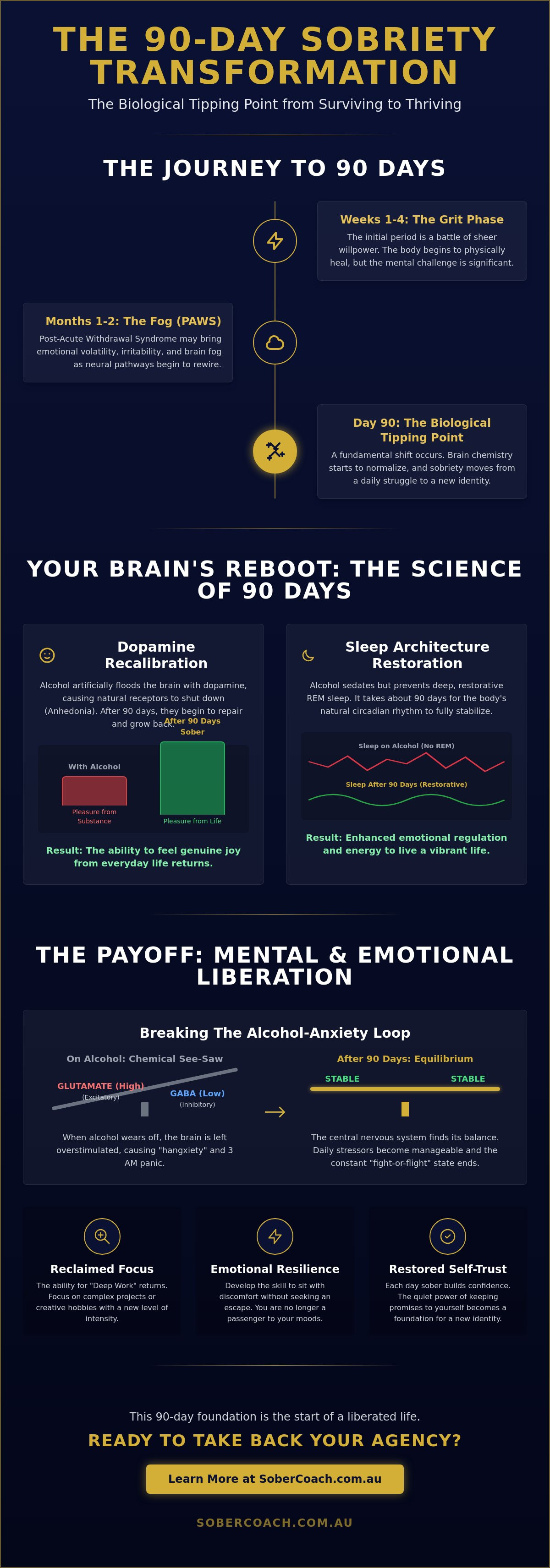
Ninety days is more than just a round number on a sobriety app. It is the Biological Rubicon. While the first few weeks are often a battle of sheer grit, the three-month mark represents the point where your brain chemistry begins a fundamental shift. This is the stage where the 90 days sober benefits move from physical repair to deep, neurological restructuring. To understand this journey, we first have to ask: What is sobriety? Beyond the simple absence of a substance, it is the process of returning your cognitive function to its natural baseline.
During the first two months, many people experience Post-Acute Withdrawal Syndrome (PAWS). This isn't the physical "shakes" of the first week; it's a period of emotional volatility, irritability, and brain fog that often peaks just before day 90. It happens because your neural habit loops are being rewritten. Your brain is literally pruning away the pathways that demanded alcohol and strengthening the ones that support clear thinking. By the time you hit twelve weeks, that heavy "fog" begins to lift, and your cognitive processing speed starts to return to its optimal state.
Dopamine Recalibration: Finding Joy in the Ordinary
Alcohol is a sledgehammer to the brain's reward system. It floods your system with dopamine, forcing your brain to "dial down" its natural pleasure receptors to protect itself. This leads to anhedonia, which is the temporary inability to feel pleasure from normal activities like a sunset or a good meal. It takes roughly 12 weeks of total abstinence for these receptors to "up-regulate" or grow back. Around the three-month mark, the world starts to regain its color. You aren't just resisting a drink; you're finally capable of feeling genuine joy without one.
Sleep Architecture Restoration
There's a massive difference between being "passed out" and actually sleeping. Alcohol acts as a sedative that skips the vital REM cycles your brain needs to process emotions and stress. It takes about 90 days for your body's internal clock and circadian rhythm to fully stabilize. Once your sleep architecture is restored, you'll find that your capacity for emotional regulation skyrockets. When you're getting deep, restorative REM sleep, the minor stresses of a Sydney commute or a busy Melbourne office no longer feel like world-ending events. You're finally waking up with the energy required to live a vibrant, liberated life.
Psychological and Emotional Benefits of 12 Weeks Alcohol-Free
By the time you reach the three-month mark, the most profound shift isn't just physical. It's the quiet. The screaming volume of "hangxiety" finally fades to a whisper. This is one of the most celebrated 90 days sober benefits because it signals that your nervous system is finally standing down. For years, you've likely lived in a state of chemical fight-or-flight, fueled by the spike and crash of your evening ritual. Now, you're learning to exist in the calm.
Emotional regulation is a skill that alcohol often stunts. When we numb the bad feelings, we inadvertently numb the good ones too. After 90 days, you are no longer a passenger to your moods. You've developed the resilience to sit with discomfort without immediately looking for the exit. This clarity brings back your capacity for "Deep Work." You can focus on complex projects or creative hobbies with a level of intensity that was impossible when your brain was constantly managing a chemical hangover. You're finally reclaiming your time and your talent.
Breaking the Alcohol-Anxiety Loop
Chronic drinking creates a volatile seesaw in your brain. Alcohol mimics GABA, your primary inhibitory neurotransmitter, which makes you feel relaxed. To compensate, your brain pumps out Glutamate, a powerful excitatory chemical. When the alcohol leaves your system, you're left with an overstimulated nervous system. This is the physiological root of your 3 AM panic. According to scientific research on alcohol's effects, it takes significant time for this chemical imbalance to level out. At twelve weeks, your central nervous system finally finds its equilibrium. Daily stressors suddenly feel manageable. You aren't just surviving the day; you're actually present for it.
Restoring Self-Trust and Confidence
There's a specific, quiet power in keeping a long-term promise to yourself. Most of us have spent years breaking those small "I'll only have one" or "I'm starting Monday" vows. This erodes your self-esteem until your internal narrative is one of constant disappointment. Crossing the 90-day threshold provides the undeniable proof you need to rewrite that story. You move from the restrictive "I can't drink" to the empowered "I don't drink." It's an identity shift that transforms your self-trust into solid ground. This is one of the core 90 days sober benefits that changes how you interact with the world. If you're ready to solidify this change, exploring one-on-one recovery coaching can help you navigate the nuances of this new identity. You've proven to yourself that a new life is possible. Now, you're just getting started.
Navigating the Australian Social Scene: The Lifestyle Shift
Living in Australia means facing a culture where "grabbing a drink" is the default setting for almost every human interaction. Whether it's a Friday afternoon at the office or a Sunday BBQ, the pressure to participate is real. One of the most significant 90 days sober benefits is the realization that mateship isn't found at the bottom of a glass. True connection is built on shared experiences and presence, not shared hangovers. You'll find that once you stop drinking, you don't lose your mates; you just lose the noise that was getting in the way of actually knowing them.
By day 90, your social circle might look different. Some friends might pull away because your sobriety holds up a mirror to their own habits. Don't let this discourage you. You are clearing space for deeper, more authentic relationships. This shift is a natural part of the Science of Brain Recovery, as your reward system begins to prioritize genuine human bonding over chemical hits. You're no longer just following the pack; you're choosing your own path.
The Pub, The BBQ, and The Office Drink
You need a plan. In Sydney, trade the late nights at the pub for a sunrise surf at Manly or the Bondi to Coogee coastal walk. In Melbourne, swap the bar crawl for the incredible coffee culture in Fitzroy or a morning run along the Tan. When someone asks why you aren't drinking, keep it simple. "I'm off the booze for a bit" or "I've got an early start tomorrow" works wonders. Most people don't actually care what's in your glass, they only care about their own. If you find the pressure mounting, our Intensive Recovery Workshops provide practical tools to handle these high-stakes social moments with ease.
The Financial and Time Dividend
Let's talk about the "Sober Dividend." According to data from 2021, the average Australian household spent $1,929 on alcohol annually. Over 90 days, that is nearly $500 back in your pocket. Beyond the cash, you're reclaiming roughly 15 to 20 hours every single week that used to be lost to drinking or recovering from hangovers. This reclaimed time is your greatest asset for personal growth, allowing you to finally pursue the hobbies, fitness goals, or side projects you've ignored for years. You're effectively gaining an extra day of life every single week.
The 90-Day 'Wall' and How to Scale It
You've reached the milestone. The initial "Pink Cloud" of sobriety, that period of high energy and effortless optimism, is starting to dissipate. This is the 90-day wall. It's the moment where the novelty of the change wears off and the reality of a life without alcohol sets in. While you've already experienced many 90 days sober benefits, this is often where motivation takes a sudden dip. You aren't doing anything wrong. You're just hitting the plateau where the biological repair meets the psychological long game. It's the difference between a sprint and a marathon.
One of the biggest risks at this stage is the belief that you've finally mastered your habits. You feel great. Your sleep is restored. Your head is clear. The voice in your head might suggest that because you've been "good" for three months, you can handle a single glass of wine at dinner. This is the "I'm cured" trap. It's a dangerous illusion that leads back to the same loops you worked so hard to break. Transitioning to 90 days sober benefits that last a lifetime requires moving from "not drinking" to proactive recovery. You have to stop looking at what you're losing and start focusing on what you're building.
Recognizing the 'I've Got This' Trap
Overconfidence is a quiet saboteur. Many people attempt "controlled drinking" experiments at this stage, only to find themselves back at square one within weeks. Willpower is a finite resource. It works for a month or two, but it won't carry you through a lifetime. To scale the wall, you need to replace sheer effort with robust systems and routines. This means maintaining your accountability structures even when you feel like you've got it all figured out. It's about creating a lifestyle where drinking simply isn't an option, rather than a daily choice you have to make.
Tools for Long-Term Maintenance
A sustainable life requires a diverse recovery toolkit. This includes daily journaling to track your emotional state and engaging with a community that understands your history. You also need to prepare for your "sober firsts." The first wedding, the first holiday, or the first major work crisis without a drink can feel daunting if you're flying solo. This is the perfect time to deepen your commitment through one-on-one recovery coaching or our Intensive Recovery Workshops. These tools help you solidify your gains and transform your foundation into a permanent lifestyle. You've built the base. Now, it's time to build the life you actually want to live. This is where the real transformation begins.
Beyond 90 Days: From Sobriety to Liberation with Sober Coach
Ninety days is a powerful milestone, but don't mistake the foundation for the finished house. While the initial 90 days sober benefits have likely restored your sleep and cleared the mental fog, the real work of transformation starts now. There's a vital distinction between being "dry" and being "sober." Being dry is simply the absence of alcohol; it often feels like a state of perpetual deprivation or white-knuckling. True sobriety is a state of liberation. It's where you no longer need the substance because the life you've built is far more compelling than the one you were trying to escape.
Sober Coach exists to help you navigate this transition from surviving to thriving. We don't just want you to stop drinking. We want you to start living with a sense of purpose and agency that alcohol previously stole. This isn't about following a rigid, one-size-fits-all script. It's about personal evolution. By focusing on the long-term 90 days sober benefits, we move past the "dry" phase and into a vibrant, goal-oriented reality where you are the architect of your own happiness.
The Power of Professional Recovery Coaching
Traditional 12-step models often focus on powerlessness and labels. While those paths work for some, our approach centers on your personal agency and future goals. Professional recovery coaching is proactive. We utilize mentors with lived experience who understand the specific nuances of the Australian lifestyle, from the corporate pressures of the CBD to the social expectations of a weekend BBQ. By engaging in One-on-One Recovery Coaching, you get a personalized roadmap that addresses your unique triggers and aspirations. We focus on where you're going, not just where you've been.
Your Path Forward: Programs for Every Stage
Transformation should be accessible, regardless of your location or schedule. For those who need a structured environment but can't commit to a residential facility, our Rehab online offers a comprehensive alternative. If you're looking for community connection without the travel, our Group coaching online via zoom provides a safe space to share experiences and strategies with others on the same path. For individuals in high-stakes environments who require more intensive, personalized attention, we offer In-Home Recovery Support to help you integrate new habits directly into your daily life.
The three-month mark is where you decide if this is a temporary break or a permanent upgrade. Ready to turn 90 days into a lifetime of liberation? Book a session today.
Your New Beginning Starts Now
Reaching the ninety-day threshold is a massive achievement. It marks the point where your brain chemistry finally begins to work with you rather than against you. You've navigated the biological recalibration of your dopamine receptors and the psychological shift from "can't drink" to "don't drink." These 90 days sober benefits aren't just temporary improvements. They are the essential building blocks for a life that feels genuinely liberated. The fog has lifted, your energy has returned, and the "hangxiety" that once defined your mornings is a thing of the past.
It's time to move beyond the plateau and turn your progress into a permanent identity. We provide an empowering, non-judgmental approach to personal transformation through professional recovery support. With lived experience at our core, we offer everything from flexible online rehab to personalized, Sydney-based in-home support. You don't have to navigate the next phase of your journey alone. We're here to help you bridge the gap between simply being "dry" and living a life that is vibrant and whole.
Start your journey to liberation with a professional Sober Coach today. You've built the foundation. Now, let's build the life you've been waiting for.
Frequently Asked Questions
What is the hardest part of being 90 days sober?
The hardest part is often the "Plateau Effect" where the initial excitement of your new lifestyle begins to fade and you're left with the reality of daily life. You've cleared the physical hurdles, but now you have to face the emotional reasons you drank in the first place. This is where many people feel a dip in motivation. It's the moment to shift from willpower to building a sustainable, vibrant lifestyle with professional support.
Can my brain fully recover from alcohol after 90 days?
Your brain begins significant repair by the three-month mark, specifically through dopamine receptor up-regulation. While 90 days isn't long enough for total restoration after years of heavy use, it's the critical window where your cognitive function returns to baseline. You'll notice improved memory, focus, and emotional stability as your neural pathways continue to heal and strengthen over the coming months of your recovery journey.
Is it normal to feel bored or depressed around the 90-day mark?
It is completely normal to feel a sense of boredom or a "flat" mood as the initial high of sobriety wears off. This often happens because your brain is still recalibrating its ability to feel pleasure from everyday activities without a chemical spike. This phase is temporary. One of the key 90 days sober benefits is that your natural joy returns as your system finds its new, healthy equilibrium without the need for substances.
How much weight can I expect to lose after 90 days alcohol-free?
Weight loss varies significantly between individuals because it depends on your previous consumption levels and current lifestyle choices. By removing the "empty" calories found in alcohol and reducing systemic inflammation, many people notice a visible reduction in bloating and facial puffiness within twelve weeks. Instead of focusing on a specific number, pay attention to your increased energy levels and how your clothes fit as your metabolism finally stabilizes.
What should I say to friends who pressure me to drink after I've hit 90 days?
Being direct and firm is the most effective way to handle social pressure in the Australian social scene. You don't owe anyone a medical history; a simple "I'm much happier and more productive without it" usually ends the conversation. If friends continue to push, it's often a reflection of their own relationship with alcohol rather than a judgment of your choice. True mates will respect your decision to prioritize your health.
Does 90 days sober count as a 'reset' for my liver?
Ninety days provides a massive recovery window for your liver to repair itself and reduce inflammation. For many, this is enough time for fatty liver deposits to decrease and for liver enzyme levels to return to a healthy range. While it's a significant "reset" for organ function, it's always best to consult with a GP for specific blood tests to monitor your individual progress and ensure your body is healing as expected.
What is the difference between a sober coach and a therapist?
A sober coach focuses on the "how" of your future, while a therapist often focuses on the "why" of your past. Coaching is a proactive, goal-oriented partnership based on lived experience and practical strategies for navigating daily life. We help you build a toolkit for social situations and career goals. Therapy is a clinical process designed to treat underlying mental health conditions or deep-seated trauma through a medical lens.
How do I deal with the 'Pink Cloud' phase ending?
Dealing with the end of the "Pink Cloud" requires a shift from relying on feelings to relying on systems. When the initial euphoria fades, it's easy to feel like you've lost your way, but you're actually just entering the "real" phase of recovery. This is the perfect time to engage with a mentor or join a group coaching online via zoom to help you stay accountable. You're moving from a temporary high into a long-term, liberated life.
Comments