

Psychosocial Recovery Coaching Activities: A Practical Guide to Rebuilding Your Life

What if your recovery wasn't measured by the number of clinical appointments on your calendar, but by the number of times you actually felt like yourself this week? Most people feel stuck in a loop of talking about the problem without ever finding the tools to build a future. You've likely spent enough time being a patient; it's time to start being the architect of your own life. Engaging in practical psychosocial recovery coaching activities is the shift from passive observation to active transformation. These aren't just clinical exercises. They are the real-world experiments that help you handle triggers, manage daily stress, and finally feel at home in your own skin.
I understand the frustration of wanting a routine that actually sticks and a way to move through Sydney without the weight of social anxiety or old habits holding you back. This guide will show you how specific, collaborative actions can bridge the gap between stability and a truly vibrant life. We will explore the practical steps for building self-confidence, mastering your daily rhythm, and reconnecting with your community in a way that feels authentic and brave.
Table of Contents
What Are Psychosocial Recovery Coaching Activities?
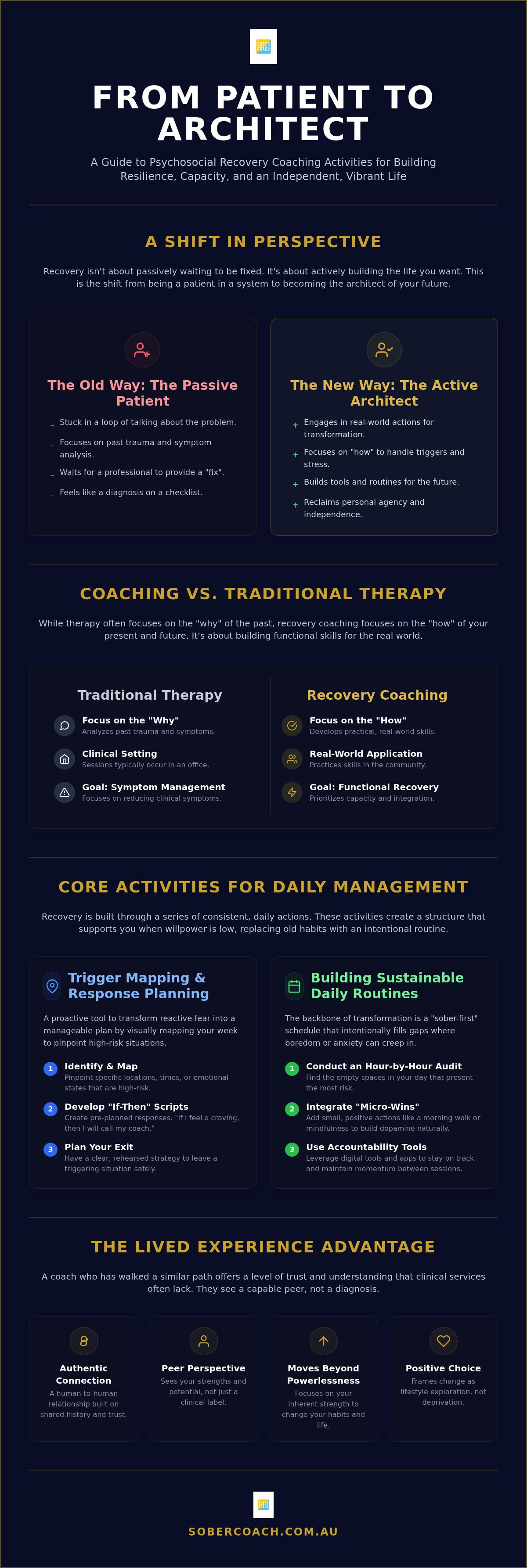
Psychosocial recovery coaching activities are the bridge between surviving and actually living. They aren't just clinical tasks or items on a bureaucratic checklist. Instead, they're the specific, real-world actions you take to build resilience, capacity, and independence. This is where you stop being a passive patient waiting for a professional to "fix" you. You become an active participant in your own life. It's about agency, not just adherence to a plan.
Every person's journey is different, so these activities are never one-size-fits-all. They're carefully tailored to your NDIS goals and your specific mental health needs. Your coach acts as a mentor who has walked a similar path, offering a human-to-human connection that typical services often lack. They don't just give advice from a distance; they stand beside you as you navigate the complexities of daily life in Sydney.
Capacity Building vs. Traditional Therapy
Traditional therapy often focuses on the "why." You sit in a room and analyze past trauma or current symptoms. While that has its place, coaching focuses on the "how." These activities are rooted in the concepts of Psychiatric rehabilitation, which prioritizes functional recovery and community integration over just symptom management. You don't just talk about your anxiety; you practice the skills needed to manage it while you're out in the world. Key differences include:
Real-world application: You might practice social interactions at a local cafe instead of just discussing them in an office.
Skill development: You learn how to identify and manage triggers in real-time as they happen.
Action-oriented: Every session involves setting a practical task and completing it to build momentum.
The Lived Experience Advantage
There's a specific kind of trust that only comes from shared history. A coach who has been there knows which psychosocial recovery coaching activities will actually move the needle for you. They don't look at you through a clinical lens or label you with a diagnosis. They see a peer who is capable of profound change. This authentic connection helps you move beyond the narrative of powerlessness. You aren't a victim of your circumstances; you're a person with the strength to change your habits. By focusing on lifestyle exploration and emotional strength, coaching turns change into a positive choice rather than a perceived deprivation. It's a courageous way to build a life that feels both stable and vibrant.
Core Coaching Activities for Daily Management
Recovery is not a concept to be studied; it is a series of movements you make every day. While clinical settings might focus on the "why" of your past, psychosocial recovery coaching activities focus on the "how" of your Tuesday afternoon. We move beyond vague intentions and build a tactical toolkit for your life in Sydney. This is about creating a structure that holds you up when your willpower feels thin. It's about replacing the chaos of old habits with a rhythmic, self-directed routine.
Trigger Mapping and Response Planning
We start by identifying exactly where the cracks appear. Trigger Mapping involves creating a visual map of your week, pinpointing high-risk locations, emotional states, or specific times of day when your resolve typically dips. If you know that 5 PM on a Friday triggers a sense of isolation, we don't just "hope" to get through it. We develop "if-then" scripts. If the craving hits at the supermarket, then you have a pre-planned exit strategy or a specific person to call. Trigger Mapping is a proactive tool for long-term sobriety that transforms reactive fear into a calculated, manageable plan.
Building Sustainable Daily Routines
A "sober-first" schedule is the backbone of your transformation. We conduct an hour-by-hour audit of your typical day to find the gaps where boredom or anxiety usually creep in. These empty spaces are often the most dangerous. By integrating micro-wins, such as a morning walk through a Sydney park or a ten-minute mindfulness exercise, we build dopamine naturally. This isn't about being "busy"; it's about being intentional. We use digital tools and accountability apps to keep you on track between sessions, ensuring the plan stays alive even when we aren't talking. If you're ready to build these habits, One-on-One Recovery Coaching provides the personalized support needed to make these routines stick.
Decision-making frameworks and self-regulation exercises round out this daily management. When stress spikes, you need grounding techniques that work in seconds. These include:
Box Breathing: A quick way to reset the nervous system during a work meeting or social event.
Sensory Grounding: Using the 5-4-3-2-1 method to pull your focus away from a spiraling thought and back to the present moment.
The "Wait Ten" Rule: A decision-making tool that requires a ten-minute pause before acting on a high-stress impulse.
These are the practical psychosocial recovery coaching activities that keep you present. You learn to navigate high-stress moments without retreating into old patterns, proving to yourself that you are the one in control. You aren't just surviving the day; you're mastering it.
Social and Community Reintegration Activities
Isolation is a survival mechanism that eventually becomes a cage. Breaking out requires more than just willpower; it requires a tactical strategy. These psychosocial recovery coaching activities are designed to help you step back into the world at a pace that doesn't trigger a total shutdown. We move from the safety of your home to the vibrant, sometimes overwhelming, streets of Sydney. It is about building a social life that supports your new identity rather than threatening it. You aren't just "getting out more"; you are intentionally redesigning your social landscape.
Navigating the Sydney Social Scene
We don't expect you to walk into a high-pressure social event on day one. Instead, we start with Social Exposure Tasks. This might mean scouting "safe" cafes in Surry Hills or finding sober-friendly weekend spots in the Inner West where you can enjoy the atmosphere without the pressure to drink. We look for environments that align with your healthy lifestyle, making the transition feel like a gain rather than a loss.
If you have a mandatory work function or a family wedding, we use a "coach-on-call" strategy. We plan your entry, your exit, and exactly what you'll say when someone offers you a drink. You aren't alone in those moments. You have a pre-rehearsed plan and a mentor just a text message away. For more inspiration on local activities, you can explore our guide on 10 Fun Sober Weekend Ideas in Sydney.
Boundary Setting and Relationship Repair
Rebuilding a life often means repairing the bridges that were scorched during the hardest times. This is difficult, sensitive work. We use role-playing to practice "boundary scripts." You learn how to say "no" to an old friend without feeling guilty, and how to explain your new path to family members who might still be skeptical. Clear communication is your best defense against relapse and social exhaustion.
Trust isn't rebuilt with apologies; it's rebuilt with consistent, activity-based interactions. Instead of a heavy, emotional dinner, we might suggest a morning walk or a shared hobby. This takes the pressure off and lets the relationship breathe. You can find more specific advice in our article on How to Rebuild Trust with Family During Recovery. These interactions prove your growth through action, which speaks much louder than words.
Finally, we look for ways to contribute. Volunteering in the local community is a powerful way to find purpose. It shifts the focus from your own challenges to the needs of others. Whether it's helping at a local animal shelter or a community garden, these activities provide a sense of belonging that clinical appointments simply can't match. You become a valued member of the Sydney community, which is a key component of long-term resilience.
Collaborative Planning and NDIS Goal Alignment
NDIS plans are often full of clinical jargon. They can feel like a static list of things you "should" do, written by people who don't know your story. In our sessions, planning is a partnership. It's a way to take your power back. Psychosocial recovery coaching activities turn those dry documents into a roadmap for a life you actually want to lead. We aren't just checking boxes. We're building a bridge between where you are and where you want to be.
Turning 'Goals' into 'Actions'
Big NDIS goals like "Independence" are too broad to tackle all at once. They feel heavy and unreachable. We strip away the weight by breaking them down into bite-sized, actionable tasks that fit into your week. This process moves through three clear stages:
Step 1: Break the big goal down. "Independence" becomes "Buying groceries alone at the local shops in Sydney."
Step 2: Identify the walls in your way. Is it anxiety about the crowds? Is it transport? We create specific tasks to dismantle those barriers one by one.
Step 3: Review and adjust. Every fortnight, we look at what worked and what didn't. We dial the intensity up or down based on your actual energy levels and progress.
The Role of the Recovery Plan
Your Recovery Plan shouldn't read like a medical report. It's a living document that we co-author using your own language, your values, and your unique strengths. It reflects who you are as a person, not just what a diagnosis says about you. When motivation is low, this plan acts as your compass. It reminds you why you started and exactly where you're headed. It keeps you steady when the path feels steep.
We also look at the bigger picture through Resource Mapping. This involves identifying how other NDIS supports, like an Occupational Therapist or a Psychologist, can work alongside our coaching. We coordinate these moving parts so you don't have to manage the bureaucracy alone. Along the way, we celebrate the micro-wins. Every successful solo trip to the store or every boundary set with a friend is a major milestone. These small victories are the fuel for long-term transformation. If you are ready to turn your NDIS plan into real-world change, our One-on-One Recovery Coaching is designed to help you take that first step.
Taking the Next Step with a Sober Coach
Recovery is not a solo sport. It requires a mentor who has been in the trenches and knows the way out. At Sober Coach, we strip away the clinical layers to provide a direct, human-to-human connection. This no-nonsense approach works because it honors your agency. We don't see you as a patient to be managed, but as a person ready to reclaim their life. Our psychosocial recovery coaching activities are built on shared history and mutual respect, not clinical distance. We speak the same language because we've lived the same stories.
One-on-One Recovery Coaching allows for deep, personalized activity planning. This is where we do the heavy lifting of trigger mapping and routine design specifically for your environment. If you feel stuck or like you've hit a plateau, our Intensive Recovery Workshops provide the jump-start needed to break old cycles through concentrated effort. For those who need real-world accountability where they live, our In-Home Recovery Support brings the coaching into your daily space. This helps you navigate triggers in the very place they often occur, turning your home back into a sanctuary.
One-on-One vs. Group Activities
Private sessions offer a safe space for the most personal work. You can explore habits and fears without an audience, allowing for a level of honesty that group settings might not permit. However, our group coaching online via zoom adds a vital layer of community and shared wisdom. Hearing others share their victories and setbacks reminds you that you aren't alone in this journey. Choosing the right mix depends on your current stage. Many people find that starting with intensive one-on-one support and eventually moving into group sessions provides the best balance of personal focus and social connection.
Starting Your Journey in Sydney
Your first session is the "Discovery" phase. We don't start with a lecture or a standardized test. Instead, we have a real conversation about your history, your strengths, and your vision for a vibrant life. We map out the specific psychosocial recovery coaching activities that will move the needle for you immediately. As of August 2026, the NDIS continues to emphasize recovery-oriented practice for the thousands of Australians living with a primary psychosocial disability. While the scheme is undergoing reforms to return to its original intent, specialized coaching remains a cornerstone for building capacity and resilience. If you're ready to stop talking about change and start living it, Book a discovery session with a Sober Coach in Sydney today.
Your Path to a Self-Directed Life
Recovery is a verb. It is found in the small, daily choices you make and the tactical structures you build to support them. We have explored how psychosocial recovery coaching activities bridge the gap between clinical theory and a vibrant, self-directed life. By mapping your triggers, designing a routine that works for your unique needs, and stepping back into the Sydney community with a solid plan, you move from powerlessness to personal agency. This process isn't about following a static document; it's about co-authoring a future that reflects your values and strengths.
Our mentors have walked this path and possess the shared history to guide you through it with authenticity and zero judgment. We have a proven track record across Australia of helping NDIS participants turn their goals into real-world milestones. You've spent enough time surviving the clinical cycle. It's time to start living a life that feels like your own. Ready to move beyond the clinic? Explore our One-on-One Recovery Coaching in Sydney. Your journey doesn't have an end point; it's a powerful beginning, and we are ready to walk it with you.
Frequently Asked Questions
What is the difference between a recovery coach and a support coordinator?
A recovery coach works directly with you on your internal capacity and resilience, while a support coordinator focuses on the logistics of your NDIS plan. Your coach helps you implement psychosocial recovery coaching activities to build daily skills. The coordinator manages your providers and ensures the budget is flowing. Think of the coordinator as the architect and the coach as the mentor helping you actually lay the bricks of your new life.
Can I use my NDIS 'Capacity Building' budget for these activities?
Yes, you can use your Capacity Building budget for these services. Psychosocial recovery coaching is a specific support item included in many NDIS plans for individuals with a primary psychosocial disability. It is designed to help you increase your independence and social participation. We recommend checking your specific plan or speaking with your support coordinator to ensure the funds are allocated correctly for your goals and lifestyle needs.
How many hours of coaching activities do I need per week?
The number of hours depends entirely on your NDIS plan and your personal goals. Most participants engage in psychosocial recovery coaching activities for one to three hours per week. This provides enough time for deep sessions without becoming overwhelming. During periods of high stress or transition, you might increase this frequency. We always adjust the intensity of our support to match your current energy levels and your specific progress milestones.
Will my recovery coach come to my home in Sydney?
Yes, we provide In-Home Recovery Support specifically for clients in the Sydney area. We understand that triggers often live where you do, so working in your own environment is incredibly effective. This allows us to help you design routines and manage your space in real-time. It bridges the gap between a clinical office and your actual life, ensuring that your recovery tools are practical and accessible where they matter most.
What happens if I have a setback during the coaching process?
Setbacks are treated as valuable data points rather than failures. If you experience a slip or a period of low motivation, we don't judge; we recalibrate. We revisit your trigger map and adjust your daily activities to provide more support. Our goal is to help you learn from the experience so you can build even stronger resilience. We focus on your personal agency and the power to begin again at any moment.
Do I need a formal diagnosis to start recovery coaching activities?
You need a formal diagnosis of a primary psychosocial disability to access NDIS funding for recovery coaching. However, if you are seeking private support, a medical label isn't required to start. We focus on your behavioral patterns and your desire for a vibrant life rather than a clinical category. Our approach is about lifestyle exploration and emotional strength, which are available to anyone ready to make a courageous and positive change.
Can coaching activities help with both mental health and addiction?
Coaching activities are highly effective for both mental health challenges and addiction because they address the underlying habits and emotional cues. We don't separate these issues into different boxes. Instead, we look at how your habits impact your overall well-being. By building a "sober-first" routine and mastering self-regulation, you create a foundation that supports your mental health and your long-term recovery from substances simultaneously through practical, real-world action.
How do I find a recovery coach with lived experience in my area?
You can find a coach with lived experience by looking for peer-led organizations that prioritize shared history. At Sober Coach, our mentors have walked the path of recovery themselves. This creates an immediate bond of trust and credibility that clinical services often lack. You can search the NDIS provider portal or contact us directly to learn more about our peer-led model and how it can support your specific journey in Sydney.
Comments