

Overcoming Shame in Sobriety: A 2026 Guide to Reclaiming Your Worth

What if the heavy, suffocating weight you carry isn't a sign that you're broken, but simply a leftover survival mechanism that no longer serves you? Many Australians in recovery struggle with the nagging feeling that they're still "less than" everyone else at the weekend BBQ or in the boardroom. Overcoming shame in sobriety is about realizing that while your past happened, it doesn't have to be your identity. You deserve to feel proud of your progress, not just relieved that you've stopped.
I promise that you can shed the weight of your history and build a life where you feel genuinely worthy of happiness and success. You'll learn how to distinguish between healthy accountability and toxic self-loathing while using practical, non-clinical strategies to reclaim your confidence. This guide explores the essential tools for navigating Sydney's social landscape in 2026 and offers a clear, empowering path toward emotional liberation and improved self-worth.
Table of Contents
Why Shame Feels Like a Shadow in Early Sobriety
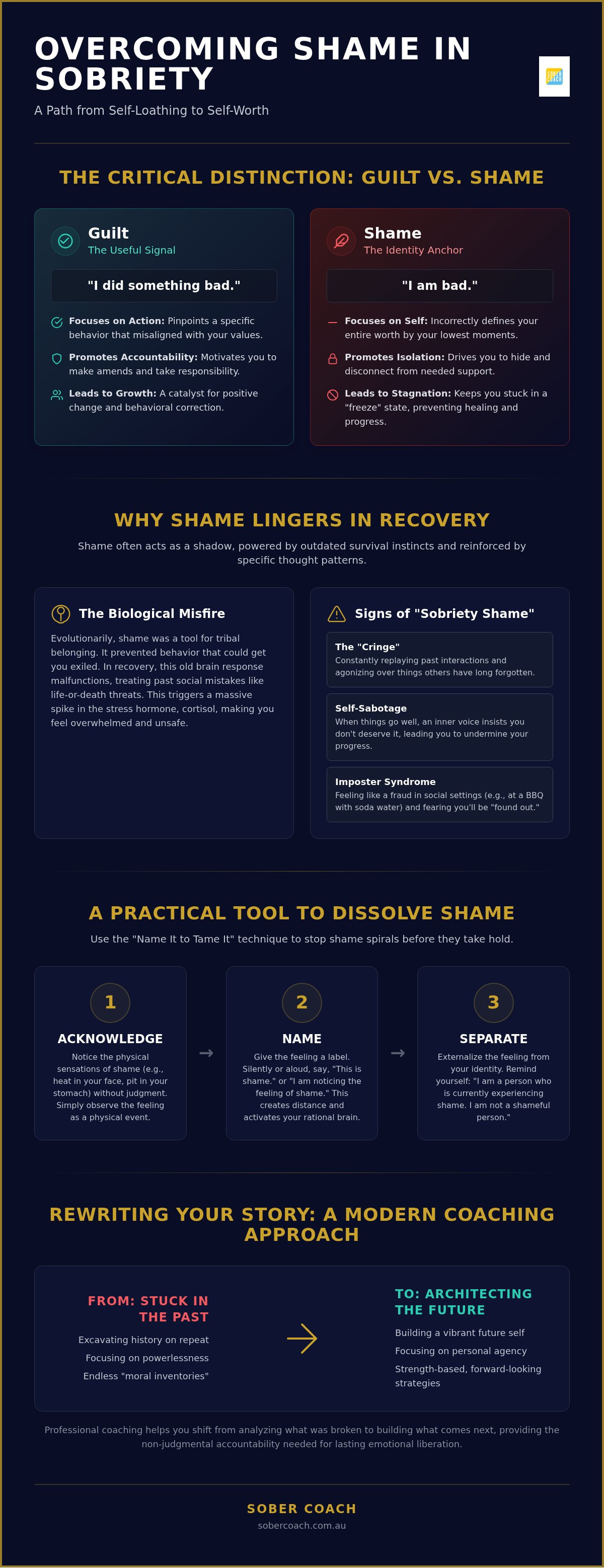
Shame is often the most persistent guest in early recovery. It sits in the corner, uninvited, whispering that you aren't just a person who made mistakes, but a person who is a mistake. This is the fundamental shift between guilt and shame. While guilt says "I did something bad," shame insists "I am bad." Understanding The Anatomy of Shame helps us see that this feeling is an internalised belief that you are the problem, rather than a person managing a complex behavioral challenge.
This belief acts as a massive wall between you and the connection you need to heal. If you believe you're fundamentally flawed, vulnerability feels like a death sentence. You hide because you're terrified of being found out. Toxic shame is a physiological "freeze" state that prevents growth. It keeps you stuck in a loop of self-protection instead of self-expansion. But here is the truth: feeling this weight is actually a sign your values have returned. You only feel shame because you now care about the person you want to be. Overcoming shame in sobriety starts with recognizing this shift in your moral compass.
The Biological Purpose of Shame
Historically, shame wasn't always your enemy. Evolutionarily, it served as a tool for tribal belonging. It kept our ancestors in line so they wouldn't get kicked out of the group, which meant certain death in the wild. In recovery, this old brain response often malfunctions. Your nervous system treats a social gaffe from three years ago like a life-threatening threat. This triggers a massive spike in cortisol, the stress hormone. When that pressure becomes unbearable, the old urge to self-medicate with a drink kicks in just to stop the noise.
Signs You Are Carrying "Sobriety Shame"
How do you know if you're still carrying this weight? Look for "the cringe." This is that late-night rumination where you replay past social interactions on a loop, agonizing over things nobody else remembers. You might also notice self-sabotage. When things finally start going well in your new life, a voice inside says you don't deserve it, so you blow it up. In Australia, this often manifests as a specific type of imposter syndrome. You're at a Sunday session with a soda water, feeling like a fraud or an outsider because you aren't participating in the "rounds" culture. Realizing these are symptoms of shame, not facts about your character, is the first step toward overcoming shame in sobriety.
The Anatomy of Shame: Why It Is Different from Guilt
Distinguishing between guilt and shame is not just a semantic exercise. It is a survival skill. Guilt functions as a moral compass, a sharp but necessary nudge that tells us our behavior has drifted away from our values. It is the feeling that prompts you to make amends after missing a family event or letting down a colleague. Shame, however, acts as an identity anchor. It doesn't just point out a mistake; it tethers you to your lowest moments and insists that those moments define your entire existence.
The danger lies in how easily our "Inner Critic" converts healthy guilt into toxic shame. You might start by feeling bad about a specific action, but within minutes, that voice has convinced you that you are fundamentally unlovable. This confusion is a primary driver of the cycle of relapse and self-loathing. When we believe we are the problem, we stop trying to find solutions. We simply try to hide. Overcoming shame in sobriety requires us to intercept this conversion and keep our focus on our actions rather than our essence.
Guilt: The Useful Signal
Think of guilt as a catalyst for accountability. It is uncomfortable, but it is also productive. In recovery, healthy guilt might arise when you realize the impact your past drinking had on your partner or children. Instead of spiralling, you can use this signal to fuel change. Making amends is the practical tool that releases the pressure of guilt. By taking responsibility and changing your future behavior, you prove to yourself that you are capable of growth. It is about moving from "I am sorry" to "I am changing."
Shame: The Silent Saboteur
Shame is the silent driver of isolation, which is the exact opposite of what a vibrant life requires. It thrives in the dark. The "Shame-Relapse Cycle" often begins with a single negative thought that blossoms into a belief that you don't deserve your new sober life. Some traditional recovery models emphasize powerlessness, which can accidentally reinforce shame if not handled carefully. If you feel powerless over your choices, it is easy to feel worthless as a person. Our approach focuses on personal agency, helping you realize that while you can't change the past, you have total authority over your next move. If you find yourself stuck in these thoughts, engaging in One-on-One Recovery Coaching can help you dismantle these patterns in a safe, non-judgmental space. Overcoming shame in sobriety is much easier when you have a mentor who has walked the same path and understands the weight of the anchor you're trying to lift.
Moving Beyond "Moral Inventories": A Modern Coaching Approach
Traditional recovery frameworks often rely on the "searching and fearless moral inventory." For many, this process feels like a forced excavation of their darkest moments. It can feel punitive rather than restorative. If you're focused on overcoming shame in sobriety, a constant look in the rearview mirror might be keeping you stuck in the very identity you're trying to outgrow. Modern coaching shifts the gaze from the past to the future. It's about architecture, not archaeology. We don't just dig up what went wrong; we design what comes next.
This approach provides a safe, non-clinical space for radical honesty. Working with a mentor who has lived experience means you don't have to explain the "why" behind your past actions. There's a shared history that builds immediate trust. You aren't being analyzed by a clinician; you're being guided by someone who has already shed the weight you're currently carrying. This human-to-human connection is essential for dismantling the belief that you're fundamentally broken.
The Problem with Labels
Labels like "addict" or "alcoholic" are often treated as permanent badges of identity. While some find comfort in these terms, others find they inadvertently keep the shame cycle alive for years. You aren't a static diagnosis. You're a person in a state of constant evolution. Overcoming shame in sobriety requires the freedom to define yourself by your current actions and your future goals, not by a title based on your lowest point. When you stop identifying as "the problem," you finally have the mental space to become the solution. You're allowed to outgrow your old labels and step into a version of yourself that is entirely new.
Strength-Based Recovery
Most people in recovery are told to focus on their defects. We suggest a different path: building a "Success Inventory." Think about the skills you used to survive during your addiction. You were likely incredibly resourceful, resilient, and capable of navigating complex social situations. Those aren't bad traits; they're powerful strengths that were simply misdirected. Our Intensive Recovery Workshops focus on pivoting these existing skills toward your new life. By setting proactive goals and achieving them, you build immediate self-efficacy. This replaces the heavy weight of the past with the tangible evidence of your current capability. You're building a life you don't want to escape from, one win at a time.
Practical Strategies to Dissolve Shame in Daily Australian Life
Living sober in a country that often treats alcohol as a personality trait requires more than just willpower. It requires a tactical approach to your own psychology. One of the most effective tools for overcoming shame in sobriety is the "Name It to Tame It" technique. When you feel that familiar heat of a shame spiral rising, acknowledge it out loud or in your head. Simply saying, "This is a shame response," shifts the activity in your brain from the emotional amygdala to the rational prefrontal cortex. This creates the space you need to choose a different reaction rather than sinking into the old "freeze" state.
Self-compassion is a biological requirement for neuroplasticity, providing the safety needed for the brain to rewire itself, rather than a soft or indulgent concept. Without this kindness toward yourself, your brain remains in a state of high stress, making it nearly impossible to form new, healthier habits. You also need to move from apologies to amends. While an apology is just words, amends are about taking consistent action to prove your change to the person who matters most: you. Every time you show up for a commitment or handle a difficult conversation without a drink, you're gathering evidence that you are no longer the person you used to be.
Navigating Social Stigma in Sydney
The Australian BBQ and beer culture can feel like a minefield. You might encounter "Tall Poppy Syndrome," where friends or family feel uncomfortable with your rapid personal growth because it highlights their own habits. When someone asks why you aren't drinking, have a script ready that feels powerful. Instead of saying "I can't," try "I've retired from the sport" or "I'm performing better without it." Sydney offers plenty of sober-friendly ways to reinforce your new identity, from early morning surfs at Maroubra to hiking the Royal National Park. These activities replace the "Sunday session" with something that builds your self-worth rather than draining it.
Daily Rituals of Self-Worth
Start your day with a five-minute morning identity check-in. Remind yourself of three things you did yesterday that align with your values. If you feel the shadow of shame creeping back in, use physical movement to process the "freeze" response. A brisk walk or a session at the gym helps shift the stuck energy that shame often leaves in the body. For those moments when the weight feels too heavy to carry alone, Group coaching online via zoom provides a space for radical transparency. Sharing your struggles with others who understand the specific pressures of Australian culture breaks the secrecy that shame needs to survive. Overcoming shame in sobriety is a daily practice, but with the right rituals, that shadow begins to fade.
How Professional Coaching Rewrites Your Recovery Story
While therapy is invaluable for processing the "why" behind your past, coaching is about building the "how" for your future. It is the bridge between a clinical understanding of addiction and the vibrant, real-world execution of a liberated life. One-on-one support provides a high level of accountability that is often missing in traditional settings. By having a dedicated partner, you can catch the early signs of a shame spiral before it leads to isolation. This proactive stance is a cornerstone of overcoming shame in sobriety, as it forces you to stay engaged with your goals rather than retreating into the shadows.
For many Australians, the real challenge happens within the four walls of their own house. Integrating recovery into your actual environment through In-Home Recovery Support allows you to tackle triggers where they live. Similarly, Intensive Recovery Workshops offer a deep dive into identity transformation, helping you strip away the old layers of self-loathing in a concentrated, supportive environment. You aren't just quitting a substance; you are architecting a new way of being that makes the old habits feel redundant.
The Power of a Sober Mentor
A mentor with lived experience is the ultimate antidote to the isolation that shame creates. When you speak to someone who has felt that same "cringe" and moved past it, the stigma begins to evaporate. A coach helps you spot the blind spots where shame is hiding, often masquerading as "modesty" or "realism." We help you shift your strategic goal from merely surviving each day to actually thriving. This transition is where the real magic happens. It is the point where sobriety stops being a chore and starts being a competitive advantage in your career and relationships.
Your Next Steps: From Secrecy to Liberation
You don't have to figure this out alone. Whether you are in the heart of Sydney or a remote part of the outback, support is accessible. We offer Rehab online and Group coaching online via zoom to ensure every Australian has a path to liberation. Overcoming shame in sobriety starts with a single, brave conversation. Reach out for a confidential chat to see how we can help you rewrite your story and reclaim your sense of worth.
Step Into Your Future Self
You've seen that shame is merely an outdated survival mechanism, not a character flaw. By distinguishing between productive guilt and the heavy anchor of shame, you can start making decisions based on who you want to be tomorrow. Whether you are navigating a Sydney weekend or rebuilding your self-worth at home, the tools for overcoming shame in sobriety are within your reach. Our professional coaching is led by mentors with lived experience who truly understand the specific pressures of Australian drinking culture. We offer a no-nonsense, non-clinical approach through flexible online and in-home support across Australia to help you achieve permanent change. You don't have to carry the heavy weight of the past any longer. It is time to trade secrecy for liberation and build a life that feels genuinely good to live. Your story isn't over; it is just getting to the best part.
Begin your transformation with a free, confidential recovery consultation.
Frequently Asked Questions
Is it normal to feel more shame after I stop drinking?
Yes, it's very common to feel a spike in shame once the fog of drinking lifts. When you stop numbing your emotions, you're suddenly forced to confront the reality of your past actions without a buffer. This isn't a sign of failure. It's proof that your moral compass is working again. Overcoming shame in sobriety begins with accepting that these feelings are a natural part of the healing process.
How long does it take for the shame to go away in sobriety?
There's no fixed timeline for shame to disappear, but it begins to fade as you build a new success inventory. The more consistent actions you take that align with your current values, the less power your past mistakes hold. Shame is a persistent shadow, but it loses its grip as you focus on your future self. Most people notice a significant shift in self-worth within the first few months of active coaching.
What is the difference between a recovery coach and a therapist for dealing with shame?
Therapy often focuses on diagnosing and processing past trauma, while recovery coaching is goal-oriented and future-focused. A coach acts as a mentor with lived experience, helping you build practical strategies for daily life. While a therapist might explore the roots of your shame, a coach helps you design a lifestyle that makes shame obsolete. Both are valuable, but coaching provides the real-world accountability needed for transformation.
Can I still use NDIS funding for recovery coaching in Sydney?
Yes, you can often use NDIS funding for recovery coaching if it aligns with your plan's goals for social and community participation. Many participants in Sydney and across Australia use their Capacity Building budget to access support that helps them build independence and emotional resilience. You should check with your plan coordinator or local area coordinator to ensure your specific funding covers non-clinical peer support and personal development.
What should I do if my family keeps bringing up my past mistakes?
You should set clear, firm boundaries while acknowledging their pain. You can't control their memory, but you can control your reaction and your current behavior. Tell them that while you take responsibility for the past, you are focused on who you are today. Consistent, changed action over time is the most powerful way to eventually silence those reminders and prove that you have reclaimed your worth.
How do I handle the shame of a relapse?
Treat a relapse as a data point rather than a character flaw. Shame thrives in the secrecy of a slip, so the best move is to be radically transparent with your coach or support group immediately. Analyze what triggered the event and use that information to strengthen your future plan. Overcoming shame in sobriety means realizing that one bad day doesn't erase your progress or your value as a person.
Are Sober Coach sessions confidential and non-judgmental?
Yes, every session is completely confidential and built on a foundation of zero judgment. We operate from a place of shared history, meaning there's nothing you can say that will shock or alienate us. Our goal is to create a safe space where you can be honest about your habits and your history. This transparency is the only way to effectively dismantle the weight of shame and start building a liberated life.
Do I have to call myself an "addict" to get help from a sober coach?
No, you never have to use labels like addict or alcoholic to work with us. We reject restrictive titles that keep people tethered to their past. You are a person who is evolving and making better choices for your future. Our focus is on your personal agency and your goals, not on fitting you into a traditional, medicalized box that might inadvertently trigger more shame or feelings of powerlessness.
Comments