

NDIS Goals for Psychosocial Recovery: 2026 Coaching Guide

What if your NDIS plan wasn't just a ledger of deficits, but a roadmap to a life that actually feels like yours again? It's common to feel buried under the weight of bureaucracy and clinical jargon while trying to secure support. You've likely felt the sting of clinical burnout from traditional therapy models that treat you like a patient to be managed rather than a person with potential. Setting ndis goals for psychosocial recovery shouldn't be another chore on a long list of requirements; it's your opportunity to reclaim your agency.
You deserve a life defined by your dreams, not your diagnosis. This guide shows you how to navigate the complex NDIS psychosocial framework and leverage recovery coaching to build a self-directed, vibrant life beyond clinical labels. We'll break down the 2026 updates and provide practical tools for daily living that move beyond the clinical room. You'll learn how to find a mentor who understands your journey and discover how to transition from simply surviving to truly thriving.
Table of Contents
What is NDIS Psychosocial Disability Support?
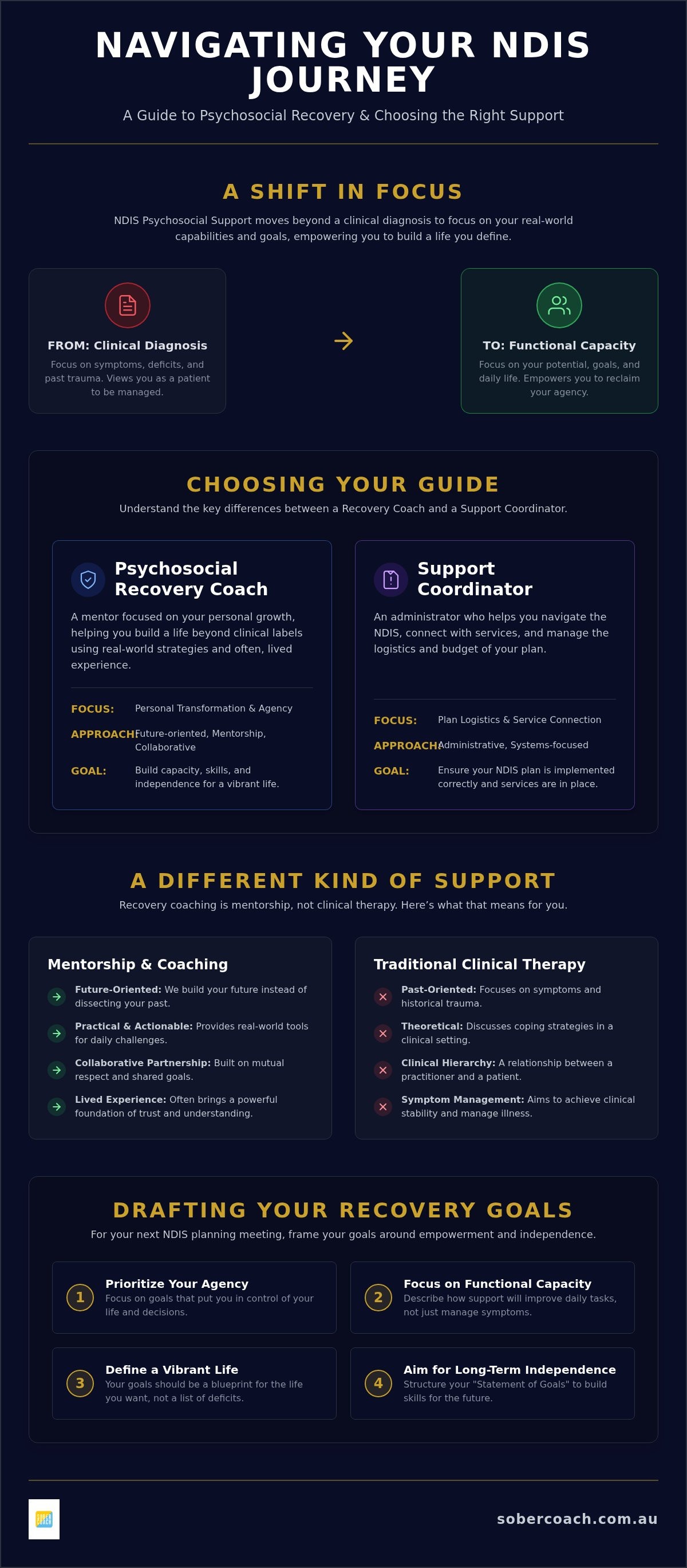
Psychosocial disability isn't just a line item in a medical file. It's the lived reality of how mental health challenges interact with your environment, often creating barriers that others don't see. Within the National Disability Insurance Scheme (NDIS), the focus shifts away from a purely clinical diagnosis. Instead, the framework looks at your functional capacity. It asks how your condition impacts your ability to show up in the world, manage a home, or hold down a job. This approach treats you as a whole person rather than a patient to be managed.
The NDIA introduced specific psychosocial recovery coaching in 2020 to bridge a massive gap in support. Traditional clinical models often fail to address the practicalities of daily life or the need for consistent, relational mentorship. By focusing on increasing independence and social participation, this support model moves beyond symptom management. When you start setting ndis goals for psychosocial recovery, you're essentially designing a blueprint for a life that feels vibrant and self-directed. It's about moving from a state of being "treated" to a state of being empowered.
The Functional Impact of Psychosocial Disability
Mental health conditions can create invisible walls that block social and economic participation. You might struggle with routine management or find that social anxiety makes simple tasks like grocery shopping feel overwhelming. Decision-making can become a heavy burden during periods of high stress. These aren't personal flaws. They're functional impacts of your disability. The NDIS recognises that these challenges fluctuate, but the need for support remains. We don't view these impairments as a lack of potential. With the right tools, you can navigate these hurdles and reclaim your agency in a way that feels authentic to you.
NDIS Eligibility for Mental Health Support
Accessing the NDIS requires meeting specific criteria, primarily that your disability is permanent or likely to be permanent. For many with psychosocial challenges, the word "permanent" feels heavy and restrictive. In this context, it simply means the functional impact on your life is expected to be lifelong, even if your symptoms wax and wane. To secure funding, you'll need to document how your condition affects your daily life through the Evidence of Disability form. It's vital to be direct and honest about your support needs. Achieving your ndis goals for psychosocial recovery starts with a plan that truly reflects your daily reality, ensuring you have the resources to build a future defined by growth rather than limitation.
The Role of a Psychosocial Recovery Coach: Beyond Traditional Care
A Psychosocial Recovery Coach doesn't look at you through a clinical lens. While doctors and therapists focus on symptoms and past traumas, a coach looks at your potential and the path ahead. This role was designed to provide the mentorship and accountability that traditional medical models often lack. It's a partnership where you aren't a patient to be fixed, but a person reclaiming their agency. By focusing on ndis goals for psychosocial recovery, a coach helps you bridge the gap between clinical stability and a life that actually feels worth living.
The core of this work is about real-world application. It's one thing to talk about coping strategies in a quiet office; it's another thing entirely to use them when you're overwhelmed at the shops or struggling to maintain a routine at home. Your coach is there to help you navigate these moments in real time. They provide a steady hand and a practical perspective, ensuring that your NDIS funding translates into tangible growth and self-discovery rather than just more appointments on a calendar.
Mentorship vs. Clinical Therapy
Coaching is inherently future-oriented. We don't spend our sessions dissecting your history; we spend them building your future. This no-nonsense approach provides you with practical tools to manage daily triggers and maintain your momentum. The relationship is collaborative, built on mutual respect rather than a clinical hierarchy. It's about finding what works for you in the here and now. If you're looking for a mentor who prioritises your personal transformation, exploring One-on-One Recovery Coaching can be the catalyst for the change you've been seeking.
Lived Experience as a Professional Tool
The power of lived experience cannot be overstated. When your coach has walked a similar path, there's an immediate foundation of trust that no degree can replicate. This shared history breaks down the stigma that often follows mental health labels. You don't have to explain the "why" behind your struggles because they've likely been there too. This shared language makes the process more efficient and deeply personal.
In the Australian NDIS framework, lived experience is a recognised professional qualification for recovery coaches. It's a formal acknowledgement that those who have successfully navigated their own recovery are uniquely equipped to guide others. This peer-led support is a cornerstone of achieving ndis goals for psychosocial recovery. It provides a roadmap that is grounded in reality, offering hope that is based on evidence, not just theory. Your journey becomes less about managing a disability and more about mastering your own life.
Recovery Coach vs. Support Coordinator: Making the Right Choice
Choosing between a Support Coordinator and a Recovery Coach often feels like a bureaucratic riddle. The NDIS landscape is filled with titles that sound similar, but their impact on your daily life is vastly different. A Support Coordinator is essentially the architect of your plan. They build the structure, manage the service agreements, and ensure the various parts of your NDIS funding work together on paper. They're experts in the system, helping you navigate the heavy lifting of provider contracts and plan reviews.
A Recovery Coach, however, is the mentor for your personal transformation. While they understand the system, their primary focus is on you, the person, rather than the paperwork. They're interested in your mindset, your habits, and your ability to reclaim your agency. While both roles aim to help you achieve your ndis goals for psychosocial recovery, the coordinator manages the logistics while the coach manages the momentum. In the 2026 NDIS framework, the NDIA typically funds one or the other, as recovery coaching includes a level of coordination specifically tailored to mental health needs.
When to Prioritise a Recovery Coach
If your primary focus is on habit change and building a life beyond your diagnosis, a Recovery Coach is the right choice. You should lean toward coaching when you need frequent, hands-on support to build confidence and establish routines that stick. This role is for those who want a mentor with specific expertise in psychosocial challenges; someone who understands the fluctuating nature of mental health. It's about moving from a state of being "managed" by a plan to being the driver of your own recovery journey.
When a Support Coordinator is Essential
A Support Coordinator becomes essential when your plan is highly complex and involves a large team of clinical providers. If you're balancing occupational therapists, psychologists, speech pathologists, and multiple home care agencies, you need a coordinator to handle the administrative hurdles. They excel at connecting you with diverse clinical services and ensuring you're prepared for high-level NDIS reviews. They're the logistical glue that holds a multi-provider plan together, allowing you to focus on your health without drowning in service agreements. While they may not walk alongside you in your daily routines, they ensure the resources you need to reach your ndis goals for psychosocial recovery are always available and properly managed.
Practical Steps to Accessing NDIS Psychosocial Support
Accessing the right support starts with being your own best advocate. During your planning meeting, you need to be specific about wanting a Psychosocial Recovery Coach. It's not enough to ask for "mental health help" in a general sense. You're looking for a mentor to help you achieve your ndis goals for psychosocial recovery. This funding sits within the Capacity Building budget of your plan. It's designed to help you build the skills and resilience needed to lead a more independent life. Your Local Area Coordinator (LAC) needs to see that this support is "reasonable and necessary" to help you overcome functional barriers and participate in your community.
Preparing your Statement of Goals is your chance to define what liberation looks like for you. Don't frame your goals around what you can't do. Instead, focus on the lifestyle choices you want to make. Whether it's finding stable employment or building a social circle that doesn't revolve around old habits, your goals should reflect your desire for a self-directed life. When you speak to your LAC, emphasize that recovery coaching provides the practical, goal-oriented mentorship that clinical therapy alone doesn't offer.
Preparing for Your NDIS Planning Meeting
Don't just list symptoms when you sit down with a planner. Instead, write a 'day in the life' summary that highlights where you get stuck. Maybe social anxiety prevents you from attending community events, or difficulty with routine makes managing a household feel impossible. Be clear about your aspirations. Your goals might include:
Returning to part-time work or vocational study.
Managing social settings without feeling overwhelmed or triggered.
Building a daily routine that supports long-term sobriety and mental health.
Gather support letters from mentors or health professionals who can attest to how a coach will help you reach these specific milestones. This documentation is vital for justifying the inclusion of coaching in your plan.
Managing Your Funding: Self-Managed vs. Plan-Managed
How you manage your plan determines how much control you have over who you hire. Self-management offers the ultimate freedom. You can choose a coach based on their lived experience and personality rather than just their NDIS registration status. This is often the best path for those seeking a human-to-human connection that feels authentic. Plan-management is a solid middle ground; it removes the administrative stress of paying invoices and tracking budgets while still allowing you to choose providers that fit your needs. Whether you are self-managed or plan-managed, our One-on-One Recovery Coaching is designed to fit seamlessly into your life, providing the direct accountability you need to move forward on your own terms.
The Sober Coach Approach: Agency, Sobriety, and Growth
At Sober Coach, we reject the restrictive labels that often come with traditional mental health and addiction services. You aren't a diagnosis, and you aren't just a patient to be managed. We believe that personal agency is the most powerful tool in your toolkit. Our approach is direct, no-nonsense, and deeply personal. We focus on who you want to become rather than what you've done. By aligning our support with your ndis goals for psychosocial recovery, we help you build a life that is defined by freedom and strength rather than perceived deprivation.
Real transformation doesn't just happen in a clinical office; it happens in the kitchen, the workplace, and the local community. This is why we offer In-Home Recovery Support across Sydney, bringing professional mentorship directly into your living environment. For those outside of New South Wales, our online rehab and Zoom coaching ensure that every Australian has access to high-quality, peer-led support. We bridge the gap between clinical intervention and long-term stability by providing the accountability you need to stay on track, regardless of your location.
Personalised Recovery Frameworks
We move beyond the rigid structures of traditional 12-step programs. While those models work for some, we utilise modern descriptors for lifestyle exploration that resonate with a contemporary demographic. Our frameworks are designed to support you in building a vibrant, liberated life through goal-oriented coaching. We address non-binary behavioural patterns, acknowledging that recovery isn't always a straight line. We focus on practical strategies that help you manage the fluctuating nature of your mental health while keeping your eyes on your long-term ndis goals for psychosocial recovery.
Getting Started with Sober Coach
The first step is always about finding the right human-to-human connection. We don't believe in anonymous, one-size-fits-all services. Our initial consultation is a space for us to explore your history and your hopes without judgment. We work closely with NDIS participants to ensure their funding is utilised effectively, focusing on outcomes that lead to greater independence and self-discovery. If you're ready to stop managing symptoms and start building a future you're excited about, we're here to walk that path with you as courageous mentors who have been where you are.
Reclaim Your Agency and Build Your Future
Your recovery shouldn't be a series of clinical checkboxes or a life spent in waiting rooms. By shifting the focus from managing symptoms to building functional capacity, you can set ndis goals for psychosocial recovery that actually reflect the vibrant, liberated life you want to lead. We've explored how a recovery coach provides the mentorship and accountability that traditional systems often lack; they act as a courageous partner in your transformation. Whether you're navigating the NDIS bureaucracy or looking for practical tools to handle daily triggers, the right support makes all the difference.
At Sober Coach, we offer professional peer-led mentorship grounded in lived experience expertise. Our team provides direct support through in-home visits in Sydney and flexible online coaching for participants across Australia. You don't have to navigate this journey alone or under the weight of restrictive labels. It's time to move beyond surviving and start thriving on your own terms. Take the first step toward a self-directed life today.
Book a One-on-One Recovery Coaching Session
You have the power to redefine your story. The path to growth is open, and we're ready to walk it with you.
Frequently Asked Questions
What is a psychosocial recovery coach under the NDIS?
It's a specialist support for people with primary psychosocial disabilities. They use a recovery-oriented approach to help you build capacity and independence. Unlike clinical staff, they focus on your daily life and personal agency. They often bring lived experience to the table, creating a human connection that prioritises your choice and control over your journey. It's about mentoring you to live a life that feels authentic and self-directed.
Is recovery coaching the same as therapy?
No, coaching is fundamentally different from clinical therapy. While therapists often focus on diagnosing and treating past traumas, coaches are future-oriented mentors. We don't use medicalised language or treat you like a patient. Coaching provides practical, hands-on accountability to help you achieve your ndis goals for psychosocial recovery. It's about real-world action and building habits that stick, rather than just talking about them in a clinical setting.
Can I use my NDIS funding for sober coaching or addiction support?
Yes, if your substance use is linked to your psychosocial disability and impacts your functional capacity. You can use your Capacity Building budget for one-on-one coaching that helps you build a liberated life. We focus on personal agency and growth rather than restrictive labels. Our coaching supports long-term sobriety by providing the tools and accountability needed to navigate daily life without the weight of old habits.
How do I add a recovery coach to my NDIS plan?
You need to request "Psychosocial Recovery Coaching" during your planning meeting or plan review. Be prepared to explain how this specific mentorship will help you overcome functional barriers. Highlighting your desire for independence and community participation helps the NDIA see the support as reasonable and necessary. Providing support letters from health professionals that mention your specific ndis goals for psychosocial recovery can strengthen your request significantly.
What is the difference between a support coordinator and a recovery coach?
A Support Coordinator is the architect who manages the logistics and service agreements of your plan. In contrast, a Recovery Coach is a mentor who focuses on your personal transformation and daily routines. While coordinators handle the paperwork, coaches walk alongside you to build confidence and resilience. The NDIS typically funds one or the other because recovery coaches also perform a level of coordination specifically tailored to mental health needs.
Do Sober Coach's online programs count as NDIS psychosocial support?
Absolutely. Our online rehab and group coaching via Zoom are designed to be accessible to all Australians, regardless of location. These programs fall under Capacity Building supports. They provide the same high-quality, peer-led mentorship as our in-home Sydney services. By participating online, you gain access to a community and a mentor who understands your journey, helping you build a vibrant life through flexible, direct support.
What happens if I do not have psychosocial recovery coaching in my current plan?
You can still use your existing Capacity Building budget if it's flexible, or you can request a plan variation. If you have funding for "Support Coordination" or "Individual Skills Development," you may be able to transition these funds to a coach who better fits your recovery path. Speak with your Plan Manager or LAC about how to redirect your current resources toward a more proactive, goal-oriented coaching model.
How much does NDIS psychosocial support cost?
NDIS psychosocial support is funded through your Capacity Building budget, with costs regulated by the national price guide. The NDIA sets maximum hourly limits to ensure the scheme remains sustainable while providing quality care. These rates are reviewed annually to reflect changes in the Australian economy. Because we provide professional, non-clinical support, our services align with these frameworks. You should review your current plan to see how much funding is allocated for these sessions.
Comments