

Mindfulness for Addiction Recovery: A Practical Guide

Mindfulness isn't just a spiritual retreat for the calm; it's a high-performance tactical tool designed to intercept the neurobiological loop of addiction. You know that feeling when a craving hits like a sudden freight train and your "monkey mind" starts screaming for the old escape. It feels like you've lost the steering wheel to your own life. We've all been there, standing at the crossroads of an urge, feeling the familiar, overwhelming anxiety about a future that seems impossible to navigate without a drink or a hit. It's exhausting to live in a constant state of internal war.
This guide explores how mindfulness for addiction recovery serves as your personal "pause button" during high-stakes moments. You'll discover how to manage cravings in real-time, reduce your stress levels without using substances, and finally reclaim your personal agency. We are going to unpack the practical, non-clinical steps to quiet the noise and build a sense of control over your emotional state. From grounding techniques to intercepting triggers, we will provide the roadmap you need to move from feeling powerless to living a vibrant, liberated life on your own terms here in Australia.
Table of Contents
What is Mindfulness for Addiction Recovery?
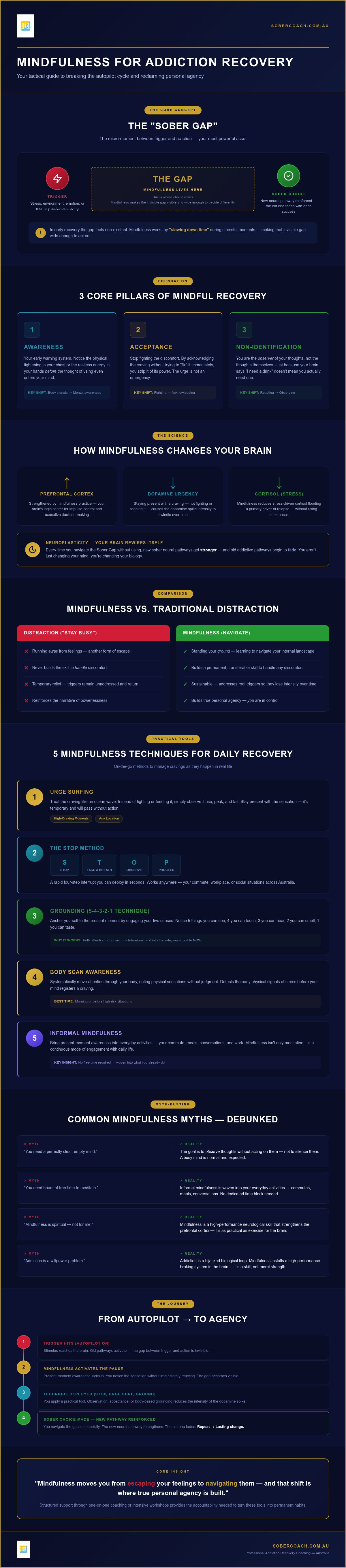
Mindfulness is often misunderstood as a passive state of relaxation, but in the context of personal transformation, it is a high-performance skill. At its core, mindfulness is the non-judgmental awareness of the present moment. It's the ability to observe your thoughts as they arise without being forced to act on them. For many, mindfulness for addiction recovery is the difference between a reactive life and an intentional one. It provides the psychological space needed to see a craving for what it is; a temporary sensation rather than a command.
This matters because addiction thrives on "autopilot." Habits are forged in the dark, repetitive corners of our daily routines. When you're on autopilot, a trigger leads directly to a substance before you've even realized you've made a choice. Mindfulness breaks this circuit. It forces a "pause" into the stimulus-response loop. You aren't just sitting in silence; you're training your brain to stay present when things get uncomfortable. This isn't about formal meditation alone. While sitting quietly helps, informal mindfulness involves bringing that same sharp awareness into your commute, your work, and your relationships across Australia.
The Core Pillars of Mindful Recovery
Building a resilient foundation requires three specific shifts in how you process reality. These aren't just theories; they are practical tools for your kit:
Awareness: This is your early warning system. You begin to notice the physical tightening in your chest or the restless energy in your hands before the thought of using even enters your mind.
Acceptance: You stop fighting the fact that you feel uncomfortable. By acknowledging the craving without trying to "fix" it immediately, you strip it of its power.
Non-Identification: You realize you are the observer of your thoughts, not the thoughts themselves. Just because your brain says "I need a drink" doesn't mean you actually need one.
Mindfulness vs. Traditional Distraction Techniques
Traditional advice often suggests "staying busy" to avoid relapse. While hobbies are great, distraction is often just another form of escape. If you're always running from your feelings, you never learn how to handle them. Mindfulness offers a sustainable alternative by teaching you to navigate your internal landscape rather than fleeing it. Instead of trying to outrun a trigger, you learn to stand your ground. This shift from escaping to navigating is what builds true personal agency. It moves you away from the narrative of powerlessness and toward a life where you are the one in control.
The Science of the 'Sober Gap': How Mindfulness Intercepts Triggers
Addiction isn't a lack of willpower; it's a hijacked biological loop. Your brain has been conditioned to respond to certain stimuli with an immediate craving for a reward. This stimulus-response loop usually happens in a heartbeat. The trigger hits and the action follows before you've even had a chance to think. By integrating mindfulness for addiction recovery, you're essentially installing a high-performance braking system in your mind. This practice strengthens the prefrontal cortex, which is the part of your brain responsible for executive function and impulse control. It's the logic center that helps you pause when the emotional parts of your brain are screaming for an escape.
Dopamine is the chemical driver behind those intense, "must-have-it-now" urges. It creates a powerful sense of urgency that feels impossible to ignore. However, when you remain present with the sensation of a craving rather than fighting it or feeding it, the intensity of that dopamine spike begins to dwindle. You're teaching your brain that the urge is not an emergency. This is where the physical reality of change happens. Over time, you aren't just changing your mind; you're changing your biology.
Creating Space Between Trigger and Action
The "Sober Gap" is the micro-moment between a trigger and your reaction. It is your most powerful asset because it's the only place where choice exists. In early recovery, this gap often feels non-existent. Mindfulness works by "slowing down time" during stressful moments, making that invisible gap visible and wide enough to make a different decision. Neuroplasticity is the brain’s ability to build new, sober pathways. Every time you navigate the gap without using, those new pathways get stronger and the old ones begin to fade.
Managing the Cortisol Spike
Stress is a primary driver of relapse because it floods the body with cortisol. When cortisol levels are high, your brain shifts into "fight or flight" mode, making it nearly impossible to access rational thought. Mindful breathing is a biological hack that signals your nervous system to stand down. Whether you're navigating the chaos of a busy Sydney commute or a high-pressure work environment, using your breath as an anchor keeps you out of survival mode. If you want to learn how to apply these tactical tools in your own life, our one-on-one recovery coaching provides the direct, peer-led support needed to master these shifts.
5 Practical Mindfulness Techniques for Daily Recovery
Theory is a great start, but the real work happens when you're out in the world. Applying mindfulness for addiction recovery in the real world means having a toolkit that works when you're under pressure. You don't need a yoga mat or a quiet room to use these. You just need a few seconds of focus. These techniques are designed to be used in the middle of a busy day, whether you're at work, at home, or navigating a social event that feels a bit too high-stakes.
Urge Surfing: The Ultimate Relapse Prevention Tool
Most people try to fight a craving by "white-knucking" it. This usually backfires because of the "Pink Elephant" effect; the more you try to suppress a thought, the more dominant it becomes. Urge surfing is a different approach. Instead of fighting the wave, you ride it. You acknowledge the physical sensations of the craving, such as a racing heart or a knot in your stomach, and you watch them without acting. Cravings usually last only 15 to 30 minutes if you don't feed them with attention or rumination. By the time the wave peaks and subsides, you're still standing, and you're still sober.
The STOP Technique for Real-World Situations
This is a four-step micro-meditation you can do in less than a minute. It's perfect for when you feel a spike of anxiety or a sudden trigger while out in public. Use it as a circuit breaker for your brain:
S: Stop. Literally pause whatever you're doing or thinking.
T: Take a breath. One deep, conscious inhale and exhale to ground yourself.
O: Observe. Notice what's happening in your body and mind. Are you hungry, angry, lonely, or tired?
P: Proceed. Move forward with an intentional choice rather than a reactive habit.
Body Scanning for Emotional Cues
Stress often shows up in the body before the mind even realizes what's happening. A quick body scan involves checking in from your toes to your head. Are your shoulders hunched? Is your jaw clenched? By locating where stress lives in your body, you can release the physical tension before it turns into a full-blown urge to numb out. This practice builds the "mindfulness muscle" required for long-term emotional regulation.
Mindful Breathing and Observation
The 4-7-8 breathing method is a biological reset button. Inhale for 4 seconds, hold for 7, and exhale for 8. This specific rhythm signals your parasympathetic nervous system to calm down. If your mind is still racing, follow it with mindful observation. Find five things you can see, four you can touch, three you can hear, two you can smell, and one you can taste. This grounds you in your immediate environment and pulls you out of a dangerous intrusive thought loop.
Common Mindfulness Myths and How to Overcome Them
Many people ditch the idea of mindfulness for addiction recovery before they even start. They believe they aren't the "meditating type" or that their brain is simply too loud to ever find quiet. Let's be clear: this practice isn't about achieving a state of zen perfection or sitting on a cushion for hours. It's about tactical awareness. If you've felt like you "failed" at mindfulness in the past, it's likely because you were chasing a myth rather than a practical tool.
The most common barrier is the belief that you have to clear your mind of all thoughts. That's impossible. If you're alive, you're thinking. Mindfulness is simply noticing those thoughts without letting them drive the car. Another hurdle is the "no time" excuse. You don't need a retreat; you need 30 seconds to ground yourself before a difficult meeting or after a stressful phone call. Even feeling "too angry" or "too restless" isn't a reason to stop. In fact, these high-voltage emotions are the best times to practice because they provide the exact training ground you need to build real-world resilience.
Mindfulness for the "Non-Meditator"
You don't need a mountain top to build these skills. You can practice while walking through the Royal Botanic Garden or during your morning commute in Sydney. Use the sensation of the wind on your face or the sound of the traffic as your anchor. Even chores like washing the dishes or taking a shower can be transformed into mindfulness exercises if you focus entirely on the temperature of the water and the movement of your hands. This is a mental gym, not a spa day. It's about training your brain to stay in the room when it wants to bolt toward an old habit.
Dealing with "Failure" in Practice
There is no such thing as failing at mindfulness. Your mind will wander. It will drift to the past or obsess about the future. That isn't a mistake; that is the practice. The moment you realize your mind has drifted and you gently bring it back, you've already "won." You've regained awareness. Removing the "all or nothing" mindset is vital for your long-term success. Every return to the breath is a win for sobriety. If you're struggling to make these tools stick, our intensive recovery workshops provide the structured, hands-on environment you need to turn these concepts into daily habits.
Integrating Mindfulness into Your Coaching Journey
Learning the mechanics of mindfulness is one thing; making it your default setting during a crisis is another. This is where the gap between knowing and doing often becomes a chasm. A Sober Coach acts as a bridge, providing the accountability you need to ensure these tools don't just stay on the page. We don't just talk about theories. We look at your specific life, your social circles, your work stress, and your home environment, and we build a custom strategy to help you stay present. This partnership transforms mindfulness for addiction recovery from a concept you've read about into a tactical weapon you use every single day.
Mentorship is the shortcut to mastery. While you can practice alone, a coach helps you identify the blind spots in your awareness that you might miss. We help you customize techniques for your specific triggers. If your stress spikes during a high-pressure corporate meeting in the CBD, we develop a micro-practice for that moment. If your cravings hit when you walk through your front door after a long shift, we create a grounding ritual for that transition. This move from "learning" to "living" is what creates a sustainable, vibrant life.
Why Coaching Accelerates Mindful Mastery
Personalized sessions translate abstract concepts into practical strategies for navigating Australian life. When you work with a mentor who has lived experience, the advice isn't clinical or detached. It's real. This shared history builds immediate trust and strips away the stigma often found in traditional models. For those utilizing the NDIS, integrating these practices into your psychosocial recovery plan can provide a structured, goal-oriented path toward emotional strength and independence. It's about building a toolkit that belongs to you, not a medical professional.
Taking the Next Step with Sober Coach
Our Sydney-based and online programs are specifically designed to bridge the gap between the controlled environment of a rehab facility and the unpredictable nature of the real world. Whether you choose the intensity of our recovery workshops or the focused attention of one-on-one coaching, you are investing in your own agency. Group coaching online via zoom also offers a unique space to share mindful successes with a community that understands the struggle. You don't have to navigate this transition alone. Ready to reclaim your agency? Book a one-on-one session with Sober Coach today.
Reclaim Your Agency and Rewrite Your Future
You now have the tactical blueprints to build a "Sober Gap" that works in the real world. By understanding the stimulus-response loop and mastering techniques like Urge Surfing, you've moved from being a passenger to the driver of your own life. Using mindfulness for addiction recovery isn't about achieving a state of zen perfection. It's about having the sharp, tactical awareness to hit the pause button when life gets loud and triggers feel overwhelming. You've learned that your thoughts are just observations, not commands that you must follow.
Real transformation happens when these tools become your default setting. With over 10 years of lived experience and professional coaching, we offer a direct, non-judgmental approach that cuts through the noise of traditional models. Whether you need Sydney-based in-home sessions or flexible Australia-wide online support, we're here to help you bridge the gap between surviving and thriving. Start Your Transformation: Explore Our Recovery Coaching Programs today. You don't have to navigate this journey alone. It's time to stop escaping and start living a vibrant, liberated life on your own terms.
Frequently Asked Questions
Is mindfulness effective for all types of addiction?
Yes, because it targets the neurobiological loop common to all compulsive behavioral patterns. Whether you are dealing with alcohol, substances, or behavioral habits, the stimulus-response mechanism remains the same. Mindfulness helps you intercept that loop by creating a tactical "pause" button. It is a universal tool for reclaiming personal agency over any habit that has started to feel out of your control.
How long do I need to practice mindfulness before I see results in my recovery?
You can often feel the physiological shifts, such as a lowered heart rate or calmer breathing, almost immediately during a single exercise. However, building the "mindfulness muscle" for long-term sobriety usually requires consistent daily practice over several weeks. Most people report a significant increase in their ability to manage sudden triggers after about 30 days of intentional, daily application in their real-world environments.
Can I practice mindfulness if I have ADHD or a restless mind?
Yes, and having a restless mind actually makes you a perfect candidate for this practice. Mindfulness isn't about stopping your thoughts or achieving a blank mind. It is simply about noticing where your attention goes. If your mind wanders a thousand times, that just gives you a thousand opportunities to practice "returning" to the present. This act of returning is exactly what strengthens your brain's impulse control.
Does mindfulness replace the need for traditional therapy or AA?
No, it is a tactical tool that complements other support systems rather than replacing them. While many find that mindfulness for addiction recovery provides the practical agency they felt was missing in traditional models, it works best alongside coaching or community support. It gives you the internal skills to navigate the intense emotions that your broader recovery plan helps you process and understand.
What is the best time of day to practice mindfulness for cravings?
The best time to practice is during your specific "high-risk" windows, such as the transition from work to home or late in the evening. However, starting your day with just five minutes of grounding helps set a baseline of awareness. This proactive morning practice makes it much easier to access your "pause button" later in the day when a sudden, high-intensity craving actually hits you.
How do I start mindfulness if I am still in early detox?
In the very early stages of sobriety, focus on simple grounding through your five senses rather than deep or long meditations. Please note that Sober Coach does not provide medical detox services; you should be in a stable physical state before starting our coaching programs. Once you are through the initial physical withdrawal, mindfulness helps you manage the psychological "itch" that often leads back to old habits.
Can mindfulness help with the anxiety that comes after quitting alcohol?
Absolutely, because it directly addresses the cortisol spikes and "fight or flight" response common in early sobriety. By using the breath as a biological anchor, you signal to your nervous system that you are safe in the present moment. This reduces the intensity of post-acute withdrawal anxiety and helps you stay present instead of spiraling into overwhelming "what if" scenarios about the future.
Are there specific apps or tools that Sober Coach recommends?
We generally focus on "no-tech" tools you can use anywhere, but apps like Insight Timer can serve as helpful training wheels for beginners. The goal of our coaching and intensive workshops is to move you beyond needing an external app. We want you to possess the internal skills to ground yourself on a busy Sydney street or at a stressful social event without needing to look at a screen.
Comments