

Life After Rehab Australia: How to Forgive Yourself and Move Forward in 2026

Your self-hatred isn't a shield against relapse; it is a roadmap right back to it. Many people believe that punishing themselves with "cringe" memories and relentless self-criticism is the only way to stay accountable. In reality, that heavy weight of shame is exactly what makes the journey of life after rehab Australia feel so impossible. You aren't broken, and you aren't fundamentally unworthy of happiness. You're simply human, navigating a complex recovery in a country where drug-related hospitalisations rose by 10.5 percent in the 2023-24 period. I know that fear. You worry that forgiving yourself is just making excuses for the past. It isn't.
Forgiveness is actually the fuel required for the hard work of staying sober. This article will teach you how to transform paralyzing shame into a productive form of accountability that actually fuels your growth. We'll walk through a practical framework for making genuine amends and quieting that inner critic once and for all. You'll learn how to stop looking backward with regret and start looking forward with a sense of agency. By the end, you'll see why self-forgiveness is the essential tool you need to build a vibrant, liberated future that feels both steady and brave.
Table of Contents
Understanding the Burden: What Life After Rehab Australia Truly Looks Like
Life after rehab australia often feels less like a victory lap and more like a quiet, heavy trial. You have done the grueling work of getting clean, but now you are standing in the wreckage of your past decisions. The concept of forgiveness is frequently misunderstood in this space. It isn't about denying the facts or pretending your history didn't happen. Instead, it's the intentional release of resentment toward yourself. You keep the lesson, but you lose the toxic sting that keeps you paralyzed. Forgiving yourself means you stop treating your past as a life sentence and start seeing it as a finished chapter.
Your brain naturally "loops" on past mistakes because of a built-in negativity bias. This survival mechanism is designed to keep you safe by highlighting threats, but in recovery, that threat becomes your own memory. You replay that one phone call or that one lost relationship until it feels like it happened five minutes ago. In Australia, we also deal with a specific cultural layer: tall poppy syndrome. We are often the first to cut ourselves down when we start to succeed. We feel that our past behavior means we don't deserve to stand tall or feel proud of our progress. This self-inflicted cutting down is a major hurdle in life after rehab australia.
The Difference Between Productive Regret and Toxic Shame
There is a massive difference between these two heavy emotions. Regret says, "I did a bad thing," which allows for growth and making amends. Toxic shame says, "I am a bad person," which leaves no room for transformation. In the Australian context, this deep shame is a primary trigger for relapse. When you believe you are fundamentally broken, the "why bother" mentality takes over. Punishing yourself doesn't actually help the people you've hurt. It only keeps you stuck in the same cycle that caused the harm in the first place.
The Myth of the Statute of Limitations on Guilt
Many people wait for a magic date when they are finally "allowed" to feel better. There is no such thing. Your ego often uses guilt as a shield to avoid true vulnerability because staying miserable feels safer than the risk of being happy again. Self-forgiveness is a prerequisite for genuine, sustainable change. Without it, your sobriety is built on a foundation of self-loathing that will eventually crack. You don't need permission from a calendar to start moving forward. You only need the courage to stop being your own most brutal judge.
The Neurobiology of Regret: Why Your Brain Won’t Let Go
Your brain isn't actually trying to make you miserable. It's trying to keep you alive. The amygdala, that primitive part of your brain responsible for the fight-or-flight response, often stores shame-based memories as active, ongoing threats. When you experience a "cringe" memory from your past, your amygdala doesn't see it as a distant event. It reacts as if the threat is happening right now, flooding your system with cortisol. This is why "just thinking positive" usually fails. You can't talk a panicked nervous system out of feeling unsafe. Research into the neuroscience of forgiveness shows that ruminating on past wrongs keeps the body in a state of chronic stress, which is a major obstacle during life after rehab australia.
While the amygdala is screaming, your prefrontal cortex is likely working overtime to over-rationalise your past behaviour. You might find yourself constantly explaining "why" you did what you did, or conversely, why you are unforgivable. This mental gymnastics is an attempt to find safety through logic, but it often leads to a "moral injury." This is a deep soul-wound that occurs when you act against your own core values. It feels like a physical and spiritual weight, making the journey of life after rehab australia feel like walking through chest-deep water. If you find yourself stuck in these loops, our One-on-One Recovery Coaching can help you identify the specific triggers that activate your inner critic.
Neuroplasticity and Rewiring the Inner Critic
The good news is that your brain is plastic. You can literally "prune" old neural pathways of self-loathing and grow new ones. Recovery coaching focuses on the "Observer Effect," which is the ability to watch your thoughts without becoming them. You are not your thoughts; you are the one hearing them. A practical exercise we use involves identifying the "Voice of the Critic" versus the "Voice of the Mentor." When a shameful thought arises, write down what the critic says. Then, write down how a courageous, compassionate mentor would respond to that same fact. This simple shift begins to rewire your internal dialogue.
The Physicality of Forgiveness
Forgiveness is a somatic experience, not just a mental one. Shame often sits in the body as a tight chest, a knotted stomach, or a heavy throat. By practicing somatic awareness, you can learn to notice these physical sensations and breathe through them rather than running from them. Chronic stress from unresolved guilt is linked to long-term physical health issues, including suppressed immune function. We focus on building a vibrant life rather than just "dry" sobriety because true recovery requires your body to feel like a safe place to live again.
Forgiveness vs. Accountability: Navigating Radical Responsibility
A common hurdle in life after rehab australia is the fear that forgiving yourself is a form of narcissism. You might feel that if you stop hating yourself, you're essentially saying that what you did didn't matter. This couldn't be further from the truth. In fact, staying stuck in a cycle of self-loathing is actually quite self-absorbed. When you are drowning in shame, your focus is entirely on your own pain and your own "brokenness." This leaves very little room to actually consider the people you've hurt or the community you want to rebuild. Radical Responsibility means owning the act completely while simultaneously releasing the self-hatred that keeps you paralyzed.
By letting go of the need to punish yourself, you actually become more capable of helping others. You move from a state of "I am a monster" to "I caused harm, and I have the agency to make it right." This shift is essential because a person consumed by shame is rarely a reliable partner, parent, or friend. Forgiveness isn't about letting yourself off the hook; it's about getting off the floor so you can finally do the work that accountability requires. It is the bridge between who you were during active addiction and the person you are becoming in your new life after rehab australia.
The Difference Between Amends and Apologies
We often confuse these two, but they serve different purposes. Apologies are just words, and in early recovery, words often feel cheap to those we've let down. Amends, however, are a fundamental change in lifestyle and consistency. It’s about showing up when you say you will, month after month. Sometimes, direct contact is impossible or even unsafe for the other person. In those cases, we practice "Living Amends." This means your current sobriety and your commitment to a vibrant, helpful life become the ultimate form of forgiveness in action. You honor the past by ensuring it never happens again.
The "Knowledge at the Time" Test
It’s easy to look back with your current perspective and judge your past self harshly. But you have to evaluate that person with the resources and mental state they had then, not what you know now. Addiction severely impairs judgment and narrows your world to a single point of survival. This isn't an excuse for the behavior, but it is vital context for your emotional healing. You are a different person today because you have different tools and a clearer mind. You cannot heal in the same internal environment that made you sick.
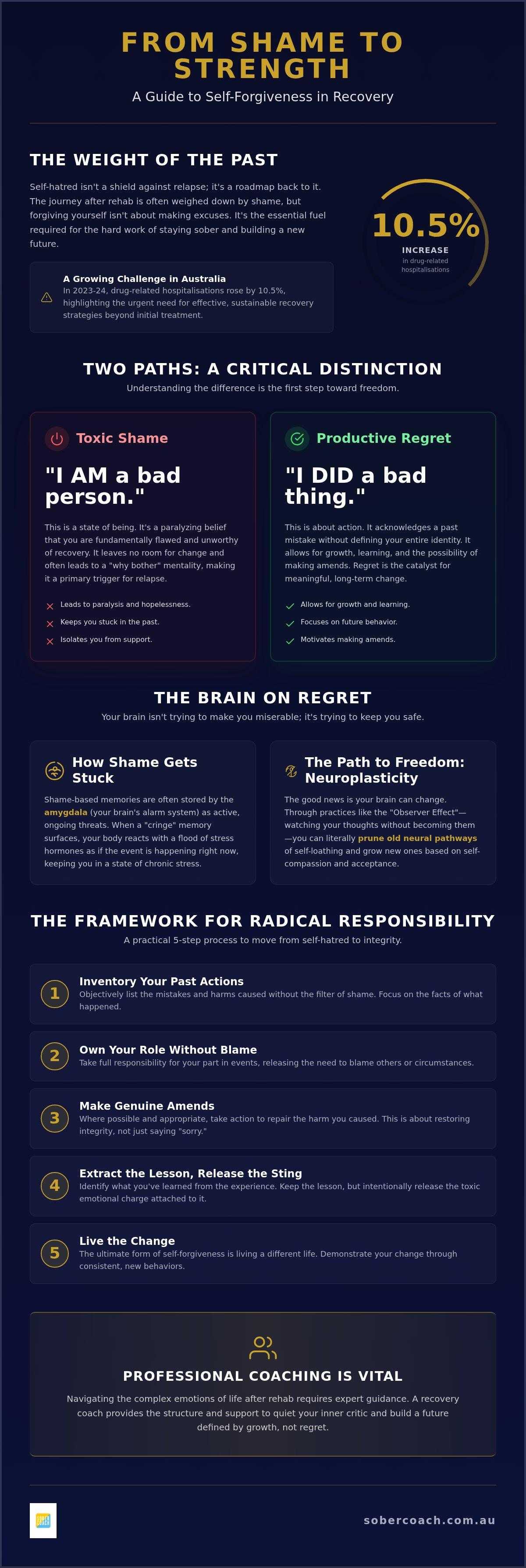
5 Practical Steps to Forgive Yourself and Move Forward
Forgiveness isn't a feeling that eventually washes over you; it's a series of intentional actions. Moving through life after rehab australia requires a strategy to dismantle the shame that keeps you stuck. You have already done the hard work of getting sober. Now, you must do the brave work of letting yourself live. These steps are designed to move you from paralyzing guilt to productive accountability.
Step 1: Inventory the Mistake. Get the guilt out of the dark and onto paper. Write down exactly what happened without the "why" or the excuses. Seeing it in black and white stops the brain from inflating the event into something insurmountable.
Step 2: Acknowledge the Impact. Own the harm you caused without gaslighting yourself or others. This isn't about self-flagellation; it's about radical honesty. Acknowledging the weight of your actions is the only way to eventually set them down.
Step 3: Perform a Ritual of Release. Use a non-clinical signal to mark the end of your self-punishment. Burn the inventory from step one or commit to a specific physical challenge. This acts as a symbolic boundary between your past and your future.
Step 4: Create a Future-Self Contract. Outline exactly what you will do differently starting today. This contract turns your regret into a blueprint for consistency and growth.
Step 5: Seek External Perspective. It’s hard to see your own worth when you’re standing in the wreckage. A professional coach provides the non-judgmental mirror required to see your progress clearly.
The "Empty Chair" Technique for Self-Compassion
We are often harsher to ourselves than any external judge would ever be. Try the empty chair technique: imagine your past self sitting across from you. If a friend told you they had done exactly what you did and were now working hard to change, would you tell them they are unforgivable? Probably not. You’d offer them grace. This exercise helps you extend that same kindness to yourself. Learning to speak to your past self with compassion is a vital part of how to rebuild trust with family during recovery.
Building a Forgiveness Toolkit
You need tools to handle "shame spikes," those unexpected memories that can lead to a relapse. A solid toolkit includes daily affirmations that focus on growth rather than fake positivity. Instead of saying "I am perfect," try "I am a person who learns from my mistakes." Our group coaching via Zoom provides a space for shared vulnerability, which is the fastest way to break the isolation of shame. If you're ready to process these emotions in a safe, peer-led environment, consider joining one of our Intensive Recovery Workshops.
The Role of Professional Recovery Coaching in Self-Forgiveness
Shame thrives in silence and isolation. When you are trying to navigate life after rehab australia, your own mind can become a dangerous neighbourhood to walk through alone. Forgiving yourself for the past is nearly impossible if you don't have a safe space to vent those "cringe" memories without fear of judgment. A Sober Coach provides that essential, non-judgmental mirror. They see the progress you're making even when you are blinded by your own history. This external perspective is what allows you to finally put down the heavy weight of regret and start looking at what is actually possible today.
We focus on the transition from "Recovery" to "Discovery." Traditional models often view recovery as simply returning to a "normal" state, but we believe your past struggles can serve as a foundation for a higher purpose. Your history isn't a stain; it’s a tool. By processing your journey through our Intensive Recovery Workshops, you can fast-track the breakthrough of emotional blocks that might have kept you stuck for years. This is about finding a vibrant, forward-facing life that isn't defined by what you lost, but by what you are currently building. Life after rehab australia shouldn't be about just "getting by"; it should be about thriving.
Why Lived Experience Matters for This Journey
There is a profound, transformative power in hearing the words, "I have been there, and I have forgiven myself too." It changes the entire energy of the conversation. When you are Navigating Early Sobriety Challenges in Sydney or any other Australian city, the stigma of addiction can feel like an invisible wall. Courageous, transparent mentoring breaks that wall down. We move away from clinical labels and focus on human-to-human connection. This shared history builds immediate trust and credibility, allowing you to explore your habits without the weight of traditional shame.
Your Next Steps: From Regret to Liberation
You don't have to carry the burden of your past into the future. Whether you choose a one-on-one session or join an upcoming group workshop, the goal remains the same: a life that is vibrant, liberated, and entirely your own. We promise a path that focuses on your personal agency rather than your powerlessness. If you're ready to stop looking backward and start building a future you actually want to live in, it's time to take that first step. Book a Discovery Call with Sober Coach today and let’s start the work of moving you from regret to true liberation.
Your Future is Bigger Than Your Past
Self-forgiveness is not an escape from your past; it is the engine that drives your future. You now have the tools to distinguish between productive regret and the toxic shame that often triggers relapse. By understanding the neurobiology of your regret and applying practical steps for release, you can finally quiet the inner critic that has held you back for too long. Forgiveness is the essential fuel you need to sustain the hard work of accountability and genuine change.
Building a successful life after rehab australia requires more than just staying dry. It requires a fundamental shift from recovery to discovery. We offer a unique blend of lived experience and professional expertise to help you navigate this transition without the weight of traditional stigma. Our Australian-based support is flexible, offering both online workshops and in-home recovery support tailored to your specific lifestyle and goals. You don't have to carry the wreckage of yesterday into the promise of tomorrow.
Ready to leave the shame behind? Explore our One-on-One Recovery Coaching
You have done the hard work of surviving the darkest chapters of your story. Now, it is time to give yourself permission to thrive in the new ones you are writing today.
Frequently Asked Questions
Is it really possible to forgive yourself for something truly terrible?
Yes, it is possible because forgiveness is a choice to release yourself from the past, not a justification of the act. Even for severe mistakes, self-forgiveness is the only way to ensure you don't repeat the cycle. It allows you to become the person who never does that thing again. You are choosing to be defined by your growth rather than your lowest moment.
Does self-forgiveness mean I am letting myself off the hook for my past?
No, self-forgiveness is actually the highest form of accountability. When you stop hating yourself, you gain the emotional energy needed to make genuine amends. Shame makes you hide and stay stuck; forgiveness makes you show up and take responsibility for your actions in a way that actually helps those you've impacted. It's about moving from useless guilt to productive action.
How long does it take to stop feeling guilty about my life during addiction?
There is no set timeline, but the intensity of guilt usually fades as your consistent "living amends" grow. As you build a track record of integrity in your life after rehab australia, your brain starts to trust your new self. It's a gradual process of replacing old memories with new, positive actions. Most people find that the "shame spikes" become less frequent as their new identity takes root.
What if the person I hurt refuses to forgive me even after I’ve changed?
You must accept that their forgiveness is outside your control. Your job is to be forgivable, not to demand forgiveness. If they choose not to reconcile, you continue your journey of "living amends" by being a better person for the world at large. You honor the harm you caused by ensuring you never cause it again, regardless of whether that specific relationship is restored.
Can a recovery coach help with shame even if I am not an alcoholic?
Yes, because shame is a universal human experience that isn't tied to a specific substance. Whether your struggle involves alcohol, other drugs, or behavioral habits, the mechanics of self-loathing are the same. Coaching focuses on your personal agency and building a vibrant future, regardless of the specific label of your past. We work on the habits and mindsets that keep you feeling stuck or unworthy.
Why do I keep remembering my past mistakes right when I am starting to feel good?
This is often your brain's way of trying to "protect" you from the vulnerability of happiness. When things go well, the ego may bring up old shame to keep you in a familiar, "safe" state of misery. Recognizing this as a protective mechanism rather than a truth helps you move past these spikes. It's a sign that you're growing, not a sign that you're failing.
How is coaching different from therapy when dealing with guilt?
Therapy often looks backward to understand the "why" of your trauma or history. Coaching is goal-oriented and focuses on the "how" of your future. We work on practical tools and strategies to manage your mindset today so you can build a liberated life after rehab australia. It is a proactive, mentor-led approach that focuses on your strengths rather than your clinical diagnosis.
Can I use my NDIS plan for self-forgiveness and recovery coaching in 2026?
Yes, if you have a psychosocial disability and your NDIS plan includes funding for a recovery coach. As of 2026, NDIS requirements for psychosocial recovery coaches emphasize lived experience and supporting participants to take more control of their lives. You should check your specific plan goals to see how coaching fits into your capacity-building supports. This is a common way many Australians access peer-led support for long-term maintenance.
Comments