

High-Risk Sobriety Planning: Proactive Survival Guide

What if the high-pressure events on your calendar weren't something to dread, but a chance to prove how much you've grown? For many, the thought of a wedding or a stressful work dinner feels like walking into a minefield. You aren't alone if you feel that familiar knot of anxiety about social exclusion or the fear of white-knuckling your way through the night. Since relapse rates for substance use sit between 40% and 60%, effective planning for high-risk situations in sobriety is not a sign of weakness. It's the ultimate act of personal agency. This shift moves you from a defensive crouch into a proactive, empowered stance.
We understand that the pressure to fit in can feel overwhelming, especially when you're still finding your feet in a vibrant, liberated life. You deserve to feel confident rather than deprived. This guide will show you how to identify your specific triggers and build a robust, coaching-led strategy to navigate intense scenarios. You'll learn a repeatable framework that replaces uncertainty with genuine empowerment. We're moving past old models of deprivation and exploring how a structured survival guide can turn every high-pressure moment into a powerful beginning for your self-discovery.
Table of Contents
What Constitutes a High-Risk Situation in Recovery?
A high-risk situation is any environment, social setting, or emotional state that threatens to pull you back into old habits. It isn't always a dramatic crisis. Often, it's a subtle shift in your internal weather or a familiar social cue that triggers a craving. Risk is deeply subjective. What feels like a safe, relaxed afternoon for one person might be a minefield for another. Understanding this personal landscape is the first step in What is Relapse Prevention? and long-term success. High-risk planning is a proactive mental rehearsal for success that allows you to navigate life without feeling caught off guard.
We can split these risks into two buckets: internal and external. Internal risks are the storms happening inside your mind and body, while external risks are the people, places, and events that make up your social world. Effective planning for high-risk situations in sobriety requires you to look at both with radical honesty. By identifying these triggers before they arrive, you reclaim your power and move from a state of reactive survival to one of empowered choice.
The 'HALT' Method and Internal Triggers
Internal triggers often start with your physiology. The HALT method is a classic tool because it highlights the four states where your defenses are lowest: Hungry, Angry, Lonely, or Tired. When you're physically or emotionally depleted, your brain can easily mistake a basic need for a desire to use. A rumbling stomach or a long day at the office can mimic the physical "itch" of a craving. To stay ahead of this, try a daily check-in. Ask yourself: "Am I actually wanting a drink, or do I just need a sandwich and a twenty-minute nap?" Addressing the physical need usually dissolves the emotional urge.
Social and Environmental External Risks
In Australia, social life often revolves around "pressure cooker" environments. Friday night drinks at the local, high-stakes weddings, or even a Saturday afternoon at the footy can feel like gauntlets. These are the "places and things" that have been anchored to your old lifestyle for years. They carry a heavy weight of expectation and history.
Relationships can also be high-risk. This doesn't mean your friends are toxic. It just means that certain people are so intertwined with your old habits that being around them triggers a subconscious response. You might find that a sibling or a long-term colleague creates a sense of peer pressure without ever saying a word. Recognizing these external cues allows you to build a strategy that prioritizes your peace over social expectations, ensuring you stay connected to your goals even when the environment is loud.
The Psychology of Proactive Planning vs. Reactive Survival
White-knuckling is the hallmark of reactive survival. It's that gritted-teeth approach where you simply hope your willpower lasts longer than the event. This method is notoriously unreliable because it relies on the limbic system, the part of your brain driven by immediate reward and emotional impulse. When a craving hits, the limbic system is in the driver's seat. In contrast, planning for high-risk situations in sobriety engages the prefrontal cortex. This is the brain's executive center, responsible for logic, long-term goals, and impulse control. By creating a sober strategy before you arrive, you've already made the hard decisions. You aren't fighting your brain. You're leading it.
Every choice we make drains our mental battery. In high-stress social settings, decision fatigue sets in quickly. If you have to decide every five minutes whether to stay or leave, or what to say when someone offers you a drink, you'll eventually run out of steam. A proactive plan eliminates these micro-decisions. You already know your exit strategy and your non-alcoholic drink order. This preserves your energy for actually enjoying the connection. For those moments when a craving does bubble up, 'Urge Surfing' is an essential mid-situation tool. Instead of fighting the urge, you acknowledge it as a temporary wave. You breathe through it, observing the physical sensations without acting on them, knowing that every wave eventually breaks and recedes.
Building the Sober Toolkit Before You Need It
Waiting until you're already triggered to decide on a course of action is too late. Your brain is already in survival mode. Mental rehearsal desensitizes the fear of social settings by allowing you to visualize success in advance. This is where professional accountability becomes a game-changer. Engaging in One-on-One Recovery Coaching provides you with a partner who has walked this path and can help you spot the blind spots in your strategy. Building these practical tools for real-world sobriety ensures you have a response ready for any scenario.
The Role of Personal Agency
We reject the idea of powerlessness. True transformation comes from shifting the narrative from 'I can't' to 'I choose.' Planning for high-risk situations in sobriety reinforces your new identity as someone who values their health and vibrancy. You aren't being deprived of a drink; you are actively choosing a life of clarity and connection. This strategic action turns a potential threat into an opportunity to confirm your commitment to yourself. By taking ownership of your environment, you move away from the restrictive labels of traditional models and into a space of personal agency.
The 'Plan A vs. Plan B' Framework for Social Events
Walking into a high-pressure social event without a map is a recipe for anxiety. We use a two-tier system to replace that dread with confidence. This framework acknowledges that while we want to thrive, we also need a safety net. Having a solid Plan B actually makes your Plan A more successful because it removes the fear of being trapped. When you know exactly how to leave, you can relax and focus on the people around you. This is the core of effective planning for high-risk situations in sobriety. It's about being prepared for the best while having a bulletproof backup.
Plan A is your engagement strategy, focusing on how you'll enjoy the night. Plan B is your protection protocol, designed to get you out safely if the environment becomes too much. By separating these two, you stop 'white-knuckling' and start navigating. You aren't just surviving the night; you're mastering it. This dual approach ensures that your recovery remains the priority, no matter how loud the music or how heavy the peer pressure becomes.
Designing Your Plan A: The Engagement Strategy
Plan A is your ideal scenario. It's how you intend to connect with others while staying true to your values. Start by choosing your non-alcoholic drink before you even walk through the door. Beating the "what can I get you?" trap is vital. If you already have a soda water with lime in your hand, the pressure to accept something else drops significantly. You've already made the decision, which saves your mental energy for conversation.
Set a strict time limit. Decide to stay for ninety minutes, then reassess. It's easier to be social when you know there's a finish line.
Identify a 'sober buddy' or an ally at the event. This is someone who knows your goals and can provide a quick reality check if things get intense.
Focus on the food or the specific reason for the gathering rather than the bar. Reframe the event as a chance for genuine connection.
Executing Plan B: The Exit Strategy
Plan B is the emergency exit you hope you don't need but are glad to have. The most critical element is the 'Sober Escape.' Never rely on someone else for a ride. Whether it's your own car or a pre-booked ride-share, having total control over your transport is non-negotiable. If the vibe shifts or you feel your resolve wavering, you leave. You don't need permission to protect your peace.
Leaving doesn't have to be a grand statement. You can use a 'Graceful Exit' script. A simple "I've had a great time, but I'm heading off now" is usually all that's needed. You don't owe anyone a detailed explanation of your recovery journey. Once you're out, the work isn't quite over. An immediate post-event debriefing helps solidify what you've learned. Whether it's a quick call with a Sober Coach or a message to your support group, talking through the experience ensures you're ready for the next one. This proactive approach to planning for high-risk situations in sobriety transforms a potentially scary night out into a clear win for your personal growth.
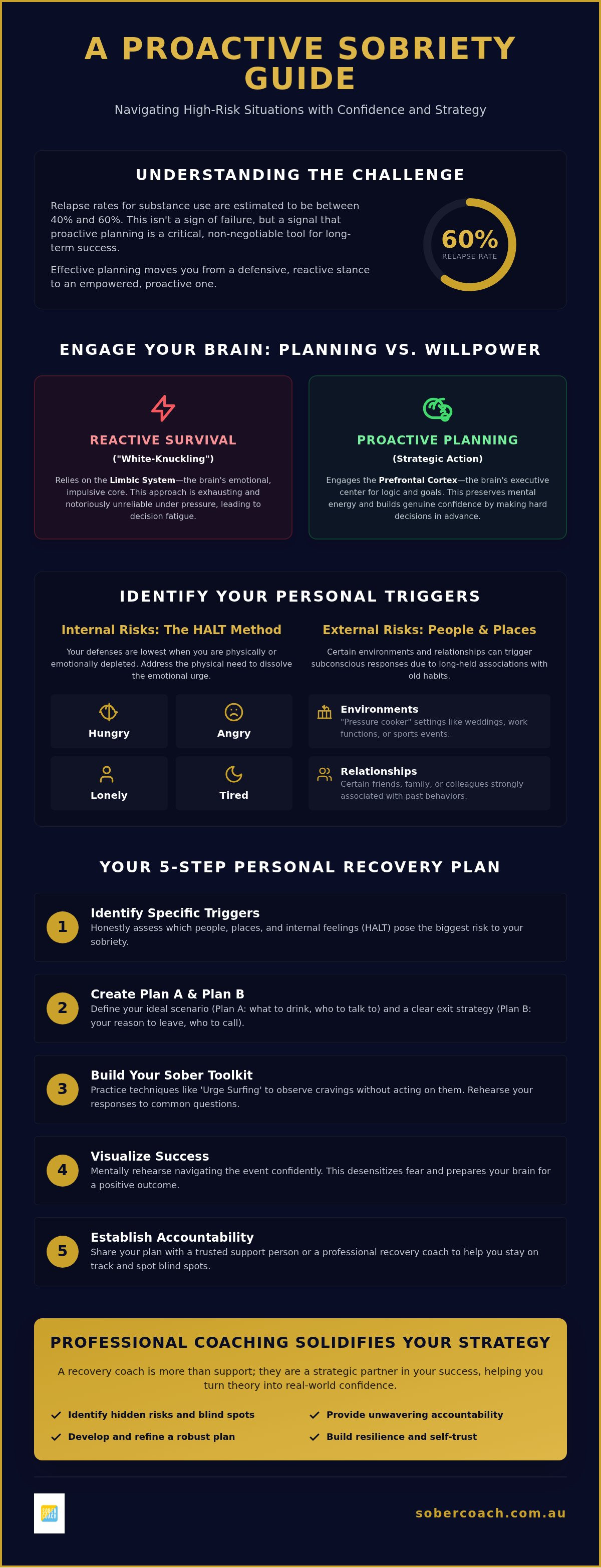
Step-by-Step: Creating Your Personal Recovery Plan (PRP)
A Personal Recovery Plan (PRP) isn't a complex medical document. It's a practical, living tool that simplifies your decision-making. Effective planning for high-risk situations in sobriety relies on repeatability. When the process is easy to follow, you're more likely to use it. Don't keep this plan in your head. Write it down. Whether you use a notes app on your phone or a physical journal, the act of writing solidifies your commitment. Research into goal achievement suggests that individuals who write down their plans can increase their success rates by as much as 42%. This simple habit transforms a vague intention into a concrete roadmap for your vibrant, liberated life.
Step 1 & 2: Identify and Assess
Look at your calendar for the next seven days. List every specific trigger you expect to encounter. It could be a stressful deadline, a family dinner, or even a specific route home that passes a favorite pub. Once you have your list, rate each situation on a scale of 1 to 10 for 'Relapse Risk.' A 1 is a walk in the park; a 10 is a high-pressure environment where your cravings are usually loudest. Finally, identify your early warning signs. These are the subtle thoughts or physical feelings, like a tight chest or a sudden "I deserve this" narrative, that show up before a craving fully takes hold. Recognizing these signals early gives you the lead time needed to act.
Step 3, 4 & 5: Action, Support, and Review
Now, look at every risk you rated as a level 5 or higher. Assign one specific 'Plan B' action to each. If the risk is a work event, your Plan B might be "Leave at 7:00 PM regardless of who is still there." Next, contact your support network before the event occurs. Send a quick text to your mentor or friend to announce your intentions. This creates a layer of external accountability that makes it harder to talk yourself out of your plan when you're in the heat of the moment. We often find that this transparency is the bridge between a plan and a successful outcome.
After the event, schedule a brief 'Review' session. This isn't about judgment; it's about data. Ask yourself what worked and what didn't. Did your early warning signs show up as expected? Was your Plan B easy to execute? This feedback loop is what builds long-term habit formation and confidence. If you want to refine these skills with a professional who has lived experience, consider our Intensive Recovery Workshops to build your toolkit in a supportive, focused environment. This proactive approach to planning for high-risk situations in sobriety ensures that every challenge becomes a lesson rather than a setback.
How Professional Coaching Solidifies Your High-Risk Strategy
A recovery coach occupies a unique space in your support system. While friends offer love and sponsors provide a structured path through a specific program, a coach acts as a strategic partner. We focus on the practical, real-world application of your goals. Planning for high-risk situations in sobriety is significantly more effective when you have an outside perspective to act as a no-nonsense mirror. A coach doesn't just listen; they challenge your assumptions and help you spot the subtle triggers that your brain might be trying to minimize or ignore. This professional relationship is built on lived experience, providing an authentic connection that bridges the gap between theoretical knowledge and daily life.
Lived experience isn't just a badge of honor. It's a predictive tool. Mentors who have navigated these same social and emotional minefields can anticipate risks you might miss. They know the "slow burn" of a stressful week and the specific pressure of an Australian social calendar. By stress-testing your strategy with a coach, you move from a state of avoidance to one of mastery. You stop hiding from high-pressure environments and start navigating them with total confidence. Our Intensive Recovery Workshops provide a safe, focused environment to practice these skills deeply, ensuring your toolkit is sharp before you ever step into a challenging situation.
Accountability Beyond the Twelve Steps
Coaching is inherently future-focused and goal-oriented. We aren't here to dwell on the past, but to build a vibrant, liberated life that you actually enjoy living. One-on-one sessions provide the accountability needed to execute your Personal Recovery Plan without the weight of traditional stigma. This isn't about powerlessness; it's about personal agency and strategic action. We help you integrate these tools into a sustainable lifestyle that feels like a positive choice rather than a series of restrictions. This shift in perspective is what transforms sobriety from a daily struggle into a powerful beginning.
Taking the Next Step in Your Recovery
It's time to stop winging it and start strategizing. Relying on luck or willpower is a gamble you don't have to take. Whether you are looking for in-home support in Sydney or prefer the accessibility of Online Rehab and Group Coaching via Zoom, professional support is available across Australia. You deserve a recovery that feels empowered and proactive. Book a discovery session to build your personalized high-risk plan today.
Own Your Future with Strategic Sobriety
Sobriety is not about staying home or living a smaller life. It's about expanding your world with the confidence that you can handle anything that comes your way. By mastering the Plan A vs. Plan B framework and committing to a written Personal Recovery Plan, you move from the exhaustion of white-knuckling to the freedom of true personal agency. This proactive approach to planning for high-risk situations in sobriety ensures that your growth is never left to chance. You've learned that your prefrontal cortex is a stronger ally than willpower alone, and that every social event is an opportunity for self-discovery.
You don't have to navigate this transition in isolation. Whether you need the flexibility of Zoom sessions across Australia or in-home support in Sydney, professional guidance with lived experience makes all the difference. We focus on practical, real-world tools that bridge the gap between treatment and your daily reality. Ready to build your bulletproof recovery plan? Work one-on-one with a Sober Coach today. Your new beginning starts with a single, strategic choice. You have the power to thrive.
Frequently Asked Questions
What is the most common high-risk situation for people in early sobriety?
Social events involving "people, places, and things" from your past are the most frequent challenges. In Australia, this often looks like the "Friday night drinks" culture or celebratory milestones. However, internal emotional states like extreme stress or isolation are equally dangerous. Recognizing that these moments are high-risk allows you to prepare your defenses before the pressure mounts, turning a potential relapse trigger into a manageable social obligation.
How do I handle peer pressure at a work event without revealing I'm in recovery?
You don't owe anyone your medical history. A simple, confident "I'm not drinking tonight" is usually enough. If people push, having a "script" ready helps. You might say you're on a fitness challenge, have an early morning, or are simply the designated driver. Holding a non-alcoholic drink like soda water with lime often stops the questions before they start, as people rarely check what is actually in your glass.
Is it better to avoid high-risk situations entirely in the first year?
Total avoidance isn't always practical or necessary. While the first few months might require a "sober bubble" to stabilize your habits, the goal of coaching is to move toward mastery. Instead of hiding, focus on planning for high-risk situations in sobriety. This allows you to re-enter your social life with a robust strategy. If an event feels like a level 10 risk, it's okay to skip it, but most situations are manageable with the right tools.
What should I do if I find myself in a high-risk situation without a plan?
Your priority is your peace, so the best move is often to leave immediately. If you are stuck, step outside for five minutes to reset your nervous system. Call a mentor, a coach, or a trusted friend to "tell on the urge." This breaks the isolation that cravings thrive on. Remember that you always have the agency to walk away, regardless of social expectations or who might be watching.
How can a sober coach help me with travel or holidays?
Travel often triggers "vacation brain," where the lack of routine makes old habits look tempting. A sober coach provides specific pre-trip strategy sessions to map out potential triggers at airports, hotels, or family gatherings. Through Zoom sessions or group coaching, we offer accountability while you're away. This ensures you have a professional ally to check in with, helping you maintain your vibrant, liberated life even when you're far from your usual support systems.
What are the early warning signs that I'm heading toward a high-risk emotional state?
Look for subtle shifts in your daily patterns. Irritability, neglecting your self-care routines, or a sudden "fading affect bias" where you only remember the "good times" of using are major red flags. You might also notice physical tension or a desire to isolate from your support network. Catching these warning signs early allows you to adjust your Personal Recovery Plan before an emotional state escalates into a high-pressure craving.
Can I still attend weddings or parties if I'm worried about triggers?
Yes, you can attend, but it requires planning for high-risk situations in sobriety to remain safe. Weddings are often "pressure cookers" due to the long hours and heavy alcohol focus. Using the Plan A vs. Plan B framework ensures you have an ally and your own transport ready. This proactive stance transforms the event from something to survive into an opportunity to experience genuine connection without the haze of old habits.
How do I explain my 'exit strategy' to my partner or friends?
Honesty is usually the most empowering path. Tell them, "I'm really looking forward to this, but I'm going to head off early if I start feeling tired or overwhelmed." True friends will support your boundaries without requiring a deep explanation. By communicating your plan in advance, you remove the "awkwardness" of a sudden departure. This reinforces your personal agency and ensures your support network knows how to help you stay successful.
Comments