

Building Self-Esteem in Recovery: Reclaim Your Worth

What if the biggest threat to your sobriety isn't the substance itself, but the way you feel when you're alone with your thoughts? You've likely spent years being your own harshest critic, replaying past mistakes while the shame spiral pulls you back toward old habits. It is exhausting to feel defined by your worst days, especially when social anxiety makes sober environments feel like a minefield. Building self-esteem in recovery isn't about suddenly loving everything you see in the mirror. It is about proving to yourself, through small and consistent actions, that you are someone worth showing up for. Since over 73% of adults who faced substance challenges now identify as being in recovery, you are joining a massive community of people who have walked this exact path to self-discovery.
We understand that feeling of powerlessness because we have been there too. You deserve a life that feels vibrant and liberated, not one defined by the restrictive labels of the past. In this guide, you will discover how to dismantle the shame-relapse cycle and build a foundation of lasting self-worth through actionable, peer-led strategies. We will look at how to silence your internal critic, set firm boundaries with confidence, and finally forge an identity that exists far beyond the word addict. This is not just about staying clean; it is about reclaiming your power and starting a courageous new chapter.
Table of Contents
Why Building Self-Esteem is the Engine of Long-Term Recovery
Self-esteem isn't a luxury in the recovery process; it is the fundamental fuel for change. If you don't believe you're capable of staying sober, or if you feel you don't deserve a better life, the weight of the journey can become unbearable. What is self-esteem? In a psychological sense, it's our overall subjective emotional evaluation of our own worth. In the context of building self-esteem in recovery, it translates directly to your belief in your capacity to stay sober and thrive. Without this foundation, you're essentially trying to build a house on shifting sand.
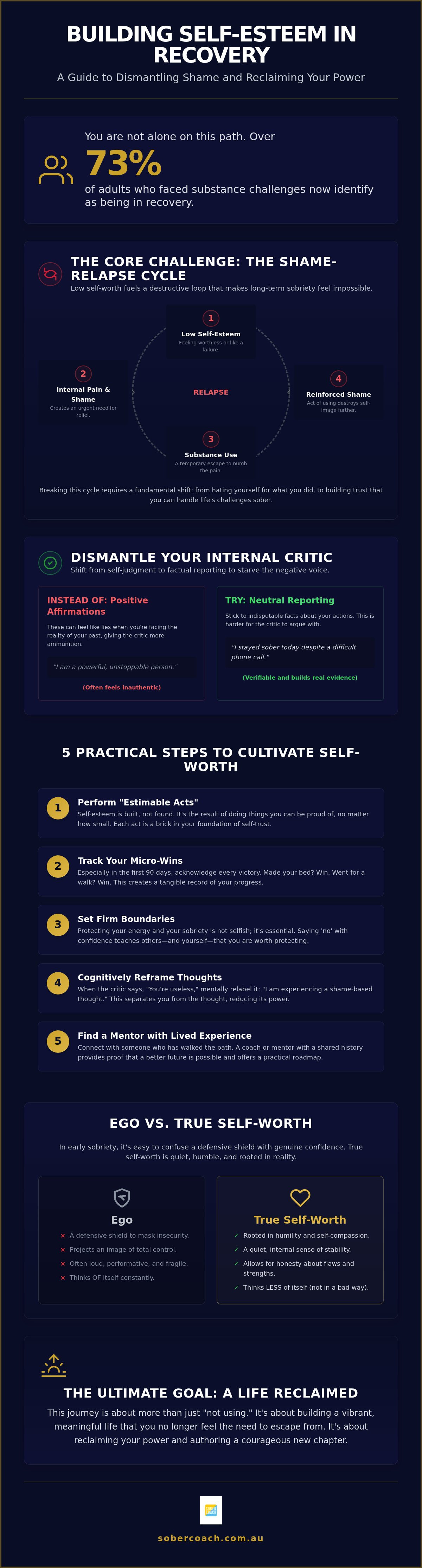
This lack of worth often feeds the "Shame-Relapse Cycle." When self-esteem is low, every minor setback feels like a confirmation that you're a failure. This internal pain creates an urgent need for relief, which often leads back to substance use. It's a brutal loop: you feel worthless, you use to numb that worthlessness, and the act of using further destroys your self-image. Breaking this cycle is the most difficult part of building self-esteem in recovery, as it requires a shift from "Sober Shame," which is hating yourself for what you did, to "Sober Efficacy." Efficacy is the growing trust that you can handle life's challenges without a crutch. It's vital to remember that self-esteem isn't something you find. It is something you build through consistent, agency-driven actions.
The Difference Between Ego and True Self-Worth
In early sobriety, many people mistake ego for confidence. You might find yourself "acting big" or projecting an image of total control to mask deep-seated insecurities. This is a defensive shield, not true self-worth. Healthy self-worth is rooted in humility and a realistic, compassionate view of your own strengths and flaws. It doesn't require you to be the loudest person in the room. Instead, it's a quiet internal steadying that allows you to be honest about where you are and where you want to go. Humility isn't about thinking less of yourself; it's about thinking of yourself less often so you can actually show up for your life.
How Addiction Erodes Your Internal Trust
Years of addiction often leave a trail of broken promises, primarily to yourself. Every time you intended to stop but couldn't, your brain recorded that as a failure of character. This erosion of trust is often exacerbated by the neuroplasticity of the brain during active use, where "brain fog" can make it difficult to see your own value clearly. It's vital to recognize that low self-worth is a symptom of the neurological and emotional toll of addiction, not a reflection of your true identity. Rebuilding that trust takes time, but it starts the moment you decide to stop lying to yourself and begin making micro-wins a priority.
Dismantling the Internal Critic: A Direct Approach to Shame
The loudest voice in early recovery usually isn't the craving for a substance. It is the Internal Critic. This is the persistent, grating inner monologue that tells you you're a fraud regardless of your clean time. It weaponizes your history against your future. While traditional clinical approaches might suggest positive affirmations, we've found that "neutral reporting" is far more effective for building self-esteem in recovery. Positive thinking often feels like a lie when you're staring down the wreckage of your past. Neutral reporting, however, sticks to the facts. Instead of telling yourself "I am a powerful person," you state "I stayed sober today despite a difficult phone call." Facts are harder for the critic to argue with.
This no-nonsense approach to self-confrontation is a cornerstone of our one-on-one recovery coaching. We don't ignore the past, but we refuse to let it dictate your identity. You have to treat self-forgiveness as a tactical necessity rather than a moral luxury. Carrying heavy shame is like trying to run a marathon with a backpack full of stones. Eventually, you will tire out, and that exhaustion is exactly what leads back to use. Since relapse rates for substance use disorders sit between 40% and 60%, maintaining your emotional energy is a matter of survival.
Cognitive Reframing for the Recovery Mindset
To change how you feel, you must change how you label your experiences. Start by identifying negative thoughts as symptoms of the causes of low self-esteem rather than absolute truths. When the critic says "you're useless," mentally relabel that as "I am experiencing a shame-based thought." This creates a crucial gap between the thought and your identity. Shift your language from "I am an addict" to "I am a person navigating recovery." Finally, use "The Friend Test." If you wouldn't say it to a friend who is five years sober, you have no business saying it to yourself. This isn't about being soft; it's about being accurate.
Processing Past Guilt Without Spiraling
There is a massive difference between guilt and shame. Guilt says "I did something bad," which allows for change. Shame says "I am bad," which leaves no room for growth. To move forward, focus on "Living Amends." This means your current behavior is the primary way you make up for the past. It's about being reliable today. Self-forgiveness is the release of hope for a better past. By letting go of the version of history you wish happened, you gain the agency to architect a future you actually want to inhabit. This process is the real work of building self-esteem in recovery.
5 Practical Steps to Cultivate Self-Worth Through Action
You cannot think your way into a new way of acting; you must act your way into a new way of thinking. This is the core philosophy behind building self-esteem in recovery. While understanding the "why" of your emotions is helpful, it is the "what" of your daily behavior that actually moves the needle. We focus on the concept of "Estimable Acts." It is a simple, direct truth: you gain self-esteem by doing things that are worthy of esteem. In the critical first 90 days of sobriety, your brain is still recalibrating its reward systems. You can't rely on feeling good to motivate your choices. Instead, you rely on a track record of agency. Consistent routines act as a trust bridge, slowly repairing the fractured relationship you have with yourself. Accountability isn't a form of punishment. It is the visible evidence that you are now a person who keeps their word.
Step 1: Commit to Radical Honesty
Honesty is the foundation of a liberated life. Even small, seemingly harmless lies create a mental friction that quietly erodes your self-worth. When you lie, you're subconsciously telling yourself that the reality of who you are isn't good enough to be seen. Practicing radical honesty in daily interactions creates a sense of psychological weightlessness. You no longer have to manage multiple versions of the truth or worry about being "found out." By simply stating the facts, even when they're uncomfortable, you reinforce the idea that you are worthy of existing exactly as you are.
Step 2: Master the Art of Small Wins
Your internal reward system has likely been conditioned to expect high-intensity spikes. To heal, you need to set goals that are literally "too small to fail." This isn't about being lazy; it's about rebuilding your dopaminergic pathways through consistent success. When you achieve a goal, no matter how minor, your brain registers a win. Over time, these wins accumulate into a new self-image.
Make your bed: Do this every morning to start the day with a completed task.
Show up early: Arrive five minutes before your commitments to prove you are reliable.
10 minutes of reflection: Spend a short window each day journaling or sitting in quiet thought.
Tracking these micro-wins provides visual evidence of your growth. When you look at a list of completed tasks at the end of the week, it becomes much harder for your internal critic to claim you're going nowhere. This tangible proof is essential for overwriting years of self-doubt.
Step 3: Service and Prosocial Behavior
Getting out of your own head is often the fastest way to feel better. We frequently get trapped in loops of self-analysis that lead to paralysis and shame. Service shifts the focus off your perceived inadequacies and onto the needs of others. This "Helper's High" is a physiological shift that reinforces your value as a member of a community. Whether you are volunteering at a local center or simply being truly present for a peer during a difficult moment, you are proving that you have something valuable to offer. This outward focus is a primary tool for building self-esteem in recovery because it provides immediate, external proof of your worth.
Why Lived-Experience Coaching is the Missing Link
Clinical therapy is an essential tool for processing trauma and understanding the roots of your behavior. However, there is often a gap between "understanding why" and "knowing how" to live a vibrant life today. This is where lived-experience coaching becomes the missing link. While therapy focuses on healing the past, coaching is about architecting the future. For building self-esteem in recovery, you need more than just insight; you need a proactive partner who helps you design a daily existence that reflects your new values. Coaching moves the needle from passive observation to active transformation.
The "Shared History" advantage is the cornerstone of this approach. There is an immediate sense of safety that comes from hearing "I've been there" from a professional mentor. It strips away the clinical hierarchy and replaces it with a human-to-human connection built on mutual respect. This direct reflection allows you to see your own progress through the eyes of someone who understands the weight of the struggle. For Australians navigating the system, this support can often be integrated into an NDIS psychosocial recovery plan, ensuring that practical, peer-led guidance is a core part of your long-term maintenance strategy.
Coaching vs. Traditional Support Models
Traditional models often position you as a "patient" in need of fixing. Coaching rejects this label. In our methodology, you are a "client" or a "partner" in growth. This shift in identity is a powerful first step in building self-esteem in recovery. Instead of waiting for a weekly session to report on your feelings, coaching provides real-time accountability and goal-oriented strategies. It is about building a track record of agency. You aren't just surviving; you are actively deciding who you want to be and taking the steps to get there. If you're ready to move beyond traditional models, explore our one-on-one recovery coaching to start architecting your new life.
The Power of Intensive Workshops
Breakthroughs in self-perception often require an immersive environment. Our Intensive Recovery Workshops provide a dedicated space to dismantle old habits and install new, empowering beliefs. In these settings, you aren't just a person "not using." You are part of a community of people who are "building a new life." This collective energy accelerates the process of reclaiming your worth. You can expect a direct, no-nonsense environment that challenges your current perceptions while offering the practical tools needed to sustain confidence long after the workshop ends. It is a catalyst for the self-esteem breakthroughs that make long-term recovery possible.
Sustaining Confidence: Moving from Sobriety to a Vibrant Life
Sobriety is not the finish line. It is the baseline. If you spend your entire life focused solely on "not using," you are living in a state of perceived deprivation. True liberation comes when you shift your focus toward creating a life that you no longer feel the need to escape. This is the final, most rewarding stage of building self-esteem in recovery. It is where you move from surviving to architecting a future that excites you. Recovery is a powerful beginning, a blank canvas where you can finally paint a version of yourself that is untethered from old labels. You are no longer just a person in a program; you are a recovered leader of your own life.
Sustaining this new confidence requires more than just willpower. It requires the active cultivation of hobbies, career goals, and healthy relationships that reinforce your worth. These aren't just distractions; they are the pillars of your new identity. When you pursue a promotion or master a new skill, you are providing your brain with evidence that you are capable and valuable. This track record of agency is what makes your confidence resilient. It's about moving beyond the "addict" identity and stepping into the role of a person who contributes, creates, and thrives in the real world.
Setting Boundaries as an Act of Self-Love
Saying "no" is one of the most effective tools for building self-esteem in recovery. In a high-pressure environment like Sydney's social scene, the ability to walk away from toxic environments or people is a massive power move. Setting a boundary isn't an act of aggression; it is an act of self-preservation. It is you telling the world that your peace of mind is not up for negotiation. Every time you choose your well-being over social pressure, your self-worth grows. This personal agency is the ultimate safeguard for your long-term sobriety, ensuring that your environment supports your growth rather than hindering it.
Your Next Steps with Sober Coach
Identity reconstruction is a journey that doesn't have to be walked alone. Whether you are looking for one-on-one recovery coaching to map out your future or need the intensive focus of our workshops, we are here to bridge the gap between rehab and real-world confidence. We offer flexible support across Australia, including in-home recovery support and online sessions via Zoom. This is your moment to move beyond the shadows of the past. You are not defined by the mistakes you've made; you are defined by the person you are choosing to become today. Reach out to start your identity reconstruction and claim the vibrant life you deserve.
Step Into Your Vibrant Life
Reclaiming your worth is not a passive event. It is a series of courageous choices. We have explored how building self-esteem in recovery is rooted in "estimable acts" and the daily commitment to silence that internal critic. By shifting from a "patient" mindset to becoming the architect of your own future, you move beyond the cycle of shame and into a life of genuine agency. You don't have to navigate this transition alone or feel restricted by medicalized labels that no longer fit your experience.
Our professional coaches possess the lived experience needed to provide immediate trust and direct, non-judgmental guidance. We offer flexible rehab online and in-home support across Australia to bridge the gap between traditional treatment and real-world confidence. It is time to stop escaping and start living. Book a One-on-One Discovery Session with Sober Coach today to begin your identity reconstruction. Your past is a history lesson, not a life sentence. The person you are becoming is worth every bit of the effort.
Frequently Asked Questions
Can self-esteem really be rebuilt after years of addiction?
Yes, self-esteem is absolutely rebuildable because your brain is capable of forming new neural pathways through consistent action. Recovery is a process of identity reconstruction where you stop being defined by your past and start being defined by your current choices. By focusing on building self-esteem in recovery through small, honest actions, you slowly replace the old shame narrative with a track record of reliability and self-trust.
What are 'estimable acts' and how do they help my recovery?
Estimable acts are simply actions that are worthy of esteem or respect. You don't get self-esteem by thinking your way into it; you earn it by doing things like keeping your word, showing up on time, or helping a peer. These acts provide the concrete evidence your brain needs to believe that you are a person of value. This is far more effective than just reciting positive affirmations that don't feel true yet.
Is there a difference between a recovery coach and a therapist for building self-worth?
The primary difference lies in the focus: therapy often looks backward to process trauma, while a recovery coach looks forward to architecting your future. While therapists are vital for healing, a coach with lived experience provides a direct, no-nonsense partnership. This relationship focuses on real-time accountability and practical strategies for building self-esteem in recovery, moving you from a patient identity to an active partner in your own growth.
How long does it take to start feeling confident in sobriety?
Confidence usually begins to shift within the first 90 days as your brain's reward system starts to recalibrate and heal. It isn't a single event but a gradual accumulation of micro-wins. You might not feel confident in the traditional sense immediately, but you will begin to feel a sense of agency as you successfully navigate daily challenges without relying on old habits or avoidance.
Can I use my NDIS funding for recovery coaching in Sydney?
Yes, many Australians use NDIS funding to access psychosocial recovery coaching in Sydney and across the country. This support is specifically designed for individuals with primary psychosocial challenges. It's a practical way to fund peer-led support that bridges the gap between clinical rehab and a vibrant, independent life. You should check the 2026 NDIS guidelines to ensure your plan meets the specific requirements for a recovery coach.
What should I do when my 'internal critic' becomes overwhelming?
When the internal critic becomes loud, shift from self-judgment to neutral reporting. Instead of arguing with the voice, label the thought as a symptom of past habits rather than a present truth. State the facts of your day: "I woke up, I made my bed, and I am sober right now." This creates a psychological gap between you and the negative thoughts, reducing their power over your identity.
How do intensive recovery workshops help with self-esteem?
Intensive workshops provide an immersive environment that accelerates breakthroughs by removing you from your usual triggers and routines. These workshops offer a safe space to explore new behaviors and build a community with others who are also focused on reclaiming their worth. This collective energy helps dismantle old identities much faster than occasional sessions alone, providing a powerful catalyst for long-term confidence and personal growth.
Do I need to be 'fully recovered' before I can start building self-esteem?
No, you do not need to be fully recovered to start. In fact, building self-worth is the engine that drives long-term sobriety, not just a reward you receive at the end of the journey. If you wait until you feel perfect to start practicing self-respect, you will never begin. You start exactly where you are today, using small acts of agency to fuel your continued progress and transformation.
Comments